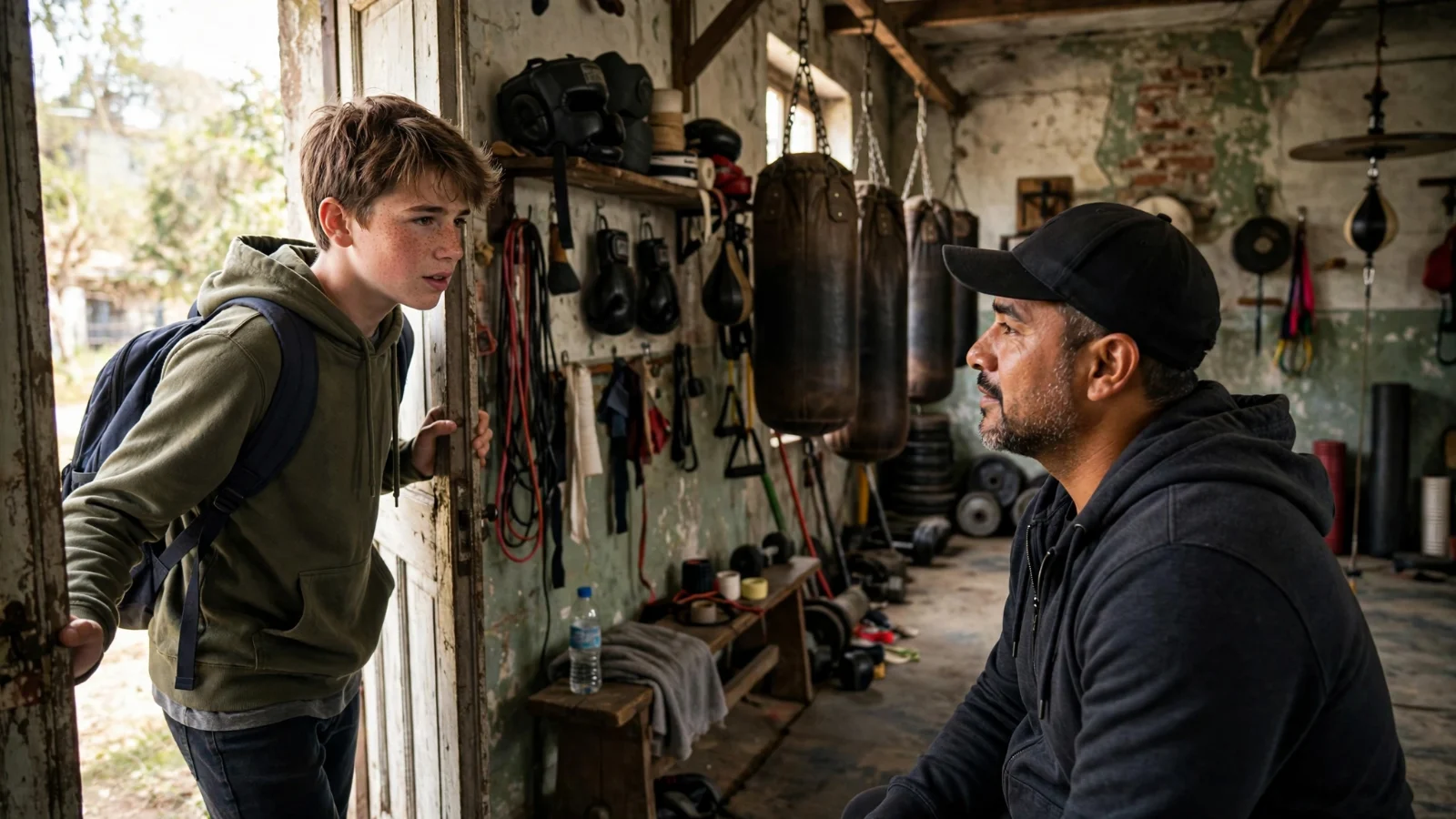
When I was a schoolboy, I got into more fights than I would recommend as a path to personal development.
I was not usually the one starting them. What pulled me in was something else: I felt obliged to defend kids who were weaker or being bullied.
That sounds noble in one sentence. In real life, it sometimes ended with bruises.
Once, it ended with a broken tooth.
That was enough to make me think differently. If I was going to keep stepping into difficult situations, perhaps it would help to know what I was doing.
So I approached a boxing coach and asked if I could join the team.
I did not know then that this small decision would change much more than my ability to throw a punch.
Confidence Did Not Arrive Before I Started
I did not walk into boxing because I was already confident.
I walked into boxing because I wanted to stop feeling helpless.
That distinction matters.
We often imagine confidence as something we should somehow manufacture before we do the difficult thing.
First I should feel confident, then I will speak up. First I should feel confident, then I will apply. First I should feel confident, then I will introduce myself. First I should feel confident, then I will try something I might fail at.
My experience has usually worked in the opposite order.
I do something uncertain. I survive it. I learn a little. I become more capable. Then confidence has something real to stand on.
Boxing Changed More Than Boxing
Training gave me physical confidence, but the effects did not stay inside the gym.
My friendships changed. I had more courage to approach girls and start conversations. I found it easier to make new friends. I no longer carried myself like someone who expected to be pushed around.
Nobody treated me like a wimp anymore.
But I did not become a bully.
I still liked hanging around with the smart kids who were sometimes the ones being picked on. I still sometimes felt I had to stand up for them.
I was never completely sure where I belonged.
Maybe that was useful too. I learned that confidence did not require joining the loudest group in the room. It gave me more freedom to choose my own place.
Competence Creates Evidence
One reason confidence is so difficult to think our way into is that the mind likes evidence.
Positive slogans can help for a few minutes. Evidence lasts longer.
Every time I trained, learned something difficult, handled pressure, or discovered that I was capable of more than I had assumed, I added another small piece of evidence.
I can learn. I can improve. I can enter an unfamiliar situation and figure things out. I can be nervous and still act.
That kind of confidence is less glamorous than motivational confidence. It is also more dependable.
Then the Confidence Started Traveling
The interesting thing was that the confidence I built in boxing began showing up in places that had nothing to do with boxing.
I started applying for jobs I was not even sure I was qualified for.
That does not mean I suddenly believed I could do anything. I simply became more willing to ask, try, explain what I could do, and let someone else decide whether the answer was yes or no.
Many opportunities disappear because we reject ourselves before anybody else gets the chance.
I Asked the Principal for Boxing Equipment
Later, when I was working in a school, I convinced the principal that we should have boxing bags and equipment.
Then I started a boxing team at the school.
I had to make a case for the idea, ask for resources, and take responsibility for what happened afterward.
Confidence was no longer about whether someone could intimidate me in a schoolyard. It had become the willingness to propose something and accept the possibility that someone might say no.
A Small Decision Became a Career
Eventually I decided I wanted coaching to become my profession.
I went to the College of Physical Education, became officially qualified as a boxing coach, and later was hired by the DTE boxing team in Debrecen.
When I look backward, the path seems almost orderly: broken tooth, boxing gym, training, confidence, school boxing team, college, professional coaching.
Life did not feel that orderly while I was living it. Most paths do not.
One step simply made the next step imaginable.
This Is Not Really an Article About Boxing
Boxing happened to be my vehicle.
For someone else it might be learning to swim, taking a class, speaking in front of a group, joining a club, applying for a better job, learning a language, lifting weights, traveling alone, or finally making a difficult phone call.
The activity matters less than the pattern.
You do something slightly beyond your current comfort. You become a little more capable. Your brain receives evidence that discomfort is survivable. The next uncomfortable thing becomes a little less intimidating.
This is one of the most useful ideas I have found repeated in different forms across self-development books: confidence grows through experience.
Not always quickly. Not evenly. And certainly not because we repeat “I am confident” into a mirror until the universe submits.
Fear and Confidence Can Exist at the Same Time
I think we make confidence unnecessarily difficult when we define it as the absence of fear.
People who appear confident can still feel nervous. They can still wonder whether they will fail. They can still feel awkward before walking into a room or making an important request.
The difference is often that they have learned they do not need to eliminate those feelings before moving.
Courage is not a clean emotional state. Sometimes it is simply doing the next sensible thing while part of your brain is explaining why you should go home.
Start With Something Slightly Uncomfortable
I would not advise anyone to build confidence by immediately choosing the most terrifying challenge they can imagine. That can backfire.
A better approach is to stretch, not snap.
Choose something mildly uncomfortable.
Introduce yourself to someone. Ask a question you have been afraid will sound foolish. Apply for a position even if you do not match every line of the description. Tell someone your idea. Make the appointment. Join the class. Ask for the opportunity.
Do one thing that makes you a little nervous but is realistically within your ability to attempt.
Do Not Measure the Step Only by the Outcome
This is important.
If you apply for something and are rejected, the exercise did not fail. If you introduce yourself and the conversation is awkward, the exercise did not fail. If you propose an idea and someone says no, the exercise did not fail.
The first thing you are training is not success. You are training your ability to act.
Outcomes matter, of course. But if every act of courage must immediately produce a reward, we will become cautious again very quickly.
Sometimes the useful result is simply: I did something I was afraid to do, and I am still here.
That becomes evidence too.
Confidence Can Change the Size of Your Life
Looking back, boxing did not simply make me less afraid of schoolyard fights.
It widened the range of things I was willing to attempt.
I approached people more easily. I formed new friendships. I applied for jobs. I persuaded a principal to support an idea. I created a school boxing team. I went to college for coaching. I made boxing part of my professional life.
None of those later steps was contained in the first conversation with the boxing coach.
But without that first conversation, many of them might never have happened.
Try This Today
Choose one thing you have been avoiding because you do not feel confident enough yet.
Keep it small. Do not choose something reckless or dangerous. Choose something that is safe but uncomfortable.
Then take one visible action.
Send the application. Ask the question. Start the conversation. Make the call. Join the class. Tell someone your idea.
Afterward, do not ask only, “Did it work?”
Ask: What did I just prove to myself that I can do?
You may not feel transformed. You may still be nervous tomorrow. That is fine.
Confidence does not need to arrive all at once.
Sometimes it begins with one slightly uncomfortable action that gives the next version of you a little more evidence to work with.