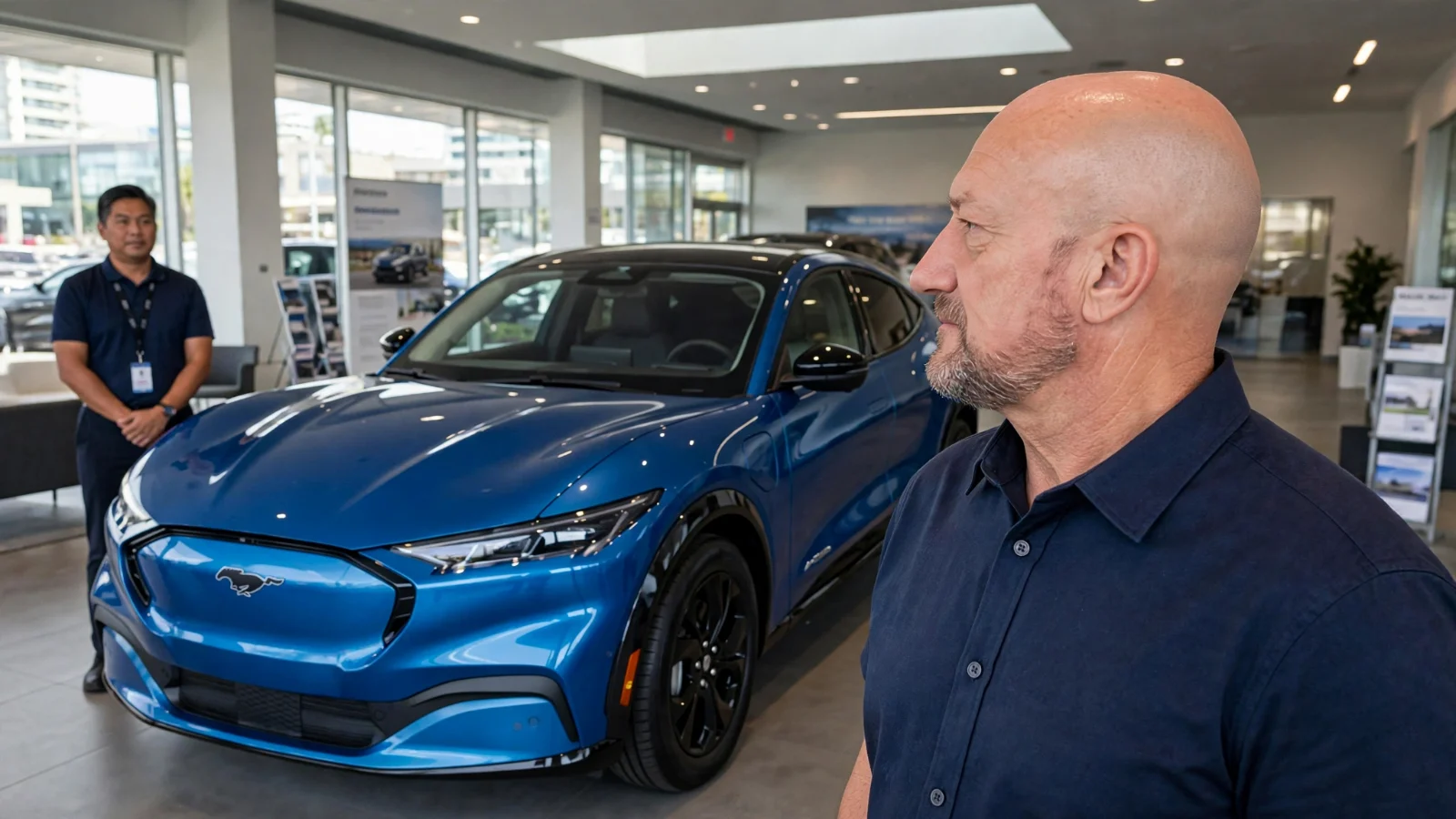
I did not go to the car dealer planning to buy a car.
I went there for an oil change.
That distinction became important later.
While I was waiting, I wandered around the dealership and saw a Mustang Mach-E. It had just come on the market, and naturally I wanted to look at it.
A salesperson approached me. We talked. Then he offered to take me for a test drive.
That was probably the moment when an ordinary oil change stopped being an ordinary oil change.
I drove the Mach-E, liked it, and suddenly I wanted the car.
Not next year. Not after a careful household discussion. I wanted it while I was still sitting in it.
There is nothing especially mysterious about that reaction. New cars are designed to be desirable. A test drive is designed to make the car feel real. The salesperson's job is not to remind you about your parking situation, your insurance bill, or the conversation waiting for you at home.
Those were my jobs.
And for a while, I wasn't doing them.
Excitement Has a Very Narrow Field of View
When I wanted the Mach-E, my attention was on the enjoyable parts.
It was new. It was different. It was electric. It was fun to drive.
My mind was already imagining ownership before I had seriously considered everything ownership would require.
I wasn't thinking clearly about the limited parking space in my building.
I wasn't thinking about adding another insurance policy.
I wasn't giving much attention to the discussions this decision would create with my wife.
I was looking at the exciting part of the decision while the boring consequences stood quietly off to the side.
That is something I have learned to watch for.
Excitement does not necessarily mean a decision is wrong. But excitement can make a decision look incomplete.
It shines a spotlight on what we gain and leaves what we must maintain sitting in the dark.
The Purchase Is Often the Beginning, Not the End
One lesson I have taken from years of reading about habits, decision-making, money, and human behavior is that we are often much better at imagining the moment of getting something than the months or years of living with it.
We picture the new car in the driveway.
We do not picture the insurance renewal.
We picture accepting the new job.
We do not picture the commute on a rainy Tuesday six months later.
We picture buying the larger house.
We do not picture cleaning it, repairing it, heating it, and paying for it.
We picture saying yes to an opportunity.
We do not always picture all the small obligations that arrive attached to that yes.
The first moment is vivid. The maintenance is boring.
Unfortunately, life contains far more maintenance than first moments.
I Needed to Ask a Less Exciting Question
The obvious question in the dealership was:
Do I want this car?
The answer was easy. Yes.
But that was not the most useful question.
A better question would have been:
Do I want everything that comes with this car?
That question is slower.
It forces parking into the conversation. Insurance gets a vote. Household finances get a vote. My wife's opinion gets a vote. The practical reality of owning another vehicle gets a vote.
The car itself was only one part of the purchase.
This sounds obvious when I write it now.
Many useful lessons do.
The difficulty is remembering them when something shiny is sitting in front of you.
The Salesperson's Urgency Does Not Have to Become Yours
There is another part of impulse decisions that deserves attention: urgency.
When we are excited, any suggestion that we should act now becomes especially powerful.
Maybe somebody else will buy it.
Maybe the offer will disappear.
Maybe this is a rare opportunity.
Sometimes those things are genuinely true.
But urgency is also one of the easiest ways to prevent ourselves from doing the boring thinking that protects us.
If a decision is large enough to affect my finances, my household, or my daily life for months or years, then a short pause is not cowardice. It is part of the decision.
I do not need to adopt somebody else's sales timetable as my thinking timetable.
A 24-Hour Rule for Things I Don't Need Today
If I could give my dealership self one small rule, it would be simple:
If the purchase is optional, expensive, and exciting, leave without buying it and give yourself 24 hours.
Not because every spontaneous purchase is foolish.
Not because we should turn buying a toaster into a government inquiry.
But when the decision carries meaningful financial or practical consequences, one night's distance can change the quality of our thinking.
Excitement is strongest when the object is directly in front of us.
At home, the decision has to survive without the polished showroom, the test drive, the salesperson, and the smell of a new car.
If I still want it tomorrow, I have lost very little.
If I no longer want it, I may have saved myself a great deal.
Write Down the Three Boring Consequences
I would add one more step.
Before saying yes to a major optional commitment, write down three consequences that are not exciting.
For my Mach-E, the list might have started like this:
- Where exactly am I going to park it?
- What will another insurance policy actually cost?
- How does my wife feel about adding another car and another expense?
Depending on the purchase, the questions will be different.
How much maintenance will this require?
What monthly expense am I adding?
What will I have to give up to afford it?
Who else is affected by this decision?
How difficult would it be to undo?
These questions are not nearly as enjoyable as a test drive.
That is precisely why they are useful.
This Is Not an Argument Against Enjoying Things
I do not want to turn this lesson into one of those forms of self-development where every pleasure has to defend itself before a committee.
Life would be miserable if we never bought anything simply because we liked it.
Sometimes wanting something is a perfectly good reason to buy it.
The point is not to eliminate desire.
The point is to give desire some adult supervision.
A purchase can be exciting and sensible.
A new opportunity can be both emotional and wise.
But when I am strongly attracted to something, I now know that my enthusiasm is giving me only part of the information.
I need to supply the rest.
The Bigger Lesson Wasn't Really About a Car
The Mach-E taught me something that applies well beyond shopping.
We make many decisions while mentally living in the first five minutes of the outcome.
We say yes to projects because we imagine the recognition.
We make commitments because we imagine making someone happy.
We accept invitations because saying yes feels easier than explaining why we would rather stay home.
We start things because beginning is exciting and forget that continuing is where most of life happens.
Before a big yes, I want to ask myself a question that excitement tends to skip:
What will this decision ask of me after the exciting part is over?
Sometimes the answer will still be worth it.
Excellent. Then I can say yes with clearer eyes.
Sometimes the answer will make me reconsider.
That is also useful.
Try This Today
If you are considering a nonessential purchase or commitment that feels exciting, do not decide while the excitement is doing all the talking.
Give it 24 hours if you reasonably can.
Then write down three boring consequences of saying yes.
They might involve money, time, maintenance, another person, storage, travel, stress, or an obligation you will still have months from now.
Then ask:
Do I want the thing, or do I also want the life that comes with the thing?
You may still say yes.
The goal is not to talk yourself out of everything you enjoy.
It is simply to make sure the person making the decision is not only the version of you who just finished the test drive.
Sometimes twenty-four hours is enough time for the rest of you to catch up.