Human-reviewed summary and review
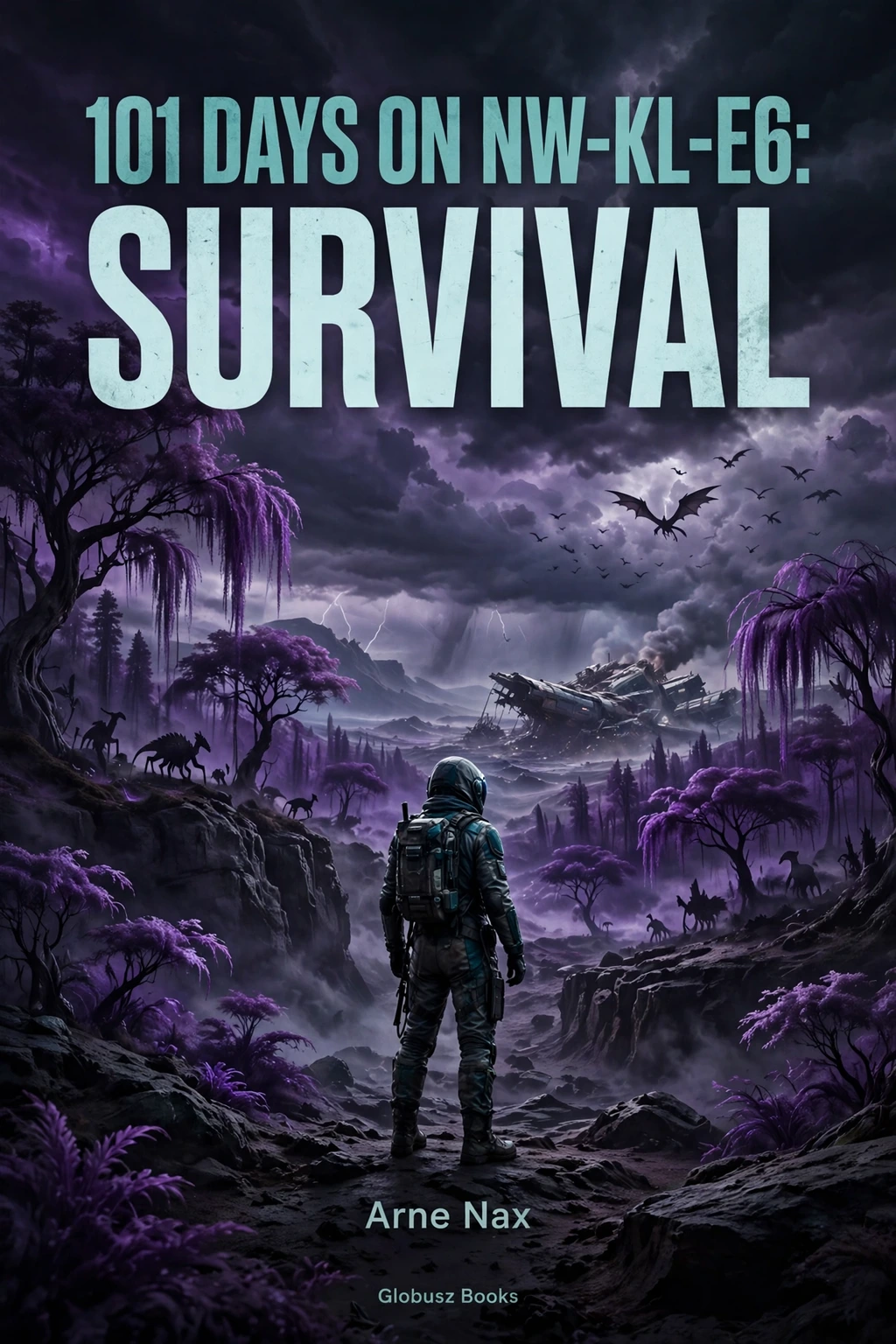
101 Days on NW-KL-E6: Survival by Arne Nax — Summary & Review
Arne Nax · en
A million-dollar survival challenge becomes an encounter with an alien ecology, unfamiliar technology and competing ideas of leadership.
Read the summary first
The short version: 101 Days on NW-KL-E6: Survival uses the unfamiliarity of an alien planet to examine familiar human questions: how people judge opportunities, choose leaders, respond to incomplete information and maintain relationships when established routines disappear.
Stefan's verdict: Worth considering for Survival science fiction readers; less useful if Readers seeking a standalone resolution.
12 min review2,508 wordsOriginal book: Introductory
ResilienceLearningLeadership
Globusz Books summary
What the book is about
101 Days on NW-KL-E6: Survival
Arne Nax
Globusz Books | Editorial Summary
Category: Science Fiction / Survival Adventure
Reference edition: First edition, 2026, supplied English EPUB
Series: The Aren Naxtron Chronicles, Book 1
Spoiler sensitivity: Moderate; discusses early discoveries and central conflicts.
The Central Idea
What happens when a familiar world of salaries, appointments and ordinary personal ambitions is exchanged for an environment in which even the most basic assumptions about nature must be learned again?
Arne Nax begins his novel with Aren living a recognizable modern life. His routines are established, but the promise of an extraordinary opportunity interrupts them. An advertisement leads to an invitation offering a million dollars for surviving one hundred days on an alien planet. The apparent simplicity of the arrangement is deceptive. Money is a clear measure of success on Earth; it provides no guidance about how to live on NW-KL-E6.
Aren and Diana, whose relationship is developing before their departure, find themselves among participants transported to a landscape of unfamiliar vegetation, unusual animals and imposing celestial scenery. Their capsule provides a temporary foundation for survival, but neither the destination nor the organization behind the expedition is adequately understood. The announcement that this is the seventh colonization attempt opens questions that the first volume deliberately leaves unresolved.
The novel combines speculative technology, ecological discovery and the social dynamics of a small group under pressure. Its interest lies as much in the allocation of work, disagreements over authority and experiments with daily living as in the spectacle of a distant planet. Instead of treating survival as a single dramatic victory, it presents it as a continuing process of acquiring reliable knowledge and building workable relationships.
Key Idea 1: A clearly stated reward is not the same as informed consent
The opening chapters establish a contrast between the precision of the advertised prize and the uncertainty of what the participants are agreeing to undertake. The promise of a million dollars gives Aren a compelling reason to investigate. His everyday obligations and his growing attachment to Diana help make the decision emotionally complicated rather than purely financial.
The invitation and selection process progressively move the characters away from the world in which they can independently evaluate ordinary risks. The recruiter, Monsieur Smith, provides enough information to keep the opportunity moving forward, but the participants cannot meaningfully assess an alien ecosystem from their existing experience. By the time they learn that the undertaking is part of a seventh colonization attempt, the significance of the missing information has changed dramatically.
This creates a distinction between an agreement that is easy to describe and one that is genuinely understood. An exact duration and a specific reward are not substitutes for knowledge of hazards, previous outcomes or the obligations of whoever is organizing an expedition. The question of the six earlier attempts is particularly disturbing because it suggests a history that the newcomers have not been equipped to interpret.
Nax does not need to establish the organizers' ultimate motives for this tension to work. Aren's uncertainty is itself important. The reader shares the gap between the information provided and the information needed to make sense of the undertaking.
Once the group arrives, the prize rapidly loses its ability to organize everyday decisions. Finding water, obtaining food and protecting the group become immediate concerns. The promise remains part of the expedition's background, but survival depends on measures of progress quite different from those that persuaded the participants to leave Earth.
Why it matters
A compelling offer can make people focus on what they stand to gain while overlooking what they cannot yet evaluate. The novel invites readers to consider the quality of information behind a decision rather than treating a precisely described reward as evidence that the decision is safe.
Key Idea 2: Leadership earns its legitimacy through useful work
Aren's emergence as a coordinator is a central element of the early planetary chapters. The people who arrive together are not automatically a cohesive community. They have different abilities, temperaments and expectations, and the pressure to establish priorities makes these differences consequential.
Aren tends to break immediate problems into tasks and tries to keep track of the group as a whole. His approach is visible in decisions about water, shelter, food and transportation. Leadership here is not principally a matter of delivering inspirational speeches. It requires attention to practical constraints and an ability to recognize what other people can contribute.
Diana offers emotional steadiness and practical initiative. Marcus contributes technical curiosity, especially when the capsule reveals capabilities the group had not understood. Priya brings medical knowledge and a willingness to examine evidence. The novel makes their contributions important because no single participant possesses all the expertise needed to interpret the environment.
Trent provides a contrasting model of authority. His conflict with Aren concerns more than personality. He questions the group's cautious approach and presents assertiveness and immediate provisioning as evidence of strength. His eventual departure and alignment with another camp show that competing ideas about leadership can produce actual divisions rather than merely disagreements around a fire.
There is a difficult question beneath the conflict. A group facing hunger and fear may find confident promises especially attractive, even when the person making them has not accounted for longer-term consequences. Conversely, caution can sound evasive when people want decisive relief. Aren's challenge is to make uncertainty compatible with action, not to eliminate it by pretending that he knows everything.
The narrative also shows that coordination does not free a leader from emotional needs. Aren's relationship with Diana and his periods of exhaustion complicate the image of the self-sufficient decision maker. Responsibility is both a source of purpose and a burden.
Why it matters
Useful leadership combines competence, accountability and respect for other people's knowledge. Confidence can support those qualities, but it cannot replace them. The contrast between Aren and Trent gives readers a way to examine authority under conditions where mistakes have immediate consequences.
Key Idea 3: An ecosystem is a network of consequences
The alien landscape initially seems to present the group with a familiar survival problem: identify resources and avoid threats. The encounter with the Keeper transforms that understanding. Communication occurs without ordinary speech, and the newcomers receive warnings that challenge their assumptions about which creatures can be treated as resources.
The Lumin are central to this discovery. Their importance is not obvious from their appearance alone. The Keeper explains that they act as stabilizers of the weather and that their destruction removes part of the protection against the planet's underlying conditions. A storm is therefore not simply an isolated inconvenience. It can reveal a relationship between living organisms and the wider environment.
This is an especially effective use of speculative fiction because the ecological connection is dramatic enough to be immediately apparent once explained, yet difficult for an uninformed visitor to anticipate. A participant who sees an animal only as potential food may fail to understand what its presence makes possible for everyone else.
The restrictions communicated by the Keeper do not amount to a prohibition on human survival. The newcomers are permitted to fish, hunt what they need and gather appropriate foods. What matters is recognizing boundaries and learning which activities are compatible with the environment. The group must distinguish acceptable use from actions with disproportionate consequences.
Trent's rejection of these constraints makes the issue social as well as ecological. A rule that depends on cooperation is vulnerable to participants who do not accept its basis. Aren cannot guarantee collective compliance simply by understanding the warning himself. His group must consider what happens when decisions made elsewhere affect the conditions under which they live.
The novel's imagined ecology is not a scientific account of any real planet. Nevertheless, it provides a useful analogy for the difficulty of recognizing environmental dependencies before they are disrupted. The Keeper's explanation also reminds the reader that unfamiliar knowledge should not be dismissed merely because its source does not fit familiar categories.
Why it matters
A resource may have functions that are invisible to someone encountering it for the first time. Responsible use begins with learning those functions and considering how a local decision could affect the wider system.
Key Idea 4: Technology creates opportunities and new dependencies
The capsule initially serves as shelter. The discovery of a hidden console and an understandable interface opens the possibility of controlling its movement. Marcus's enthusiasm and the group's experiments turn a seemingly fixed refuge into a means of exploration. The first successful hover changes the practical geography of their situation.
Mobility enables them to investigate other capsules and reach new locations. It gives Aren's group options they did not possess while traveling on foot. Yet the excitement of discovering the technology is tempered by the experience of flying near dangerous weather. The capsule's energy reserves fall sharply as its systems struggle against turbulence. Its ability to fly does not mean that every flight is prudent.
This distinction becomes even more important as the capsule becomes a center of ordinary life. Its systems provide warmth, protection and a degree of comfort. When it shuts down, the participants recognize the extent of their reliance on machinery they do not fully understand. A sophisticated device can remove several immediate problems while creating a single point of vulnerability.
The later work on an external shelter is therefore more than a construction project. It represents an attempt to make survival less dependent on one piece of technology. The novel presents the creation of a camp and the exploration of the capsule's hardware as complementary activities rather than opposing philosophies.
Naming the capsule Curiosity 37 also marks a change in the group's relationship with it. The people begin to treat an object supplied by the expedition as part of their own developing identity. They are no longer merely passengers waiting for instructions; they are attempting to make decisions about their circumstances.
Why it matters
A useful tool should expand choices without becoming an unquestioned substitute for independent capability. The story encourages readers to ask what happens when a system fails, what alternatives exist and whether its apparent convenience hides important operating constraints.
Key Idea 5: Curiosity and ordinary routines make uncertainty manageable
The later chapters expand the group's knowledge of NW-KL-E6 while retaining a strong emphasis on everyday necessities. Learning about edible species, finding food near the lake and making shelter are not distractions from the science-fiction premise. They are the means by which an alien environment gradually becomes intelligible.
Diana's recognition of Lantern Root is a good example of the continuing interaction between exploration and inherited knowledge. The group has received information from the Keeper, but it must still work out how to interpret and apply that knowledge in particular situations. No initial set of instructions can anticipate every encounter.
The discovery of remains in a hollow tree broadens the story's questions. Priya's assessment challenges the assumption that they necessarily belong to an earlier human expedition. Diana raises the possibility that the planet is inhabited. The burial that follows gives the discovery a moral dimension: the strangers cannot determine the whole history of the individual, but they can choose how respectfully to respond.
These moments show the limitations of the participants' original mental framework. The expedition announcement provides one possible explanation of what they encounter, but it cannot explain everything. A willingness to revise assumptions is as important as the ability to accumulate facts.
At the same time, the group establishes small forms of continuity. Meals, work assignments, conversation and the relationship between Aren and Diana give their lives structure beyond the next danger. These episodes make the protagonists more than interchangeable survivors. They are people trying to preserve meaningful relationships while constructing a new understanding of their surroundings.
The book does not resolve the full promised survival period. Its closing material announces a continuation titled Control. Readers should therefore approach this installment as the opening stage of a longer narrative, not as a complete account of the expedition's eventual outcome.
Why it matters
Curiosity is most productive when it is paired with attention to everyday needs and the willingness to reconsider earlier explanations. A difficult situation becomes more manageable through repeated learning and shared effort, even when its largest questions remain unanswered.
Five Practical Lessons
1. Examine the unknowns behind an attractive offer.
Before making an important commitment, separate the benefits that have been clearly promised from the risks and obligations that remain uncertain. Ask what previous participants experienced and what evidence is available independently of the person presenting the opportunity.
2. Make competence more important than status.
When a group faces a difficult problem, identify the knowledge and abilities its members actually possess. Give people responsibility for tasks they can perform and allow new evidence to influence decisions. A leader need not be the best specialist in every area.
3. Consider indirect consequences.
Before acting on an unfamiliar system, ask what other processes depend on the part you intend to change. Immediate gains can be outweighed by effects that are difficult to reverse. This is a principle for decision-making, not an instruction to imitate the novel's fictional survival practices.
4. Preserve alternatives to essential tools.
Identify the services or devices on which you rely most heavily. Consider how you would continue if one became unavailable. A modest backup or an independent skill can reduce the consequences of an unexpected failure.
5. Build routines that support cooperation.
In a period of uncertainty, small achievable tasks can restore a sense of progress. Share responsibilities, allow room for rest and make time for meaningful conversation. The novel illustrates how practical accomplishments and personal relationships can support one another.
Final Takeaway
101 Days on NW-KL-E6: Survival uses the unfamiliarity of an alien planet to examine familiar human questions: how people judge opportunities, choose leaders, respond to incomplete information and maintain relationships when established routines disappear.
Its strongest recurring insight is that survival requires more than individual determination or advanced equipment. The participants must learn the structure of their environment, understand the consequences of their actions and develop ways of cooperating despite genuine differences in priorities.
The narrative's deliberate attention to daily tasks will appeal particularly to readers who enjoy gradual exploration and speculative systems. Those expecting a rapidly resolved adventure should know that this is the first installment of a continuing series. The mystery of the expedition remains open.
The author also explicitly acknowledges the role of artificial intelligence in his creative process in an afterword. That disclosure is part of the supplied edition and offers readers additional context for the work's development.
Editorial Metadata
Source: Arne Nax, 101 Days on NW-KL-E6: Survival, first edition (2026), supplied English EPUB. Copyright Arne Nax; all rights reserved. This original editorial summary does not reproduce the manuscript. Author website and visual companion: https://arnenax.com/books/survival/
Reader fit: Readers of survival science fiction, ecological speculation, group dynamics and technological exploration.
Content notes: Peril, interpersonal conflict, death and descriptions of animal hunting.
Beyond the summary
What might this book awaken in you?
Learn unfamiliar systems, cooperate under pressure and preserve alternatives to essential tools.
Before you commit
Why you might read this
A million-dollar survival challenge becomes an encounter with an alien ecology, unfamiliar technology and competing ideas of leadership.
Spoiler sensitivity: mediumDiscusses early discoveries and central conflicts.
Themes worth noticing
Survival
Leadership
Cooperation
Ecology
Technology
Curiosity
Uncertainty
Key ideas, explained
A clearly stated reward is not the same as informed consent
The opening chapters establish a contrast between the precision of the advertised prize and the uncertainty of what the participants are agreeing to undertake. The promise of a million dollars gives Aren a compelling reason to investigate. His everyday obligations and his growing attachment to Diana help make the decision emotionally complicated rather than purely financial.
The invitation and selection process progressively move the characters away from the world in which they can independently evaluate ordinary risks. The recruiter, Monsieur Smith, provides enough information to keep the opportunity moving forward, but the participants cannot meaningfully assess an alien ecosystem from their existing experience. By the time they learn that the undertaking is part of a seventh colonization attempt, the significance of the missing information has changed dramatically.
This creates a distinction between an agreement that is easy to describe and one that is genuinely understood. An exact duration and a specific reward are not substitutes for knowledge of hazards, previous outcomes or the obligations of whoever is organizing an expedition. The question of the six earlier attempts is particularly disturbing because it suggests a history that the newcomers have not been equipped to interpret.
Nax does not need to establish the organizers' ultimate motives for this tension to work. Aren's uncertainty is itself important. The reader shares the gap between the information provided and the information needed to make sense of the undertaking.
Once the group arrives, the prize rapidly loses its ability to organize everyday decisions. Finding water, obtaining food and protecting the group become immediate concerns. The promise remains part of the expedition's background, but survival depends on measures of progress quite different from those that persuaded the participants to leave Earth.
Leadership earns its legitimacy through useful work
Aren's emergence as a coordinator is a central element of the early planetary chapters. The people who arrive together are not automatically a cohesive community. They have different abilities, temperaments and expectations, and the pressure to establish priorities makes these differences consequential.
Aren tends to break immediate problems into tasks and tries to keep track of the group as a whole. His approach is visible in decisions about water, shelter, food and transportation. Leadership here is not principally a matter of delivering inspirational speeches. It requires attention to practical constraints and an ability to recognize what other people can contribute.
Diana offers emotional steadiness and practical initiative. Marcus contributes technical curiosity, especially when the capsule reveals capabilities the group had not understood. Priya brings medical knowledge and a willingness to examine evidence. The novel makes their contributions important because no single participant possesses all the expertise needed to interpret the environment.
Trent provides a contrasting model of authority. His conflict with Aren concerns more than personality. He questions the group's cautious approach and presents assertiveness and immediate provisioning as evidence of strength. His eventual departure and alignment with another camp show that competing ideas about leadership can produce actual divisions rather than merely disagreements around a fire.
There is a difficult question beneath the conflict. A group facing hunger and fear may find confident promises especially attractive, even when the person making them has not accounted for longer-term consequences. Conversely, caution can sound evasive when people want decisive relief. Aren's challenge is to make uncertainty compatible with action, not to eliminate it by pretending that he knows everything.
The narrative also shows that coordination does not free a leader from emotional needs. Aren's relationship with Diana and his periods of exhaustion complicate the image of the self-sufficient decision maker. Responsibility is both a source of purpose and a burden.
An ecosystem is a network of consequences
The alien landscape initially seems to present the group with a familiar survival problem: identify resources and avoid threats. The encounter with the Keeper transforms that understanding. Communication occurs without ordinary speech, and the newcomers receive warnings that challenge their assumptions about which creatures can be treated as resources.
The Lumin are central to this discovery. Their importance is not obvious from their appearance alone. The Keeper explains that they act as stabilizers of the weather and that their destruction removes part of the protection against the planet's underlying conditions. A storm is therefore not simply an isolated inconvenience. It can reveal a relationship between living organisms and the wider environment.
This is an especially effective use of speculative fiction because the ecological connection is dramatic enough to be immediately apparent once explained, yet difficult for an uninformed visitor to anticipate. A participant who sees an animal only as potential food may fail to understand what its presence makes possible for everyone else.
The restrictions communicated by the Keeper do not amount to a prohibition on human survival. The newcomers are permitted to fish, hunt what they need and gather appropriate foods. What matters is recognizing boundaries and learning which activities are compatible with the environment. The group must distinguish acceptable use from actions with disproportionate consequences.
Trent's rejection of these constraints makes the issue social as well as ecological. A rule that depends on cooperation is vulnerable to participants who do not accept its basis. Aren cannot guarantee collective compliance simply by understanding the warning himself. His group must consider what happens when decisions made elsewhere affect the conditions under which they live.
The novel's imagined ecology is not a scientific account of any real planet. Nevertheless, it provides a useful analogy for the difficulty of recognizing environmental dependencies before they are disrupted. The Keeper's explanation also reminds the reader that unfamiliar knowledge should not be dismissed merely because its source does not fit familiar categories.
Technology creates opportunities and new dependencies
The capsule initially serves as shelter. The discovery of a hidden console and an understandable interface opens the possibility of controlling its movement. Marcus's enthusiasm and the group's experiments turn a seemingly fixed refuge into a means of exploration. The first successful hover changes the practical geography of their situation.
Mobility enables them to investigate other capsules and reach new locations. It gives Aren's group options they did not possess while traveling on foot. Yet the excitement of discovering the technology is tempered by the experience of flying near dangerous weather. The capsule's energy reserves fall sharply as its systems struggle against turbulence. Its ability to fly does not mean that every flight is prudent.
This distinction becomes even more important as the capsule becomes a center of ordinary life. Its systems provide warmth, protection and a degree of comfort. When it shuts down, the participants recognize the extent of their reliance on machinery they do not fully understand. A sophisticated device can remove several immediate problems while creating a single point of vulnerability.
The later work on an external shelter is therefore more than a construction project. It represents an attempt to make survival less dependent on one piece of technology. The novel presents the creation of a camp and the exploration of the capsule's hardware as complementary activities rather than opposing philosophies.
Naming the capsule Curiosity 37 also marks a change in the group's relationship with it. The people begin to treat an object supplied by the expedition as part of their own developing identity. They are no longer merely passengers waiting for instructions; they are attempting to make decisions about their circumstances.
Curiosity and ordinary routines make uncertainty manageable
The later chapters expand the group's knowledge of NW-KL-E6 while retaining a strong emphasis on everyday necessities. Learning about edible species, finding food near the lake and making shelter are not distractions from the science-fiction premise. They are the means by which an alien environment gradually becomes intelligible.
Diana's recognition of Lantern Root is a good example of the continuing interaction between exploration and inherited knowledge. The group has received information from the Keeper, but it must still work out how to interpret and apply that knowledge in particular situations. No initial set of instructions can anticipate every encounter.
The discovery of remains in a hollow tree broadens the story's questions. Priya's assessment challenges the assumption that they necessarily belong to an earlier human expedition. Diana raises the possibility that the planet is inhabited. The burial that follows gives the discovery a moral dimension: the strangers cannot determine the whole history of the individual, but they can choose how respectfully to respond.
These moments show the limitations of the participants' original mental framework. The expedition announcement provides one possible explanation of what they encounter, but it cannot explain everything. A willingness to revise assumptions is as important as the ability to accumulate facts.
At the same time, the group establishes small forms of continuity. Meals, work assignments, conversation and the relationship between Aren and Diana give their lives structure beyond the next danger. These episodes make the protagonists more than interchangeable survivors. They are people trying to preserve meaningful relationships while constructing a new understanding of their surroundings.
The book does not resolve the full promised survival period. Its closing material announces a continuation titled Control. Readers should therefore approach this installment as the opening stage of a longer narrative, not as a complete account of the expedition's eventual outcome.
How to Use This Book in Real Life
Examine the unknowns behind an attractive offer.
Before making an important commitment, separate the benefits that have been clearly promised from the risks and obligations that remain uncertain. Ask what previous participants experienced and what evidence is available independently of the person presenting the opportunity.
Make competence more important than status.
When a group faces a difficult problem, identify the knowledge and abilities its members actually possess. Give people responsibility for tasks they can perform and allow new evidence to influence decisions. A leader need not be the best specialist in every area.
Consider indirect consequences.
Before acting on an unfamiliar system, ask what other processes depend on the part you intend to change. Immediate gains can be outweighed by effects that are difficult to reverse. This is a principle for decision-making, not an instruction to imitate the novel's fictional survival practices.
Preserve alternatives to essential tools.
Identify the services or devices on which you rely most heavily. Consider how you would continue if one became unavailable. A modest backup or an independent skill can reduce the consequences of an unexpected failure.
Build routines that support cooperation.
In a period of uncertainty, small achievable tasks can restore a sense of progress. Share responsibilities, allow room for rest and make time for meaningful conversation. The novel illustrates how practical accomplishments and personal relationships can support one another.
Questions to carry with you
- What makes consent meaningful?
- How does leadership earn trust?
- What dependencies are hidden in unfamiliar systems?
The bottom line
101 Days on NW-KL-E6: Survival uses the unfamiliarity of an alien planet to examine familiar human questions: how people judge opportunities, choose leaders, respond to incomplete information and maintain relationships when established routines disappear.
Its strongest recurring insight is that survival requires more than individual determination or advanced equipment. The participants must learn the structure of their environment, understand the consequences of their actions and develop ways of cooperating despite genuine differences in priorities.
The narrative's deliberate attention to daily tasks will appeal particularly to readers who enjoy gradual exploration and speculative systems. Those expecting a rapidly resolved adventure should know that this is the first installment of a continuing series. The mystery of the expedition remains open.
The author also explicitly acknowledges the role of artificial intelligence in his creative process in an afterword. That disclosure is part of the supplied edition and offers readers additional context for the work's development.
If this idea interested you
Related books, with a reason to choose each one.
A different perspective on the same shelf1984George Orwell
In Orwell’s 1984, the Party doesn’t just watch you—it controls what you believe, remember, and even think. Winston Smith’s quiet rebellion reveals how totalitarianism can rewrite reality itself. How far would you go to keep your mind your own?
Read the summary & review →A useful follow-up for exploring the subject further1Q84Haruki MurakamiIn 1Q84, Tokyo in 1984 is just familiar enough to feel real—until you notice the second moon hanging in the sky. A fitness instructor moonlights as an assassin, and a math teacher rewrites a mysterious novel, both drawn into a parallel world where reality bends and cults pull the strings. It’s Murakami’s sprawling, strange meditation on loneliness, power, and the stories that shape us.
Read the summary & review →Another entry point into this category2666Roberto BolañoIn '2666,' four academics’ obsession with a mysterious author pulls them into the violent underbelly of a border city where unsolved murders cast a long shadow. This sprawling novel refuses neat answers, weaving fragmented lives and histories into a haunting meditation on evil and the limits of art. It’s a challenging read that stays with you long after the last page.
Read the summary & review →Explore the theme
More books about stress
Continue the journey
Read the original when you are ready.
Globusz Books helps you understand the central ideas before deciding whether the complete book deserves your time.
Read the original if: you want the evidence, stories, examples, nuance, and full argument in the author's own voice.
The summary may be enough if: you only need the central framework or want to decide whether this book suits you.
Is this worth your time if you…?
Survival science fiction readers
Found an error or outdated detail? Contact Stefan with a correction.