Human-reviewed summary and review
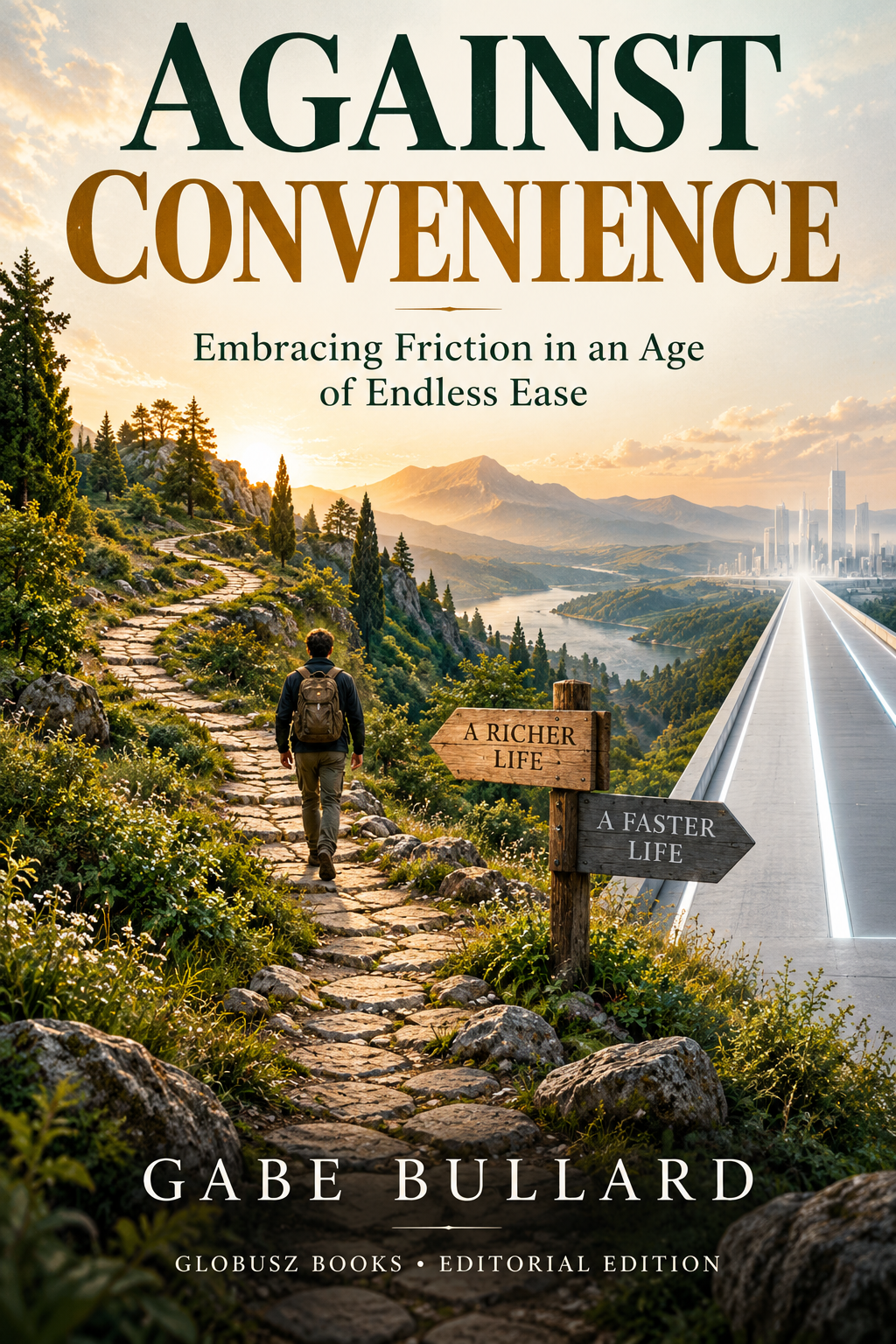
Against Convenience: Embracing Friction in an Age of Endless Ease by Gabe Bullard — Summary & Review
Gabe Bullard · en
What do we lose when every errand, meal, and conversation becomes frictionless? Journalist Gabe Bullard examines the hidden labor and trade-offs behind modern convenience.
Read the summary first
The short version: What do we lose when every errand, meal, and conversation becomes frictionless? Journalist Gabe Bullard examines the hidden labor and trade-offs behind modern convenience.
Stefan's verdict: Worth considering for Readers examining technology and everyday choices; less useful if Readers seeking an unqualified rejection of all technology.
4 min review801 wordsOriginal book: Introductory
Better decisionsIntentional living
Globusz Books summary
What the book is about
Against Convenience: Embracing Friction in an Age of Endless Ease examines a deceptively attractive proposition: when technology removes effort from daily life, does the time and attention it saves necessarily make us better off? Journalist Gabe Bullard argues that the promise of frictionless living deserves close scrutiny. A tap on a screen can conceal difficult work, new fees, lost social encounters, and a reduced sense of involvement in the world. This editorial overview is grounded in the publisher's description, an independent trade review, and a published excerpt—not a reading of the complete book.
The key distinction is between convenience that genuinely helps and convenience that simply moves costs elsewhere. Food-delivery services offer an instructive case. A meal appears at the door without the customer cooking, traveling, or speaking to a restaurant employee. Yet the order still must be prepared, packaged, transported, and kept appealing during the journey. The chapter excerpt published by Longreads follows these practical pressures and describes how delivery changes a public, social activity into a private transaction. The costs are not always visible to the person placing the order.
Bullard's critique is broader than food. The publisher identifies ride-hailing, streaming entertainment, self-checkout, and app-based services as examples of a culture organized around minimum resistance. Publishers Weekly also describes his discussions of connected appliances, digital attention economies, online ordering, and the erosion of gathering places such as cafés. These are distinct subjects, but they raise a common question: when a company promises to eliminate inconvenience, who defines the problem, and who benefits from the proposed solution?
One way to read the book's argument is as a challenge to the narrow accounting of efficiency. The time saved by an individual purchase may be measurable, while the social costs are harder to quantify. A neighborhood business can lose the interactions that once made it a gathering place. Workers may assume new obligations and risks. Entertainment designed for effortless consumption may encourage passive attention rather than memorable engagement. These consequences cannot be established for every service or user, but they are important considerations beyond the advertised speed of an app.
The published excerpt makes the economic and experiential tension vivid. A delivered meal may cost more and arrive in worse condition than one eaten where it was prepared. Customers gain control over when and where they participate, yet the friction removed also includes conversations, small surprises, and awareness of the people doing the work. Bullard's point is not that every customer should always dine out. Rather, the apparent simplicity of a transaction can disguise trade-offs that deserve to be chosen consciously.
The argument also has limits. For people with disabilities, mobility constraints, caregiving duties, or demanding schedules, delivery, automation, and remote access can create real freedom. A useful critical reading must distinguish a genuinely empowering convenience from a commercial service that only appears to simplify life. It would be a mistake to turn an argument against thoughtless dependence into a moral judgment about people who need or value assistance. The available materials indicate that Bullard is criticizing how technology is promoted and organized, not rejecting all technological advances.
Publishers Weekly characterizes Bullard's approach as a mixture of individual case studies and broader social criticism. It also notes that he recognizes his own inconsistent relationships with the technologies he questions. That self-implication matters: readers are not being asked to imagine a perfectly self-sufficient life outside modern systems. Instead, the book appears to encourage realistic changes in habits and collective priorities, including patronizing businesses directly and supporting policies that protect workers and local commerce.
A practical application is to examine a convenience before making it a default. What work disappears for me, and what work becomes invisible? Do I save money or merely exchange money for speed? Does the service preserve a valued relationship or displace it? Is the occasional inconvenience itself meaningful, educational, or enjoyable? The answers need not point to the least convenient option. They can help readers reserve frictionless tools for moments when those tools provide an actual benefit.
The book's strongest documented contribution is therefore its reframing of ease as a choice rather than an unquestioned good. Convenience is not a neutral feature; it influences how we spend money, encounter other people, experience art, and participate in communities. Its promise is most credible when the benefits remain after the hidden labor and downstream costs are considered. Readers interested in consumer culture, technology, and deliberate living may find a useful framework here, even if they disagree with some of Bullard's conclusions.
Editorial scope: this is a source-grounded thematic assessment built from the publisher's overview, the Publishers Weekly review dated June 29, 2026, and the Longreads excerpt published September 15, 2026. It does not claim complete-book or chapter-by-chapter coverage. Particular examples or prescriptions beyond these sources are not attributed to the book.
Beyond the summary
What might this book awaken in you?
Ease and quality of life are not the same measure. A useful convenience should account for who does the work, who pays the costs, and what experiences disappear.
Before you commit
Why you might read this
What do we lose when every errand, meal, and conversation becomes frictionless? Journalist Gabe Bullard examines the hidden labor and trade-offs behind modern convenience.
Themes worth noticing
Convenience culture
Technology and society
Consumer behavior
Community
Attention
What the book does especially well
- Connects personal choices to invisible labor and community costs
- Offers concrete everyday examples
Where the book gets shaky
- Evidence available for this overview does not cover the full text
- Convenience can be vital for accessibility and care responsibilities
Questions to carry with you
- Who really bears the cost of this time-saving service?
- Which inconveniences add value to my day?
If this idea interested you
Related books, with a reason to choose each one.
A different perspective on the same shelfThe Road to JonestownJeff Guinn
Jim Jones was a preacher with a political edge who built a movement promising racial equality and social justice. But beneath his charm lay a hunger for control that turned hope into horror. Jeff Guinn's 'The Road to Jonestown' unravels how idealism morphed into fanaticism with tragic consequences.
Read the summary & review →A useful follow-up for exploring the subject furtherThe Little HeapEdith SödergranEdith Södergran’s "The Little Heap" is a compact burst of modernist poetry that refuses to follow traditional rules. It’s a fragment that demands attention to the small, overlooked pieces of identity and emotion. This isn’t gentle or straightforward—it's a raw, intimate dive into the chaos beneath the surface.
Read the summary & review →Another entry point into this categoryPersepolisMarjane SatrapiMarjane Satrapi’s Persepolis plunges you into a childhood shaped by war, revolution, and relentless political pressure. Through stark black-and-white images, it reveals how a young girl fights to hold onto her identity amid chaos. How do you grow up when your world is constantly being rewritten?
Read the summary & review →Explore the theme
More books about focus
Continue the journey
Read the original when you are ready.
Globusz Books helps you understand the central ideas before deciding whether the complete book deserves your time.
Read the original if: you want the evidence, stories, examples, nuance, and full argument in the author's own voice.
The summary may be enough if: you only need the central framework or want to decide whether this book suits you.
Is this worth your time if you…?
Readers examining technology and everyday choices
Found an error or outdated detail? Contact Stefan with a correction.