Human-reviewed summary and review
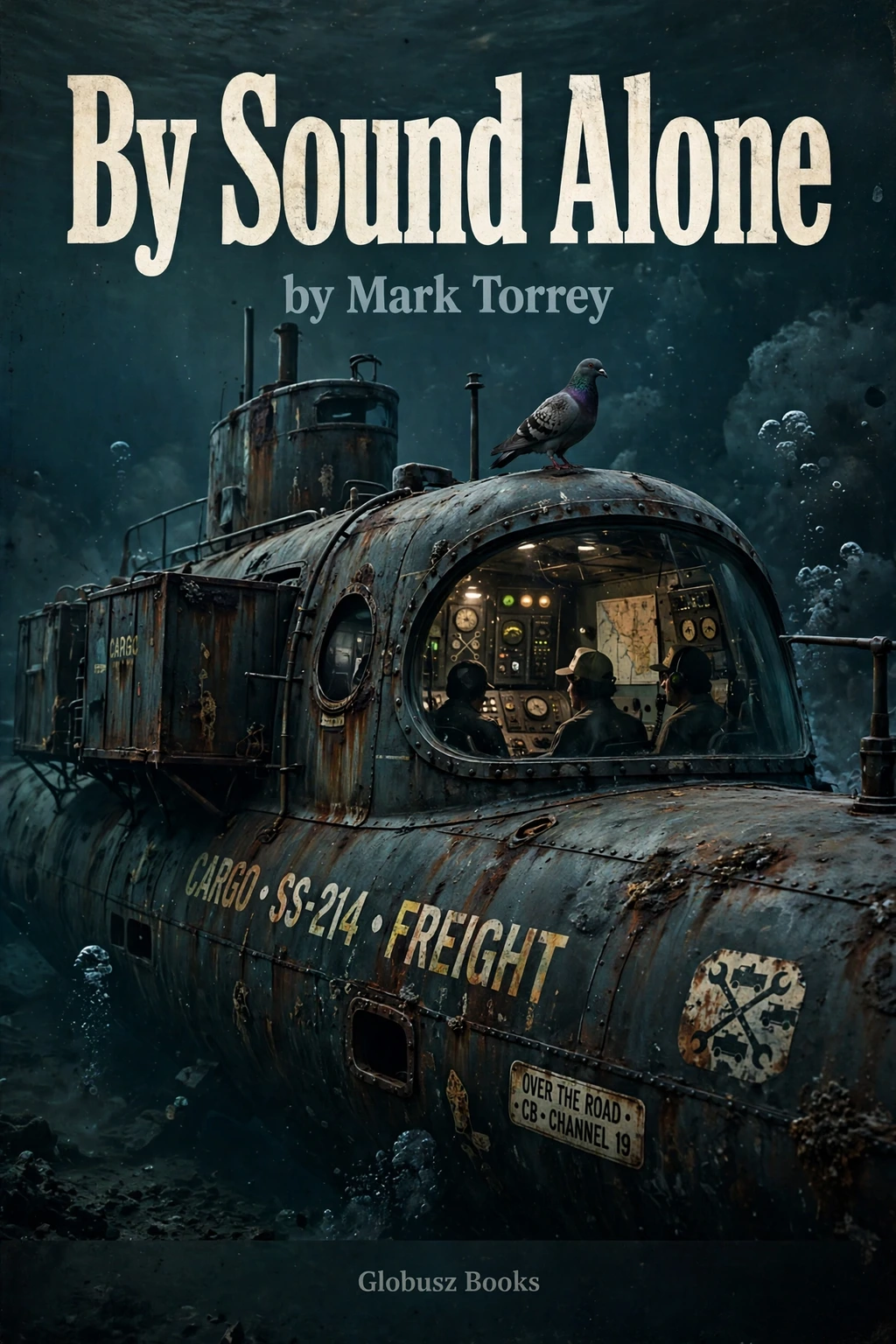
By Sound Alone by Mark Torrey — Summary & Review
Mark Torrey · en
A freight captain and her crew rely on mechanical ingenuity, sound and uneasy alliances in an alternate world of cargo submarines.
Read the summary first
The short version: By Sound Alone is a maritime adventure built around an unusually concrete vision of human ingenuity. Its protagonists survive not because they possess flawless machines or unlimited authority, but because they can interpret, repair and adapt the equipment around them and cooperate despite conflicting interests.
Stefan's verdict: Worth considering for Technical adventure readers; less useful if Readers who dislike technical detail or strong language.
10 min review2,237 wordsOriginal book: Moderate
Globusz Books summary
What the book is about
Show the full summary — it may reveal major plot developments
By Sound Alone
Mark Torrey
Globusz Books | Editorial Summary
Category: Science Fiction / Alternate History / Adventure
Publication: 2025
Source edition: Author's EPUB, June 1, 2025
Spoiler sensitivity: High — the following analysis discusses the conclusion.
The Central Idea
What happens when your livelihood, your freedom and your survival depend on a machine you must understand intimately? Mark Torrey's By Sound Alone imagines an alternative mid-century world in which independent freight operators carry goods aboard cargo submarines. Rather than presenting an advanced technological future, Torrey builds an adventure around machinery whose operation can be grasped through experience, observation and mechanical reasoning.
Captain Sylvia Percy commands the Prospect, a commercial submarine whose crew must contend with damaged equipment, hostile vessels, uncertain jurisdiction and the ordinary pressure of earning a living. Her navigator Hemi Howell brings a meticulous analytical temperament to the enterprise. Their survival depends on a wider circle of specialists, including the mechanic Chips, sonar operator Cassandra and the independent captain Shakes, who operates the smaller submarine Gnat.
The novel opens with a maritime emergency and develops into a sustained pursuit. The danger is never merely the presence of an adversary. Water pressure, failing machinery, finite battery power and incomplete knowledge continually constrain the possible responses. Even when a plan succeeds, the crew must deal with the damage and economic consequences it leaves behind.
Torrey's preface identifies the human relationship with mechanical machinery as the book's central concern. The narrative transforms that concern into a question of agency: how much independence can people retain when they depend on equipment, markets, institutions and one another?
Key Idea 1: Understanding a machine is a form of independence
The Prospect is not a magical vehicle that obeys a command without revealing how it works. Its gauges, valves, pumps, batteries and controls are part of the narrative's vocabulary. Readers learn to associate changes in the machinery with changes in the crew's prospects. The tension arises not only from what might happen next but from understanding why something that appears minor could become disastrous.
The opening chapter, Tablemount, makes this approach particularly clear. Damage threatens the submarine's ability to maintain its depth. Hemi studies the relationship between speed, battery reserves and the rate of descent. The crew's predicament is therefore a problem of interpreting interdependent systems rather than simply finding the courage to act. A submerged plateau offers a possibility of relief from the seemingly bottomless ocean, but the boat still needs repair and careful management.
Chips's work on the hull makes visible the labor behind the captain's ability to command. A decision to continue moving has little meaning unless somebody can keep the machinery capable of carrying it out. The physical difficulty of repair, especially in an unforgiving underwater environment, prevents technical competence from becoming an abstract virtue.
In the preface, Torrey distinguishes comprehensibility from simplicity. Older electromechanical systems can be complicated while remaining accessible to a person who studies their parts and learns their behavior. The novel develops this distinction through action rather than treating it solely as a historical argument.
The implication is not that older machinery is necessarily safer or better. The Prospect is vulnerable precisely because it is a physical object that can break. Rather, a machine that people can diagnose and repair gives them opportunities to respond intelligently when its ordinary operation fails.
Why it matters
The novel invites readers to distinguish using technology from understanding it. That distinction becomes especially significant when ordinary support systems are unavailable and the consequences of failure cannot be outsourced.
Key Idea 2: Leadership means accepting constraints and consequences
Percy is a forceful captain, but her authority does not exempt her from physical reality or from the expertise of her crew. She must choose among imperfect alternatives, often without knowing whether an apparent improvement in one area will introduce a new danger elsewhere.
The first chapter shows the emotional cost of this responsibility. Chips becomes furious after a dangerous maneuver involving the trim tanks and strikes Percy with a piece of pipe. Hemi intervenes. The conflict is not reducible to an argument between a competent leader and an unreasonable subordinate. Chips has been working under punishing conditions, and her objection to the maneuver has a technical basis. Her violence is nonetheless destructive.
The episode establishes that a crew may contain indispensable individuals whose relationships remain difficult. Authority cannot automatically produce trust. Nor does technical competence guarantee sound interpersonal judgment. The captain has to continue directing the enterprise even after personal and professional loyalties have been strained.
The revelation involving Owen near the end of the novel sharpens this problem. A previous decision by Percy to leave him behind becomes the source of his subsequent hostility. In the epilogue, Hemi asks whether she considers her earlier decision a mistake. Percy insists that it was rational under the circumstances and that she would make the same choice again. She rejects Owen's attempts to take revenge on the entire boat.
The book does not require readers to accept Percy's self-assessment as the final moral verdict. Her insistence on rationality is part of her characterization. Readers can ask whether the original decision was defensible, whether alternative responses were possible, and how responsibility should be divided between a person making a difficult choice and someone who subsequently chooses vengeance.
Why it matters
A leader may make a defensible decision and still face terrible consequences. Evaluating leadership requires distinguishing the quality of the original judgment from its outcome, while also remaining open to criticism of both.
Key Idea 3: Independence depends on cooperation
The encounter with Shakes and the Gnat complicates the novel's image of the independent operator. Shakes has his own vessel, customers and commitments. Helping the Prospect has a cost for him, and Percy cannot simply assume that another captain will abandon his business obligations to meet hers.
The negotiation that follows links survival to the practical realities of commerce. Repairs and assistance require time, materials and labor. The smaller boat becomes a source of electrical reserves for the larger one when the vessels are connected. What might appear to be a minor commercial encounter becomes essential to the Prospect's ability to continue.
The relationship between the submarines is one of the novel's strongest illustrations of mutual dependence. Each vessel has its own capabilities and limits; neither represents a complete solution to every problem. Their operators must work out how to combine resources, communicate intentions and distribute risks without pretending that their interests are identical.
Later, the use of Herschel, a homing pigeon, offers another striking instance of cooperation and ingenuity. Hemi attaches a message to the bird and sends it away in the hope that it will reach its destination. This means of communication is neither glamorous nor guaranteed. Its significance lies in making use of an available alternative when more conventional communication is difficult.
By the final confrontation the relationship between the two vessels has become an issue of survival for their crews. Shakes and Hemi aboard the Gnat ultimately depend on Cassandra and the Prospect to locate and recover them. In the epilogue the severely damaged little submarine rides on the larger vessel's deck, a tangible reminder of the assistance that has made their survival possible.
Why it matters
Independence need not mean refusing help. It can mean having the freedom to form reciprocal relationships and the competence to contribute something valuable to them.
Key Idea 4: Information is valuable because it is incomplete
The title points toward one of the novel's distinctive sources of suspense: the dependence of submariners on sound. Beneath the surface, visibility is limited and reliable information is difficult to acquire. An operator must make sense of signals that may be faint, intermittent or masked by other noises.
Cassandra's role at the sonar equipment turns listening into a demanding intellectual activity. She is not merely a passive recipient of information. She must separate significant sounds from background activity and communicate what she believes they mean. Her observations help determine what the captain and crew can responsibly conclude about another vessel's location or condition.
Hemi supplies a complementary kind of understanding. His navigational work turns measurements and observations into judgments about position, movement and time. He is willing to acknowledge what cannot yet be known. This quality matters in a setting where premature certainty can encourage a dangerous course of action.
The novel repeatedly distinguishes evidence from confirmation. During the events near Stilt City, the crew hears explosions and sounds consistent with the failure of a pressure hull. Although these noises suggest that the pursuing Grackle may have been destroyed, Percy cannot immediately establish that conclusion with certainty. The difference between a plausible interpretation and verified knowledge has immediate consequences for the crew's sense of safety.
The final rescue in Garbage Gyre gives Cassandra's listening its greatest dramatic significance. She identifies the distressed Gnat amid the noises of the sinking enemy submarine and helps guide the Prospect toward it. Her contribution illustrates how accumulated expertise can transform apparently chaotic information into a meaningful response.
Why it matters
Good judgment requires attending to evidence, recognizing its limitations and resisting the temptation to confuse what one hopes is true with what one actually knows.
Key Idea 5: Survival does not end the struggle to make a living
Torrey's alternative history is as much about commerce as it is about submarines. The vessels are working machines operated by people who need customers, supplies, repairs and income. Their adventures cannot be separated from the conditions that make independent freight work possible.
The depot chapter expands the world beyond the interior of the Prospect. Commercial activity takes place within a fragmented political landscape of competing Authorities. A conversation about potential privateering arrangements suggests that the balance between local power, trade and organized violence may be changing. For an independent captain, political uncertainty is not a distant abstraction: it can alter the safety and viability of a voyage.
This setting helps explain why the crew's technical resourcefulness is insufficient on its own. A well-maintained boat can still encounter hostile institutions, predatory competitors or circumstances that make a profitable voyage impossible. The captain must navigate economic and political pressures as well as the ocean itself.
The epilogue makes this point without a grand speech. After the dangers of the pursuit, the crew enjoys sunlight, fishing and a meal cooked on deck. The damaged Gnat still requires attention, and the Prospect must keep moving. When Hemi asks Percy about the emotional legacy of Owen's death, she turns instead to the question of where the next job will come from.
Her response captures the peculiar mixture of freedom and insecurity that defines the independent worker in this world. Surviving extraordinary events does not settle the ordinary question of how to earn a living tomorrow. The narrative ends not with permanent security but with a return to the continuing demands of work.
Why it matters
The novel offers a counterweight to romantic visions of independence. Autonomy can bring satisfaction and dignity, but it also exposes people to risks that require resources, relationships and continuing effort to manage.
Five Practical Lessons
1. Learn the systems you rely on.
Understanding the limits and failure modes of important tools can help you recognize trouble early and decide when expert assistance is necessary.
2. Separate authority from expertise.
A responsible decision-maker listens to the people who understand different parts of a problem, particularly when their information contradicts an attractive plan.
3. Build reciprocal relationships before a crisis.
Cooperation is more dependable when the parties recognize each other's interests and contributions rather than expecting assistance without cost.
4. Treat uncertainty as information.
Distinguish observations from interpretations and conclusions. An unconfirmed possibility should not be treated as an established fact.
5. Account for the cost of recovery.
Solving an immediate crisis is not the same as restoring a sustainable situation. Consider the resources, repairs and relationships that will be needed afterward.
Final Takeaway
By Sound Alone is a maritime adventure built around an unusually concrete vision of human ingenuity. Its protagonists survive not because they possess flawless machines or unlimited authority, but because they can interpret, repair and adapt the equipment around them and cooperate despite conflicting interests.
The novel's affection for mechanical technology is balanced by its awareness of physical danger, exhausting labor and economic insecurity. Its characters are neither idealized heroes nor interchangeable operators. Their particular abilities, faults and relationships determine what their machines can accomplish.
For readers interested in alternate history, technical adventure and the meaning of independent work, Torrey offers a world in which the practical details of everyday machinery become the substance of drama. Its enduring question is how people can preserve meaningful agency in systems they depend upon but cannot entirely control.
Editorial Metadata
Discovery hook: In an alternate mid-century world of cargo submarines, a freight captain and her crew must rely on mechanical ingenuity, sound and uneasy alliances to survive a relentless pursuit.
Themes: Mechanical technology; Leadership; Cooperation; Independent enterprise; Uncertainty; Maritime survival.
Reader fit: Readers who enjoy technical adventure, alternate history, working maritime settings and character-driven survival stories. Contains strong language, violence and sustained danger.
Primary source: Mark Torrey, By Sound Alone, author-supplied EPUB edition dated June 1, 2025, copyright 2025 Mark Torrey, CC BY-NC-SA. Author website: https://bysoundalone.net/. This independently written editorial analysis is not an official author summary.
Beyond the summary
What might this book awaken in you?
Understand the systems you rely on, recognize uncertainty, and value reciprocal cooperation.
Before you commit
Why you might read this
A freight captain and her crew rely on mechanical ingenuity, sound and uneasy alliances in an alternate world of cargo submarines.
Spoiler sensitivity: highDiscusses major plot developments and the ending.
Themes worth noticing
Mechanical Technology
Leadership
Cooperation
Independent Enterprise
Uncertainty
Maritime Survival
Key ideas, explained
Understanding a machine is a form of independence
The Prospect is not a magical vehicle that obeys a command without revealing how it works. Its gauges, valves, pumps, batteries and controls are part of the narrative's vocabulary. Readers learn to associate changes in the machinery with changes in the crew's prospects. The tension arises not only from what might happen next but from understanding why something that appears minor could become disastrous.
The opening chapter, Tablemount, makes this approach particularly clear. Damage threatens the submarine's ability to maintain its depth. Hemi studies the relationship between speed, battery reserves and the rate of descent. The crew's predicament is therefore a problem of interpreting interdependent systems rather than simply finding the courage to act. A submerged plateau offers a possibility of relief from the seemingly bottomless ocean, but the boat still needs repair and careful management.
Chips's work on the hull makes visible the labor behind the captain's ability to command. A decision to continue moving has little meaning unless somebody can keep the machinery capable of carrying it out. The physical difficulty of repair, especially in an unforgiving underwater environment, prevents technical competence from becoming an abstract virtue.
In the preface, Torrey distinguishes comprehensibility from simplicity. Older electromechanical systems can be complicated while remaining accessible to a person who studies their parts and learns their behavior. The novel develops this distinction through action rather than treating it solely as a historical argument.
The implication is not that older machinery is necessarily safer or better. The Prospect is vulnerable precisely because it is a physical object that can break. Rather, a machine that people can diagnose and repair gives them opportunities to respond intelligently when its ordinary operation fails.
Leadership means accepting constraints and consequences
Percy is a forceful captain, but her authority does not exempt her from physical reality or from the expertise of her crew. She must choose among imperfect alternatives, often without knowing whether an apparent improvement in one area will introduce a new danger elsewhere.
The first chapter shows the emotional cost of this responsibility. Chips becomes furious after a dangerous maneuver involving the trim tanks and strikes Percy with a piece of pipe. Hemi intervenes. The conflict is not reducible to an argument between a competent leader and an unreasonable subordinate. Chips has been working under punishing conditions, and her objection to the maneuver has a technical basis. Her violence is nonetheless destructive.
The episode establishes that a crew may contain indispensable individuals whose relationships remain difficult. Authority cannot automatically produce trust. Nor does technical competence guarantee sound interpersonal judgment. The captain has to continue directing the enterprise even after personal and professional loyalties have been strained.
The revelation involving Owen near the end of the novel sharpens this problem. A previous decision by Percy to leave him behind becomes the source of his subsequent hostility. In the epilogue, Hemi asks whether she considers her earlier decision a mistake. Percy insists that it was rational under the circumstances and that she would make the same choice again. She rejects Owen's attempts to take revenge on the entire boat.
The book does not require readers to accept Percy's self-assessment as the final moral verdict. Her insistence on rationality is part of her characterization. Readers can ask whether the original decision was defensible, whether alternative responses were possible, and how responsibility should be divided between a person making a difficult choice and someone who subsequently chooses vengeance.
Independence depends on cooperation
The encounter with Shakes and the Gnat complicates the novel's image of the independent operator. Shakes has his own vessel, customers and commitments. Helping the Prospect has a cost for him, and Percy cannot simply assume that another captain will abandon his business obligations to meet hers.
The negotiation that follows links survival to the practical realities of commerce. Repairs and assistance require time, materials and labor. The smaller boat becomes a source of electrical reserves for the larger one when the vessels are connected. What might appear to be a minor commercial encounter becomes essential to the Prospect's ability to continue.
The relationship between the submarines is one of the novel's strongest illustrations of mutual dependence. Each vessel has its own capabilities and limits; neither represents a complete solution to every problem. Their operators must work out how to combine resources, communicate intentions and distribute risks without pretending that their interests are identical.
Later, the use of Herschel, a homing pigeon, offers another striking instance of cooperation and ingenuity. Hemi attaches a message to the bird and sends it away in the hope that it will reach its destination. This means of communication is neither glamorous nor guaranteed. Its significance lies in making use of an available alternative when more conventional communication is difficult.
By the final confrontation the relationship between the two vessels has become an issue of survival for their crews. Shakes and Hemi aboard the Gnat ultimately depend on Cassandra and the Prospect to locate and recover them. In the epilogue the severely damaged little submarine rides on the larger vessel's deck, a tangible reminder of the assistance that has made their survival possible.
Information is valuable because it is incomplete
The title points toward one of the novel's distinctive sources of suspense: the dependence of submariners on sound. Beneath the surface, visibility is limited and reliable information is difficult to acquire. An operator must make sense of signals that may be faint, intermittent or masked by other noises.
Cassandra's role at the sonar equipment turns listening into a demanding intellectual activity. She is not merely a passive recipient of information. She must separate significant sounds from background activity and communicate what she believes they mean. Her observations help determine what the captain and crew can responsibly conclude about another vessel's location or condition.
Hemi supplies a complementary kind of understanding. His navigational work turns measurements and observations into judgments about position, movement and time. He is willing to acknowledge what cannot yet be known. This quality matters in a setting where premature certainty can encourage a dangerous course of action.
The novel repeatedly distinguishes evidence from confirmation. During the events near Stilt City, the crew hears explosions and sounds consistent with the failure of a pressure hull. Although these noises suggest that the pursuing Grackle may have been destroyed, Percy cannot immediately establish that conclusion with certainty. The difference between a plausible interpretation and verified knowledge has immediate consequences for the crew's sense of safety.
The final rescue in Garbage Gyre gives Cassandra's listening its greatest dramatic significance. She identifies the distressed Gnat amid the noises of the sinking enemy submarine and helps guide the Prospect toward it. Her contribution illustrates how accumulated expertise can transform apparently chaotic information into a meaningful response.
Survival does not end the struggle to make a living
Torrey's alternative history is as much about commerce as it is about submarines. The vessels are working machines operated by people who need customers, supplies, repairs and income. Their adventures cannot be separated from the conditions that make independent freight work possible.
The depot chapter expands the world beyond the interior of the Prospect. Commercial activity takes place within a fragmented political landscape of competing Authorities. A conversation about potential privateering arrangements suggests that the balance between local power, trade and organized violence may be changing. For an independent captain, political uncertainty is not a distant abstraction: it can alter the safety and viability of a voyage.
This setting helps explain why the crew's technical resourcefulness is insufficient on its own. A well-maintained boat can still encounter hostile institutions, predatory competitors or circumstances that make a profitable voyage impossible. The captain must navigate economic and political pressures as well as the ocean itself.
The epilogue makes this point without a grand speech. After the dangers of the pursuit, the crew enjoys sunlight, fishing and a meal cooked on deck. The damaged Gnat still requires attention, and the Prospect must keep moving. When Hemi asks Percy about the emotional legacy of Owen's death, she turns instead to the question of where the next job will come from.
Her response captures the peculiar mixture of freedom and insecurity that defines the independent worker in this world. Surviving extraordinary events does not settle the ordinary question of how to earn a living tomorrow. The narrative ends not with permanent security but with a return to the continuing demands of work.
How to Use This Book in Real Life
Learn the systems you rely on.
Understanding the limits and failure modes of important tools can help you recognize trouble early and decide when expert assistance is necessary.
Separate authority from expertise.
A responsible decision-maker listens to the people who understand different parts of a problem, particularly when their information contradicts an attractive plan.
Build reciprocal relationships before a crisis.
Cooperation is more dependable when the parties recognize each other's interests and contributions rather than expecting assistance without cost.
Treat uncertainty as information.
Distinguish observations from interpretations and conclusions. An unconfirmed possibility should not be treated as an established fact.
Account for the cost of recovery.
Solving an immediate crisis is not the same as restoring a sustainable situation. Consider the resources, repairs and relationships that will be needed afterward.
Questions to carry with you
- What makes a machine understandable?
- When does independence require cooperation?
- How should leaders act on incomplete information?
The bottom line
By Sound Alone is a maritime adventure built around an unusually concrete vision of human ingenuity. Its protagonists survive not because they possess flawless machines or unlimited authority, but because they can interpret, repair and adapt the equipment around them and cooperate despite conflicting interests.
The novel's affection for mechanical technology is balanced by its awareness of physical danger, exhausting labor and economic insecurity. Its characters are neither idealized heroes nor interchangeable operators. Their particular abilities, faults and relationships determine what their machines can accomplish.
For readers interested in alternate history, technical adventure and the meaning of independent work, Torrey offers a world in which the practical details of everyday machinery become the substance of drama. Its enduring question is how people can preserve meaningful agency in systems they depend upon but cannot entirely control.
If this idea interested you
Related books, with a reason to choose each one.
A different perspective on the same shelf1984George Orwell
In Orwell’s 1984, the Party doesn’t just watch you—it controls what you believe, remember, and even think. Winston Smith’s quiet rebellion reveals how totalitarianism can rewrite reality itself. How far would you go to keep your mind your own?
Read the summary & review →A useful follow-up for exploring the subject further1Q84Haruki MurakamiIn 1Q84, Tokyo in 1984 is just familiar enough to feel real—until you notice the second moon hanging in the sky. A fitness instructor moonlights as an assassin, and a math teacher rewrites a mysterious novel, both drawn into a parallel world where reality bends and cults pull the strings. It’s Murakami’s sprawling, strange meditation on loneliness, power, and the stories that shape us.
Read the summary & review →Another entry point into this category2666Roberto BolañoIn '2666,' four academics’ obsession with a mysterious author pulls them into the violent underbelly of a border city where unsolved murders cast a long shadow. This sprawling novel refuses neat answers, weaving fragmented lives and histories into a haunting meditation on evil and the limits of art. It’s a challenging read that stays with you long after the last page.
Read the summary & review →Explore the theme
More books about leadership
Continue the journey
Read the original when you are ready.
Globusz Books helps you understand the central ideas before deciding whether the complete book deserves your time.
Read the original if: you want the evidence, stories, examples, nuance, and full argument in the author's own voice.
The summary may be enough if: you only need the central framework or want to decide whether this book suits you.
Is this worth your time if you…?
Technical adventure readers
Found an error or outdated detail? Contact Stefan with a correction.