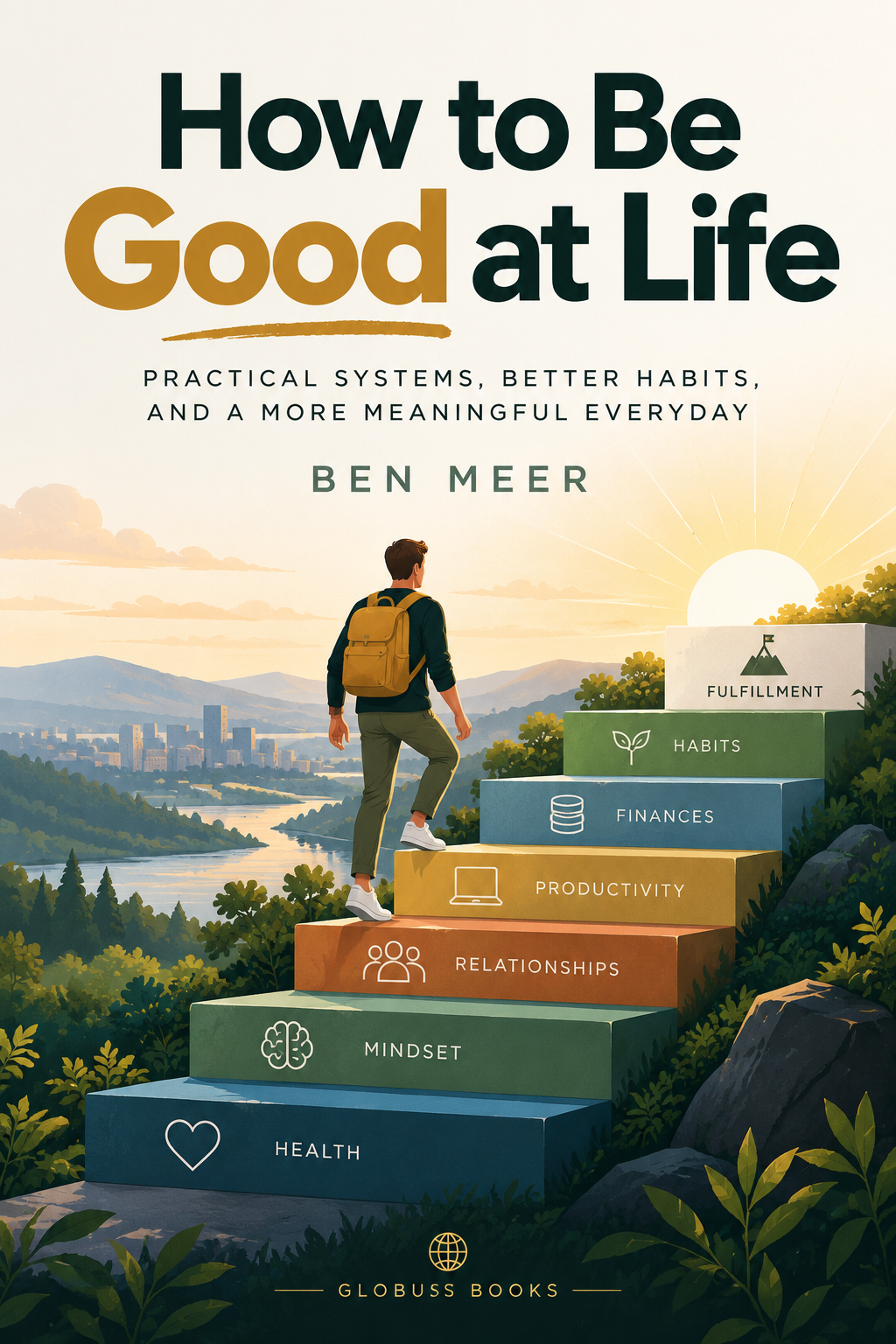
Human-reviewed summary and review
How to Be Good at Life by Ben Meer — Summary & Review
Ben Meer · English
Could practical systems make meaningful goals easier to pursue without depending on constant willpower?
Read the summary first
The short version: Could practical systems make meaningful goals easier to pursue without depending on constant willpower?
Stefan's verdict: Worth considering for Readers who want practical routines and structured goal-setting; less useful if Readers who prefer a free-form philosophical approach to a good life.
4 min review735 wordsOriginal book: Introductory
habitsproductivity
Globusz Books summary
What the book is about
How to Be Good at Life By Ben Meer
Research-based editorial overview — prepared from publisher information, the author's published description, and an independent trade review. This is not a review based on reading the complete book.
What the book is about
Modern life requires us to manage a surprising number of small decisions. We must remember appointments, maintain relationships, look after our health, handle money, and make progress on personal goals. Even when we know what matters, consistently doing the right things can be difficult.
In How to Be Good at Life, Ben Meer proposes that the answer is not always greater motivation or willpower. Instead, he argues for building practical systems that make desirable actions easier to repeat.
The central distinction is between wanting an outcome and creating a reliable process that supports it.
The DRIVE method
Meer organizes his approach around five steps:
1. Define: Clarify the result you want and the problem you need to solve. 2. Reverse Engineer: Work backward from the desired result to identify the actions and conditions required. 3. Implement: Put routines, checklists, habits, and supporting tools into practice. 4. Validate: Examine whether the system is producing useful results. 5. Evolve: Adjust the system as circumstances and priorities change.
Rather than treating a goal as a single challenge requiring sustained enthusiasm, DRIVE encourages readers to construct a repeatable process.
Consider someone who wants to improve physical fitness. A goal might be to exercise more regularly. A supporting system could involve choosing specific exercise days, preparing equipment beforehand, arranging a realistic schedule, and reviewing progress each week.
The example illustrates how systems thinking can reduce dependence on remembering, deciding, and negotiating with oneself every day.
The seven Life Engines
The book extends this approach beyond conventional productivity.
Meer identifies seven interconnected areas: Health, Relationships, Career, Money, Emotions, Mind, and Environment.
These categories help readers recognize that effective living involves more than completing tasks. A well-organized workday is of limited value if relationships, rest, or personal well-being are consistently neglected.
The framework invites readers to consider which parts of life require attention and whether their existing routines support their priorities.
System Sunday
One of the practical tools presented in the book is System Sunday, a weekly ritual for reviewing and organizing everyday responsibilities.
The underlying idea is that regular maintenance can prevent unnecessary decisions and neglected obligations from accumulating.
A weekly review might involve looking at upcoming commitments, identifying unfinished tasks, checking financial responsibilities, and preparing for important activities. The value comes from making this review consistent rather than waiting until something becomes urgent.
What appears useful
The strongest feature of the approach is its emphasis on repeatability.
Systems can provide structure when motivation fluctuates. Checklists reduce dependence on memory. Routines make recurring activities more predictable. Periodic reviews create opportunities to notice what is not working.
The framework also encourages a broader definition of productivity. Its intended outcome is not simply more output, but a calmer and more manageable daily life.
Where caution is useful
Systems are tools, not guarantees.
A routine that works well for one person may be unrealistic for another because of work schedules, family responsibilities, health, or financial constraints. Complex systems may also become burdensome if maintaining them requires more effort than the problems they solve.
The independent Library Journal review notes that the book contains substantial information and may be more useful when approached gradually.
Readers should therefore resist turning every part of life into another optimization project. A simple system that actually gets used is often more valuable than an elaborate one that is abandoned.
Who may benefit
This book may appeal to readers who have several important goals but struggle to maintain consistent progress. It may also interest people who enjoy practical frameworks, structured routines, and regular reflection.
Readers seeking an unstructured, philosophical exploration of a good life may find its systems-oriented approach less appealing.
Globusz Books takeaway
The central lesson is that intentions become more dependable when they are supported by practical structures.
Rather than asking how to stay motivated indefinitely, readers can ask what would make a worthwhile action easier to repeat.
The most useful starting point may be modest: choose one recurring problem, design a simple routine around it, observe the results, and adjust as needed.
Editorial limitation: This overview summarizes and evaluates the publicly documented framework. It does not assess the complete book's argument, evidence, or every example.
Beyond the summary
What might this book awaken in you?
Build a small, repeatable system for one important part of life instead of relying on motivation alone.
Before you commit
Why you might read this
Could practical systems make meaningful goals easier to pursue without depending on constant willpower?
Themes worth noticing
Systems thinking
Small processes make desired actions easier to repeat.
Habits and routines
Repeatable structures support consistency.
Intentional living
Systems should serve meaningful priorities.
What the book does especially well
- A clearly organized five-stage method
- Applies systems thinking to multiple areas of life
Where the book gets shaky
- A framework is not a guarantee of results
- Extensive techniques may overwhelm readers who prefer simplicity
Questions to carry with you
- Where could a repeatable routine reduce unnecessary decisions?
- What small system would improve one meaningful area of life?
If this idea interested you
Related books, with a reason to choose each one.
A different perspective on the same shelfThe Road to JonestownJeff Guinn
Jim Jones was a preacher with a political edge who built a movement promising racial equality and social justice. But beneath his charm lay a hunger for control that turned hope into horror. Jeff Guinn's 'The Road to Jonestown' unravels how idealism morphed into fanaticism with tragic consequences.
Read the summary & review →A useful follow-up for exploring the subject furtherThe Little HeapEdith SödergranEdith Södergran’s "The Little Heap" is a compact burst of modernist poetry that refuses to follow traditional rules. It’s a fragment that demands attention to the small, overlooked pieces of identity and emotion. This isn’t gentle or straightforward—it's a raw, intimate dive into the chaos beneath the surface.
Read the summary & review →Another entry point into this categoryPersepolisMarjane SatrapiMarjane Satrapi’s Persepolis plunges you into a childhood shaped by war, revolution, and relentless political pressure. Through stark black-and-white images, it reveals how a young girl fights to hold onto her identity amid chaos. How do you grow up when your world is constantly being rewritten?
Read the summary & review →Explore the theme
More books about meaning
Continue the journey
Read the original when you are ready.
Globusz Books helps you understand the central ideas before deciding whether the complete book deserves your time.
Read the original if: you want the evidence, stories, examples, nuance, and full argument in the author's own voice.
The summary may be enough if: you only need the central framework or want to decide whether this book suits you.
Is this worth your time if you…?
Readers who want practical routines and structured goal-setting
Found an error or outdated detail? Contact Stefan with a correction.