Human-reviewed summary and review
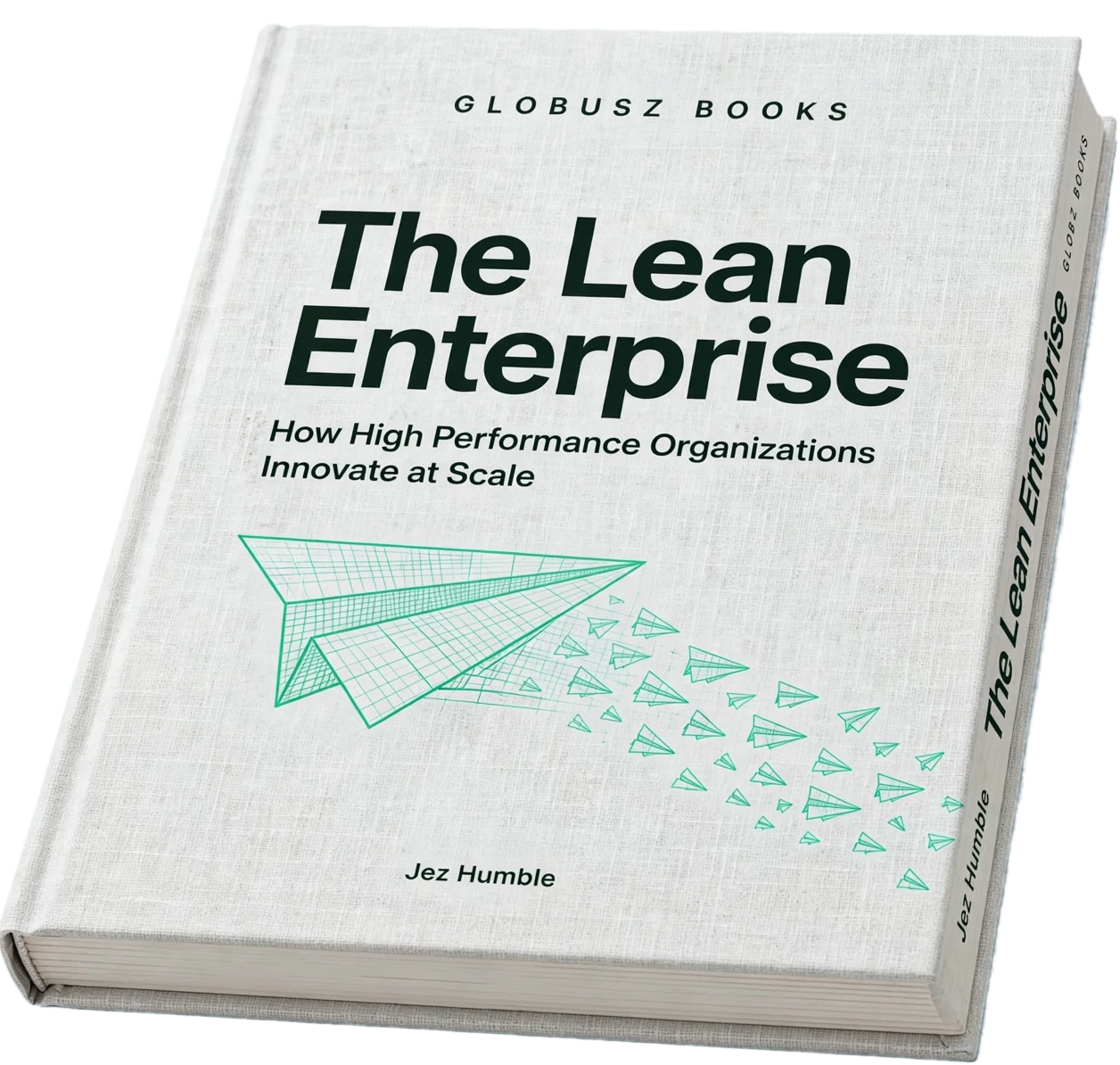
Lean Enterprise: How High Performance Organizations Innovate at Scale by Jez Humble — Summary & Review
Jez Humble · English
Large enterprises often struggle to innovate not because they lack ideas, but because their structures and processes are designed to preserve stability rather than enable change. "Lean Enterprise" reveals how these organizations can dismantle bureaucratic barriers and adopt Lean and Agile principles to innovate at scale without losing control.
Read the summary first
The short version: If your company is big enough to have a million moving parts, you can’t just wish your way into innovation. It takes guts to question how you fund projects, how your leaders behave, and how your culture rewards—or punishes—risk. "Lean Enterprise" doesn’t promise a magic bullet. It offers a hard, honest look at what it takes to move fast while staying stable. If you’re ready to get real about innovation and willing to do the messy work, this book is a solid place to start.
Stefan's verdict: Worth considering for Business leaders and executives in large companies struggling to innovate.; less useful if Small business owners and startup founders looking for basic Agile introductions..
3 min review497 wordsOriginal book: Introductory
Organizational ChangeInnovation ManagementLeadership DevelopmentContinuous ImprovementBusiness Strategy
Globusz Books summary
What the book is about
"Lean Enterprise: How High Performance Organizations Innovate at Scale" confronts the paradox faced by large companies: how to move quickly and innovate like startups while managing the complexity and risk inherent in their size. Jez Humble, Joanne Molesky, and Barry O'Reilly argue that innovation at scale requires more than adopting Agile or Lean practices superficially—it demands a fundamental transformation of culture, governance, and organizational mindset.
The book opens by challenging the entrenched command-and-control management style common in large enterprises. This traditional approach stifles innovation by centralizing decision-making and enforcing rigid processes that discourage experimentation. Instead, the authors advocate for empowering teams to operate autonomously, make decisions rapidly, and learn continuously through fast, small-scale experiments. This shift creates a culture of psychological safety where failure is seen as a learning opportunity rather than a career risk.
Central to the authors’ thesis is the concept of balancing exploration and exploitation within an enterprise portfolio. Large organizations must allocate resources not only to sustaining and improving existing products that generate revenue but also to exploring new, unproven ideas that could become future growth engines. The book provides practical frameworks for managing this delicate balance, helping organizations avoid the twin pitfalls of innovation theater—where efforts are performative but unproductive—and stagnation, where fear of risk leads to missed opportunities.
Governance and financial management are identified as critical levers for enabling innovation. Traditional budgeting cycles and approval processes are often too slow and inflexible to support the rapid experimentation that Lean advocates. The authors propose adaptive funding models and streamlined governance structures that maintain accountability while giving teams the freedom to pivot as they learn. This requires overcoming significant political and organizational resistance, a challenge the book addresses candidly.
The authors enrich their arguments with detailed case studies from diverse industries, illustrating how companies have successfully implemented Lean Enterprise principles. These examples demonstrate that while there is no one-size-fits-all solution, the underlying principles of continuous learning, empowered teams, and adaptive governance are universally applicable.
A standout theme throughout the book is the emphasis on continuous learning as the engine of sustained innovation. Innovation is not a project with a fixed endpoint but an ongoing process embedded in every layer of the organization. Feedback loops must extend beyond product development teams to include leadership and operational units, ensuring that insights drive strategic adjustments in real time.
Leadership transformation is another critical dimension. The authors argue that leaders must transition from controllers to enablers—removing obstacles, aligning incentives, and fostering an environment where teams can act decisively. This requires humility and a willingness to challenge long-held assumptions about authority and control.
Overall, "Lean Enterprise" is a rigorous and pragmatic guide for large organizations seeking to innovate effectively. It does not offer quick fixes or simplistic recipes but instead presents a nuanced roadmap grounded in real-world experience. For executives, managers, and change agents committed to driving meaningful transformation, this book provides both the conceptual framework and actionable strategies necessary to foster a culture of innovation at scale.
Beyond the summary
What might this book awaken in you?
If your company is big enough to have a million moving parts, you can’t just wish your way into innovation. It takes guts to question how you fund projects, how your leaders behave, and how your culture rewards—or punishes—risk. "Lean Enterprise" doesn’t promise a magic bullet. It offers a hard, honest look at what it takes to move fast while staying stable. If you’re ready to get real about innovation and willing to do the messy work, this book is a solid place to start.
Before you commit
Why you might read this
Large enterprises often struggle to innovate not because they lack ideas, but because their structures and processes are designed to preserve stability rather than enable change. "Lean Enterprise" reveals how these organizations can dismantle bureaucratic barriers and adopt Lean and Agile principles to innovate at scale without losing control.
Spoiler sensitivity: lowThis is a nonfiction summary.
Themes worth noticing
Organizational Culture
How the shared values, norms, and behaviors in a company can either nurture or kill innovation.
Innovation at Scale
The unique challenges and strategies for fostering new ideas in large, complex enterprises.
Lean and Agile Principles
Applying iterative development, experimentation, and continuous learning beyond software teams.
Governance and Funding Models
How financial and decision-making structures must evolve to support adaptive innovation.
Leadership and Empowerment
The shift from command-and-control to enabling teams to act quickly and responsibly.
Key ideas, explained
Culture Eats Strategy for Breakfast
The success of Lean transformation hinges on cultivating a culture that embraces experimentation and tolerates failure. Without psychological safety, no amount of process improvement or strategic planning will enable true innovation.
Balancing Exploration and Exploitation
Effective portfolio management requires allocating resources to both sustaining existing products and exploring new opportunities. This balance prevents organizations from either stagnating or chasing every new idea without discipline.
Governance and Funding Should Enable, Not Strangle
Rigid governance and budgeting processes slow down innovation. Lean Enterprise advocates for flexible funding mechanisms and lightweight oversight that empower teams to adapt quickly while maintaining accountability.
Continuous Learning Is the Only Constant
Innovation is an ongoing process that depends on embedding feedback loops at every organizational level. This continuous learning mindset allows companies to adapt strategies based on real-time data and evolving market conditions.
Leadership’s Role Is to Remove Obstacles, Not Command
Leaders must shift from micromanaging to enabling, focusing on clearing barriers and aligning incentives so teams can make decisions swiftly and confidently.
How to Use This Book in Real Life
Create Safe Spaces for Experimentation
Encourage teams to run small, rapid experiments without fear of punishment. Recognize and reward learning from failures as much as from successes to foster a culture of innovation.
Reevaluate Your Budgeting Process
Transition from rigid, annual budgets to flexible funding models that can respond to changing project needs and new information, enabling teams to pivot when necessary.
Implement Portfolio Management That Balances Risk
Develop clear criteria and processes to allocate resources between sustaining current products and exploring new ideas, ensuring a healthy balance that supports both stability and innovation.
Build Feedback Loops Across the Organization
Extend mechanisms for data-driven learning beyond product teams to include all levels of the organization, ensuring continuous adaptation and improvement.
Train Leaders to Support, Not Control
Focus leadership development on skills that remove barriers and empower teams rather than enforcing rigid control, fostering an environment conducive to rapid innovation.
What the book does especially well
- Offers a comprehensive, realistic blueprint for innovation in large, complex organizations.
- Combines Lean and Agile principles with practical case studies, making abstract ideas tangible.
- Addresses cultural, financial, and governance challenges head-on, not just the tech or process side.
- Balances theory with actionable advice, useful for managers and change agents alike.
Where the book gets shaky
- Dense and jargon-heavy at times, requiring multiple reads to fully digest.
- Case studies focus mostly on certain industries, which may limit applicability in others.
- Primarily geared toward large enterprises, so smaller companies or startups might find some advice less relevant.
- Some recommendations, especially around governance changes, may underestimate political resistance in real organizations.
Questions to carry with you
- How does my organization’s culture reward or punish experimentation and failure?
- Are our budgeting and governance processes flexible enough to support innovation?
- Do our leaders empower teams or micromanage them?
- How balanced is our portfolio between exploring new ideas and exploiting existing products?
- What feedback loops exist to help us learn and adapt continuously?
The bottom line
If your company is big enough to have a million moving parts, you can’t just wish your way into innovation. It takes guts to question how you fund projects, how your leaders behave, and how your culture rewards—or punishes—risk. "Lean Enterprise" doesn’t promise a magic bullet. It offers a hard, honest look at what it takes to move fast while staying stable. If you’re ready to get real about innovation and willing to do the messy work, this book is a solid place to start.
If this idea interested you
Related books, with a reason to choose each one.
A different perspective on the same shelfEthical Machines: The Role of Ethics in AI and Machine LearningWendell Wallach
Machines are getting smarter, but do they know right from wrong? Wendell Wallach isn’t just asking if AI can make ethical decisions—he’s digging into how and whether we should even let them try. This isn’t sci-fi daydreaming; it’s a messy, urgent conversation about the moral code behind the algorithms shaping our lives.
Read the summary & review →A useful follow-up for exploring the subject furtherProgramming PearlsJon BentleyProgramming isn’t just banging out lines of code until something works. Jon Bentley’s "Programming Pearls" throws you right into the gritty reality that good programming is about crafting clever, efficient solutions—pearls, if you will—out of messy problems. This book doesn’t hand you magic spells or trendy frameworks; it forces you to think like a problem solver, not a code monkey.
Read the summary & review →Another entry point into this categoryAlgorithms UnlockedThomas H. CormenAlgorithms are the unseen engines running everything from your GPS to your online bank. But if the word makes you glaze over, Thomas Cormen’s 'Algorithms Unlocked' is your chance to get the basics without drowning in jargon. It’s like having a patient friend explain what’s under the hood of your smartphone — minus the tech-speak and with just enough grit to keep it real.
Read the summary & review →Explore the theme
More books about starting over
Technology relevance
Still relevant in 2026: Yes — foundational
Provides foundational knowledge for organizational development.
Topics: Management · Leadership · Organizational Development · Innovation
Continue the journey
Read the original when you are ready.
This summary scratches the surface of the book’s rich insights and practical guidance. The full text dives deeper into the nitty-gritty of shifting organizational culture, redesigning governance, and managing portfolios with real-world examples that bring the concepts to life. It also tackles the political and human challenges that come with such transformations, which are often glossed over elsewhere. For anyone serious about making Lean and Agile work beyond theory, the full book provides a roadmap sprinkled with caution and hard-earned wisdom.
Read the original if: you want the evidence, stories, examples, nuance, and full argument in the author's own voice.
The summary may be enough if: you only need the central framework or want to decide whether this book suits you.
Is this worth your time if you…?
Business leaders and executives in large companies struggling to innovate.
Found an error or outdated detail? Contact Stefan with a correction.