Human-reviewed summary and review
Micrographia by Robert Hooke — Summary & Review
Robert Hooke · en
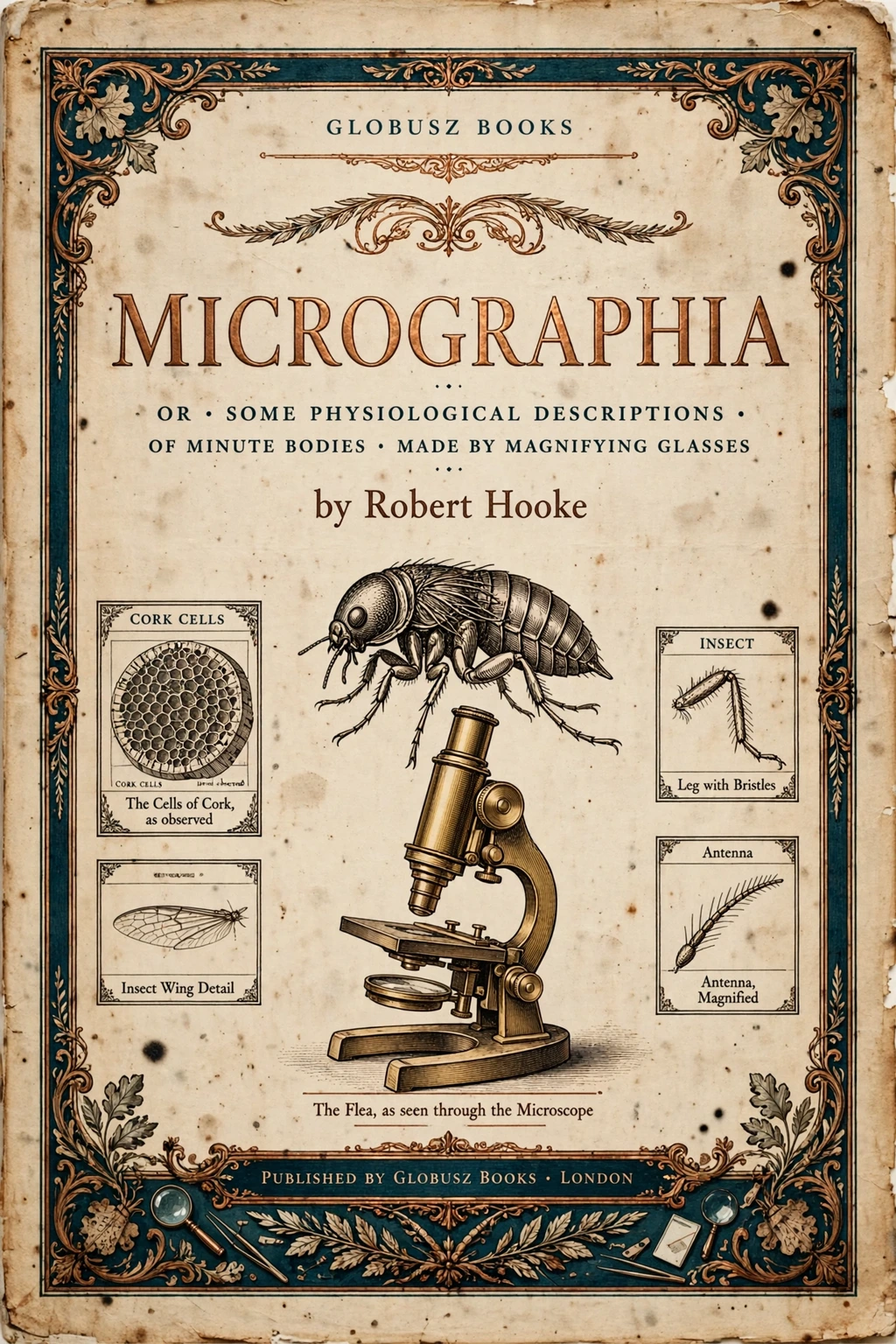
From cork cells to insect anatomy, microscopic observation reveals hidden structures and the limits of ordinary perception.
Read the summary first
The short version: Micrographia opened a new field of attention by showing that the apparently ordinary world contains structures beyond unaided perception. Its historical adaptation makes visible a second achievement: the preservation and revision of scientific knowledge across generations.
Stefan's verdict: Worth considering for History of science readers; less useful if Readers seeking a modern microscopy textbook.
11 min review2,311 wordsOriginal book: Moderate
LearningPerspective
Globusz Books summary
What the book is about
Micrographia
Robert Hooke
Globusz Books | Editorial Summary
Category: Science / Microscopy / History of Science
Original publication: 1665
Reference edition: Microscopic Observations; or, Dr. Hooke's Wonderful Discoveries by the Microscope (London, 1780), also headed Micrographia Restaurata.
Reading level: Moderate to challenging
The Central Idea
A polished needle, a piece of cork and a fly's wing seem to belong to an ordinary world whose basic features we already understand. Under a microscope, however, each becomes an unfamiliar object. Robert Hooke's investigations invite readers to reconsider the confidence they place in their unaided senses. The smallest things are not necessarily the simplest, and the boundaries of human perception are not the boundaries of nature.
The supplied eighteenth-century adaptation makes that invitation through thirty-three engraved plates and accompanying explanations. Its preface explains why the editors did not simply reprint Hooke's original work: the earlier volume had become scarce and expensive, its descriptions were dispersed, and some of its hypotheses had been superseded. The adaptation reorganizes explanations around the illustrations and adds later observations. This summary therefore treats the supplied work as an editorial presentation of Hooke's discoveries, not as an unaltered transcript of his 1665 text.
The common thread is a movement from appearance to structure, from structure to possible explanation, and from explanation to further examination. Magnification reveals surprising shapes, but a surprising picture alone is not a scientific conclusion. The observer must consider light, preparation, scale and alternative interpretations.
Key Idea 1: Ordinary objects become extraordinary when the scale changes
The first plate presents three commonplace manufactured objects: the point of a needle, a printed dot and the edge of a razor. They are deliberately uncomplicated starting points. Before attempting to explain an organism, the investigator can learn how much a seemingly simple object conceals.
The needle that looks sharp and polished to the naked eye exhibits an irregular tip, scratches and hollows. A printed period becomes an uneven patch rather than a perfect circle. The description connects that irregularity with the texture of paper, the distribution of ink and the effects of illumination. The razor, likewise, shows an uneven edge and grooves left by polishing. The side worked on a grindstone is compared to a furrowed field.
These observations do not mean that needles or razors fail to perform their ordinary functions. They show that the qualities we assign to objects are often relative to the scale at which we use them. Smoothness is a useful everyday description without necessarily being an accurate description of a surface under magnification.
The second plate extends the lesson to woven fabric. Fine ribbon consists of interlaced filaments, while the changing sheen of watered silk is connected to the shape of the threads and the way they reflect light. The adaptation explains how the treatment of the fabric changes that shape. An effect appreciated for its beauty becomes an opportunity to investigate a material process.
The historical authors contrast the apparent roughness of human craftsmanship with the intricacy of natural structures, expressing admiration for the Creator. That theological interpretation belongs to the intellectual setting of the work; modern readers need not adopt it to appreciate the observations. Nor does the comparison establish that every natural object is more refined than every manufactured one.
Why it matters
The same object may require different descriptions at different scales. The useful question is not simply whether an appearance is true or false, but what level of detail a particular observation can support.
Key Idea 2: Seeing clearly requires more than a powerful lens
The preface describes Hooke's double microscope and his method of estimating magnification. By viewing a magnified object with one eye and comparing it with a ruler seen by the other, he could relate apparent size to a familiar measure. The account is a reminder that an image needs a reference if it is to communicate dimensions rather than merely impress the observer.
The discussion of animal hair supplies an especially valuable caution. A cat's whisker, viewed in section, appears to contain a particular texture. Under one arrangement of illumination, features seem to be pores; changing the position shows that the light is reflected from them. The adaptation explicitly warns against announcing conclusions before examining an object in different lights and positions.
The same chapter describes sections of hog bristles, horse hair, human hair and the hair of an Indian deer. The comparisons reveal differences in shape and transparency. They also introduce disagreements between investigators about the interior structure of hair. Hooke's interpretation is placed alongside claims by Power, Malpighi and Leeuwenhoek. The reader encounters not a finished encyclopedia of unquestionable facts but an ongoing investigation in which different observers draw different conclusions.
Preparation can itself influence what appears. In the description of cut bristles, marks made by the razor are recognized as consequences of cutting. An investigator who mistakes such marks for the original structure of the object may construct an explanation for something produced by the method of examination.
These examples make the microscope more than a device for extending eyesight. It becomes part of a relationship between instrument, specimen, observer and interpretation. The quality of the resulting knowledge depends on how carefully those elements are distinguished.
Why it matters
Evidence is obtained under particular conditions. Changing those conditions and checking whether a feature persists is a practical way to distinguish the object from the effects of the observation process.
Key Idea 3: Hidden structure helps explain familiar material properties
The eighth plate, devoted in part to cork, contains one of the most celebrated discoveries associated with Hooke. Thin slices reveal numerous cavities separated by walls, resembling a honeycomb. The adaptation describes two differently oriented sections: one exposes the cavities across their width, and the other reveals their arrangement lengthwise.
That change in orientation matters. A three-dimensional arrangement can produce very different appearances in two sections. By examining both, the observer develops a richer understanding than either image could supply independently.
The text estimates the number of small compartments in a given length and extrapolates to an area and a volume. These historical estimates illustrate the enormous number of structures that can occupy a small piece of material. They should not be treated as universal measurements of cork, since actual dimensions vary and the calculation rests on assumptions about the arrangement of the compartments.
The adaptation then connects the structure to cork's everyday properties: its low weight, buoyancy and ability to recover after compression. A material containing substantial enclosed space may occupy considerable volume without containing an equivalent amount of solid matter. The account also considers the elasticity of the partitions. Here the microscopic investigation is valuable because it offers a possible explanation for behavior that people have long observed without seeing its underlying structure.
The historical significance of the cork observation extends beyond the material itself. The compartments are associated with the origin of the biological term cell. As modern historical context, however, it is important to distinguish the empty compartments of mature cork that Hooke examined from the living cells and detailed cellular processes studied in later biology. The seventeenth-century discovery was not yet a complete cell theory.
Why it matters
A visible property may arise from an invisible arrangement of smaller elements. Connecting structure with function is a powerful explanatory strategy, provided the proposed mechanism is tested rather than accepted solely because it seems plausible.
Key Idea 4: Small organisms reveal complex arrangements of parts
The plates devoted to insects make an especially striking impression. Their subjects are readily encountered in everyday life, but their details are difficult or impossible to appreciate without optical assistance.
The twentieth plate presents part of a fly's eye and part of its wing. The eye is described as a group of rounded, reflective surfaces. The author notes that images of windows can be seen reflected in them. The description establishes something about the shape and optical behavior of the surfaces, although it should not be confused with a complete explanation of how an insect's nervous system constructs visual experience.
The wing is described through its membrane, supporting ribs, scales and bristles. Rather than treating a wing as a single undifferentiated sheet, the account distinguishes parts that contribute to its shape and support. The leading edge and the finer features of the membrane receive separate attention. The drawing helps the reader follow these relationships.
The later descriptions of the flea and louse likewise transform familiar pests into subjects of anatomical inquiry. The flea's legs and movement attract attention, and the adaptation discusses its development from eggs through immature forms. The louse is examined in considerable anatomical detail, with comparisons between observers. These are historical investigations into the structure and behavior of living things, not instructions for pest treatment or modern laboratory procedures.
The enlarged images also alter the reader's emotional response. An animal ordinarily dismissed as insignificant or disagreeable becomes a subject worthy of sustained observation. The illustrations allow attention to remain on its organization rather than its ordinary reputation.
The book's language sometimes interprets this complexity through natural theology. The scientific lesson available to a modern reader is that complicated biological structures deserve explanation in their own right. Their form can suggest a function, but establishing the precise function requires more evidence than an attractive resemblance or an engraved representation.
Why it matters
Taking small things seriously expands the range of questions we can ask. Familiarity, size and human usefulness are poor measures of how much there is to learn about an organism.
Key Idea 5: Scientific knowledge improves by revising earlier explanations
The eighteenth-century edition is itself evidence of a changing scientific culture. Its preface praises Hooke's illustrations but rejects the need to reproduce all his speculative opinions. In particular, it identifies spontaneous generation as a once-common doctrine that later investigators had reason to challenge.
The account of blue or white mould illustrates the distinction. A patch found on a red leather book cover appears under magnification as a cluster of delicate stalks bearing rounded heads. The descriptions distinguish heads that are smooth, elongated, cracked or broken, and consider how the appearance varies with growth. Hooke's observations survive even though his suggestion that such organisms might arise from decaying material without seed is challenged by the adaptation.
The later editor appeals to discoveries concerning the reproductive structures of mushrooms and considers whether the heads of the minute organisms might similarly contain reproductive material. The text uses the historical vocabulary of seeds and plants; modern biology distinguishes fungi from plants and describes fungal reproduction using concepts such as spores. The contrast between historical terminology and modern knowledge should remain visible rather than be silently corrected in a way that obscures the history of inquiry.
The preface also describes the recovery of most of Hooke's original copperplates and the preparation of copies to complete the set. It explains that figure labels and page references were introduced to improve usability. The illustrations could thus circulate again with shorter explanations and additional observations. Knowledge depends not only on discovering something but also on preserving, communicating and making it accessible to subsequent readers.
This does not imply that every eighteenth-century addition is correct by modern standards. It shows that the editors understood the value of retaining reliable observations while modifying or discarding explanations that no longer seemed adequate.
Why it matters
An investigator can be mistaken about a cause while still contributing valuable observations. Progress requires the ability to separate those contributions from the interpretations that accompany them.
Five Practical Lessons
1. Begin with a familiar object.
Choose a commonplace object and examine its details before trying to understand a complicated system. The progression from needle and paper to biological specimens shows how simple examples can establish reliable habits of observation.
2. Compare conditions before reaching a conclusion.
Record what changes when the angle, illumination or method of preparation changes. If a feature vanishes under another condition, consider whether it was an effect of observation rather than a permanent property of the object.
3. Describe before explaining.
Keep a clear distinction between a recorded feature and the proposed reason for it. Drawings, measurements and descriptions provide a foundation that alternative explanations can subsequently share.
4. Use more than one view of a structure.
When investigating a complex arrangement, compare different perspectives or sections. Hooke's cork illustrations show how apparently different patterns may belong to the same three-dimensional organization.
5. Preserve evidence while revising beliefs.
Do not discard a useful observation merely because an accompanying interpretation proves wrong. Conversely, do not defend an outdated explanation simply because it came from an important investigator. Let the evidence remain available for reconsideration.
Final Takeaway
Micrographia opened a new field of attention by showing that the apparently ordinary world contains structures beyond unaided perception. Its historical adaptation makes visible a second achievement: the preservation and revision of scientific knowledge across generations.
The needle, cork, mould and insect illustrations each remind us that looking and understanding are different activities. Instruments extend perception, but judgment is still required to interpret what they reveal. The best observations invite comparison, measurement, criticism and further investigation.
The book is worth reading for its historical illustrations and intellectual method, not as an up-to-date reference on microscopy, anatomy or reproduction. Its enduring lesson is to remain curious about the familiar and cautious about conclusions that exceed the evidence.
Editorial Metadata
Primary source: Uploaded 1780 London edition of Microscopic Observations, headed Micrographia Restaurata in the text; title page and preface (PDF pages 1, 3–4), plates I–III, VIII, XX, and the later flea and louse descriptions. The scan has imperfect machine-readable text. This summary uses the adaptation's explanations and distinguishes later editorial additions from Hooke's original work where the source identifies them.
Reader fit: History of science, microscopy, natural history, experimental reasoning and scientific illustration.
Beyond the summary
What might this book awaken in you?
Examine familiar objects at new scales and distinguish observations from explanations.
Before you commit
Why you might read this
From cork cells to insect anatomy, microscopic observation reveals hidden structures and the limits of ordinary perception.
Spoiler sensitivity: lowHistorical scientific nonfiction.
Themes worth noticing
Microscopy
History of Science
Natural History
Scientific Method
Observation
Cell Structure
Key ideas, explained
Ordinary objects become extraordinary when the scale changes
The first plate presents three commonplace manufactured objects: the point of a needle, a printed dot and the edge of a razor. They are deliberately uncomplicated starting points. Before attempting to explain an organism, the investigator can learn how much a seemingly simple object conceals.
The needle that looks sharp and polished to the naked eye exhibits an irregular tip, scratches and hollows. A printed period becomes an uneven patch rather than a perfect circle. The description connects that irregularity with the texture of paper, the distribution of ink and the effects of illumination. The razor, likewise, shows an uneven edge and grooves left by polishing. The side worked on a grindstone is compared to a furrowed field.
These observations do not mean that needles or razors fail to perform their ordinary functions. They show that the qualities we assign to objects are often relative to the scale at which we use them. Smoothness is a useful everyday description without necessarily being an accurate description of a surface under magnification.
The second plate extends the lesson to woven fabric. Fine ribbon consists of interlaced filaments, while the changing sheen of watered silk is connected to the shape of the threads and the way they reflect light. The adaptation explains how the treatment of the fabric changes that shape. An effect appreciated for its beauty becomes an opportunity to investigate a material process.
The historical authors contrast the apparent roughness of human craftsmanship with the intricacy of natural structures, expressing admiration for the Creator. That theological interpretation belongs to the intellectual setting of the work; modern readers need not adopt it to appreciate the observations. Nor does the comparison establish that every natural object is more refined than every manufactured one.
Seeing clearly requires more than a powerful lens
The preface describes Hooke's double microscope and his method of estimating magnification. By viewing a magnified object with one eye and comparing it with a ruler seen by the other, he could relate apparent size to a familiar measure. The account is a reminder that an image needs a reference if it is to communicate dimensions rather than merely impress the observer.
The discussion of animal hair supplies an especially valuable caution. A cat's whisker, viewed in section, appears to contain a particular texture. Under one arrangement of illumination, features seem to be pores; changing the position shows that the light is reflected from them. The adaptation explicitly warns against announcing conclusions before examining an object in different lights and positions.
The same chapter describes sections of hog bristles, horse hair, human hair and the hair of an Indian deer. The comparisons reveal differences in shape and transparency. They also introduce disagreements between investigators about the interior structure of hair. Hooke's interpretation is placed alongside claims by Power, Malpighi and Leeuwenhoek. The reader encounters not a finished encyclopedia of unquestionable facts but an ongoing investigation in which different observers draw different conclusions.
Preparation can itself influence what appears. In the description of cut bristles, marks made by the razor are recognized as consequences of cutting. An investigator who mistakes such marks for the original structure of the object may construct an explanation for something produced by the method of examination.
These examples make the microscope more than a device for extending eyesight. It becomes part of a relationship between instrument, specimen, observer and interpretation. The quality of the resulting knowledge depends on how carefully those elements are distinguished.
Hidden structure helps explain familiar material properties
The eighth plate, devoted in part to cork, contains one of the most celebrated discoveries associated with Hooke. Thin slices reveal numerous cavities separated by walls, resembling a honeycomb. The adaptation describes two differently oriented sections: one exposes the cavities across their width, and the other reveals their arrangement lengthwise.
That change in orientation matters. A three-dimensional arrangement can produce very different appearances in two sections. By examining both, the observer develops a richer understanding than either image could supply independently.
The text estimates the number of small compartments in a given length and extrapolates to an area and a volume. These historical estimates illustrate the enormous number of structures that can occupy a small piece of material. They should not be treated as universal measurements of cork, since actual dimensions vary and the calculation rests on assumptions about the arrangement of the compartments.
The adaptation then connects the structure to cork's everyday properties: its low weight, buoyancy and ability to recover after compression. A material containing substantial enclosed space may occupy considerable volume without containing an equivalent amount of solid matter. The account also considers the elasticity of the partitions. Here the microscopic investigation is valuable because it offers a possible explanation for behavior that people have long observed without seeing its underlying structure.
The historical significance of the cork observation extends beyond the material itself. The compartments are associated with the origin of the biological term cell. As modern historical context, however, it is important to distinguish the empty compartments of mature cork that Hooke examined from the living cells and detailed cellular processes studied in later biology. The seventeenth-century discovery was not yet a complete cell theory.
Small organisms reveal complex arrangements of parts
The plates devoted to insects make an especially striking impression. Their subjects are readily encountered in everyday life, but their details are difficult or impossible to appreciate without optical assistance.
The twentieth plate presents part of a fly's eye and part of its wing. The eye is described as a group of rounded, reflective surfaces. The author notes that images of windows can be seen reflected in them. The description establishes something about the shape and optical behavior of the surfaces, although it should not be confused with a complete explanation of how an insect's nervous system constructs visual experience.
The wing is described through its membrane, supporting ribs, scales and bristles. Rather than treating a wing as a single undifferentiated sheet, the account distinguishes parts that contribute to its shape and support. The leading edge and the finer features of the membrane receive separate attention. The drawing helps the reader follow these relationships.
The later descriptions of the flea and louse likewise transform familiar pests into subjects of anatomical inquiry. The flea's legs and movement attract attention, and the adaptation discusses its development from eggs through immature forms. The louse is examined in considerable anatomical detail, with comparisons between observers. These are historical investigations into the structure and behavior of living things, not instructions for pest treatment or modern laboratory procedures.
The enlarged images also alter the reader's emotional response. An animal ordinarily dismissed as insignificant or disagreeable becomes a subject worthy of sustained observation. The illustrations allow attention to remain on its organization rather than its ordinary reputation.
The book's language sometimes interprets this complexity through natural theology. The scientific lesson available to a modern reader is that complicated biological structures deserve explanation in their own right. Their form can suggest a function, but establishing the precise function requires more evidence than an attractive resemblance or an engraved representation.
Scientific knowledge improves by revising earlier explanations
The eighteenth-century edition is itself evidence of a changing scientific culture. Its preface praises Hooke's illustrations but rejects the need to reproduce all his speculative opinions. In particular, it identifies spontaneous generation as a once-common doctrine that later investigators had reason to challenge.
The account of blue or white mould illustrates the distinction. A patch found on a red leather book cover appears under magnification as a cluster of delicate stalks bearing rounded heads. The descriptions distinguish heads that are smooth, elongated, cracked or broken, and consider how the appearance varies with growth. Hooke's observations survive even though his suggestion that such organisms might arise from decaying material without seed is challenged by the adaptation.
The later editor appeals to discoveries concerning the reproductive structures of mushrooms and considers whether the heads of the minute organisms might similarly contain reproductive material. The text uses the historical vocabulary of seeds and plants; modern biology distinguishes fungi from plants and describes fungal reproduction using concepts such as spores. The contrast between historical terminology and modern knowledge should remain visible rather than be silently corrected in a way that obscures the history of inquiry.
The preface also describes the recovery of most of Hooke's original copperplates and the preparation of copies to complete the set. It explains that figure labels and page references were introduced to improve usability. The illustrations could thus circulate again with shorter explanations and additional observations. Knowledge depends not only on discovering something but also on preserving, communicating and making it accessible to subsequent readers.
This does not imply that every eighteenth-century addition is correct by modern standards. It shows that the editors understood the value of retaining reliable observations while modifying or discarding explanations that no longer seemed adequate.
How to Use This Book in Real Life
Begin with a familiar object.
Choose a commonplace object and examine its details before trying to understand a complicated system. The progression from needle and paper to biological specimens shows how simple examples can establish reliable habits of observation.
Compare conditions before reaching a conclusion.
Record what changes when the angle, illumination or method of preparation changes. If a feature vanishes under another condition, consider whether it was an effect of observation rather than a permanent property of the object.
Describe before explaining.
Keep a clear distinction between a recorded feature and the proposed reason for it. Drawings, measurements and descriptions provide a foundation that alternative explanations can subsequently share.
Use more than one view of a structure.
When investigating a complex arrangement, compare different perspectives or sections. Hooke's cork illustrations show how apparently different patterns may belong to the same three-dimensional organization.
Preserve evidence while revising beliefs.
Do not discard a useful observation merely because an accompanying interpretation proves wrong. Conversely, do not defend an outdated explanation simply because it came from an important investigator. Let the evidence remain available for reconsideration.
Questions to carry with you
- How does magnification change what we know?
- How can we distinguish an observation from an interpretation?
- How does scientific knowledge change over time?
The bottom line
Micrographia opened a new field of attention by showing that the apparently ordinary world contains structures beyond unaided perception. Its historical adaptation makes visible a second achievement: the preservation and revision of scientific knowledge across generations.
The needle, cork, mould and insect illustrations each remind us that looking and understanding are different activities. Instruments extend perception, but judgment is still required to interpret what they reveal. The best observations invite comparison, measurement, criticism and further investigation.
The book is worth reading for its historical illustrations and intellectual method, not as an up-to-date reference on microscopy, anatomy or reproduction. Its enduring lesson is to remain curious about the familiar and cautious about conclusions that exceed the evidence.
If this idea interested you
Related books, with a reason to choose each one.
A different perspective on the same shelf21st Century Nanoscience – A Handbook: Nanopharmaceuticals, Nanomedicine, and Food NanoscienceKlaus D. Sattler
Nanotechnology promises a tiny revolution in how we take medicine and eat our food. But does shrinking stuff down to microscopic bits actually deliver the magic, or is it mostly hype? If you’ve ever wondered what nanoscience really means for your pills, your doctor, or your dinner plate, buckle up—it’s a mixed bag of brilliant potential and messy reality.
Read the summary & review →A useful follow-up for exploring the subject furtherA Brief History of TimeStephen HawkingStephen Hawking’s “A Brief History of Time” cuts through the cosmic fog to explain how the universe works without drowning you in jargon. It’s a clear-eyed tour from ancient models to black holes and quantum puzzles. Can physics really reveal the mysteries of time, space, and everything in between?
Read the summary & review →Another entry point into this categoryA Century of Cosmic Discoveries: Heliophysics and Space Physics, Astrophysics and CosmologyKanaris TsinganosKanaris Tsinganos traces a century of cosmic breakthroughs, from the Sun’s volatile moods to the baffling diversity of exoplanets. This book skips the heavy math and dives into the drama of star birth, planetary oddities, and the universe’s grandest mysteries. Ready for a clear-eyed tour of the cosmos that respects your curiosity without talking down?
Read the summary & review →Explore the theme
More books about perspective
Continue the journey
Read the original when you are ready.
Globusz Books helps you understand the central ideas before deciding whether the complete book deserves your time.
Read the original if: you want the evidence, stories, examples, nuance, and full argument in the author's own voice.
The summary may be enough if: you only need the central framework or want to decide whether this book suits you.
Is this worth your time if you…?
History of science readers
Found an error or outdated detail? Contact Stefan with a correction.