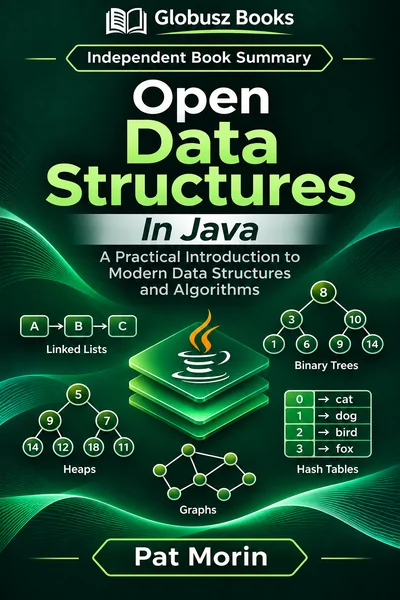
Human-reviewed summary and review
Open Data Structures by Pat Morin — Summary & Review
Pat Morin · English
Measure the cost of an operation, not just the size of the program
Important, but not for everyone
The short version: Open Data Structures teaches a habit of reasoning that remains useful as languages, libraries and platforms change. Efficient software begins with understanding the operations a problem requires and selecting a representation that supports them with acceptable costs. The strongest implementation is not necessarily the most sophisticated one. It is the one whose correctness, performance and maintenance requirements fit the actual task.
Stefan's verdict: Worth considering for Technical learners and software developers; less useful if Readers seeking a nontechnical overview only.
14 min review2,955 wordsOriginal book: Intermediate
Measure the cost of an operation, not just the size of the programSequence representations expose trade-offs between access, insertion and storageDictionaries require a decision between fast exact lookup and useful orderingPriority, sorting and bounded integer keys create specialized opportunitiesRelationships and storage boundaries change the model of the problem
Globusz Books summary
What the book is about
Open Data Structures — Pat Morin
Independent Globusz Books editorial summary and practical learning guide.
Source attribution: Based on Pat Morin's Open Data Structures (in Java), edition 0.1G, available from the author's project under Creative Commons Attribution 2.5 Canada. This text condenses and reorganizes concepts from the original and adds independent commentary and original Java examples. It is not an official edition or an author-endorsed publication. The source license remains applicable to source-derived material.
Central Idea
Programming involves more than expressing a calculation correctly. A program must also organize the information on which that calculation operates. An application that retrieves a record instantly when it contains a hundred items may become frustrating when it holds a million. A different representation of the same information can change that outcome without changing what the application is supposed to accomplish.
Pat Morin's textbook examines this relationship between representation, operations and resource consumption. Its educational ambition is to make the implementation and mathematical analysis of fundamental data structures accessible without requiring students to buy a textbook. The Java edition connects abstract operations with executable implementations, while the openly available project makes further study and experimentation possible.
The central editorial takeaway is that a data structure is a commitment about which operations deserve to be inexpensive. A list, dictionary, priority queue and graph answer different questions. Selecting among them means examining the workload, the guarantees required, the available memory and the complexity of maintaining the implementation. The fastest structure in one situation may be a poor choice in another.
For a reader building real software, the book offers a way to move beyond memorizing collection names. It encourages reasoning about why a representation works, when its performance deteriorates and what must remain true after every update.
Five Key Ideas
1. Measure the cost of an operation, not just the size of the program
The introductory chapter establishes the analytical background for the later implementations. The most useful distinction for a working developer is between an abstract operation and the work needed to perform it. Asking a collection for an element may look like one instruction in Java, even when the implementation must inspect many records.
Asymptotic notation describes how resource requirements grow with input size. Constant growth, logarithmic growth and linear growth imply different scaling behavior. A linear scan of a million records may need to examine every record; a balanced search structure can narrow the search through a much smaller number of decisions. These are statements about growth, not promises about elapsed milliseconds.
Three kinds of performance reasoning deserve separate attention. Worst-case analysis bounds the cost of an individual operation under the stated model. Expected analysis averages over specified random choices. Amortized analysis distributes the total cost of a sequence across its operations. An occasional expensive resize is compatible with inexpensive amortized insertion, even though a particular insertion may be slow.
These distinctions matter when designing a service. A background catalog importer can tolerate occasional expensive operations if overall throughput is good. An interactive interface with strict response deadlines may need a stronger guarantee. Neither workload should be evaluated solely by the average time observed in a small demonstration.
Consider an original example that counts the number of visits to a sequential collection during an unsuccessful search:
static int countVisits(List<String> titles, String target) {
    int visits = 0;
    for (String title : titles) {
        visits++;
        if (title.equals(target)) break;
    }
    return visits;
}
With a target absent from the list, doubling the number of titles doubles the visits. Measuring visits rather than clock time isolates the algorithmic behavior from hardware noise. For production decisions, elapsed time and memory measurements should supplement this reasoning, not replace it.
2. Sequence representations expose trade-offs between access, insertion and storage
The chapters on array-based and linked lists compare ways of maintaining ordered sequences. An array provides direct positional access. Inserting into the middle, however, can require moving existing elements. A linked representation avoids moving a contiguous block when a known node is edited, but finding a position can require following links.
Capacity management introduces another layer of design. An expandable collection can allocate additional storage and transfer its contents when necessary. Reserving extra room reduces how frequently this transfer occurs. Reserving too much wastes memory. The balance between these goals is an example of a policy whose consequences can be analyzed over a sequence of updates.
The text also introduces alternatives that avoid treating every sequence as a simple growable array. A deque supports operations at either end, and more specialized representations divide storage into multiple components. Skip lists provide a different approach: probabilistic shortcuts through ordered elements permit efficient navigation without the same balancing machinery as a conventional search tree.
A practical developer should begin with the interface required by the task. A stack processes the newest item first; a queue processes items in arrival order; a deque permits access at both ends. These behavioral contracts remain distinct even when a single library implementation can satisfy several of them.
For example, a catalog validation job can maintain its pending work in a Java deque:
Deque<String> pending = new ArrayDeque<>();
pending.addLast("check-author");
pending.addLast("check-cover");
pending.addLast("check-license");
while (!pending.isEmpty()) {
    System.out.println(pending.removeFirst());
}
This original example uses ordinary Java library collections rather than reproducing Morin's implementations. It processes tasks in their arrival order. If processing must survive application shutdown, however, an in-memory deque is insufficient: a persistent work log or another durable mechanism is needed. The abstraction solves ordering, not durability.
3. Dictionaries require a decision between fast exact lookup and useful ordering
The hash-table and search-tree chapters examine different ways of maintaining collections searchable by key. In a hash-based design, a key is transformed into a numerical value that helps choose a storage location. Because distinct keys can lead to the same location, the design needs a collision policy.
Chaining groups colliding records together; probing searches for another suitable location in the backing storage. Both approaches depend on how crowded the table becomes and how its hash values are distributed. Equality also needs consistent treatment: a key's hash behavior must remain compatible with the definition of equality. Changing a stored key in a way that changes its hash can make retrieval unreliable.
Hashing is attractive for exact membership questions, but it does not naturally provide a sorted traversal. Search trees instead organize their decisions around comparisons. A balanced tree prevents a long, narrow chain from dominating retrieval costs. The textbook explores randomized search trees, scapegoat trees and red-black trees, demonstrating that the same ordering interface can be supported through different maintenance strategies.
These strategies matter because they offer different types of assurance. Randomized approaches can have favorable expected performance; balanced structures can supply stronger individual-operation bounds. Implementation difficulty, memory overhead and workload characteristics remain legitimate reasons to choose one approach over another.
An original Java example illustrates two distinct indexes over book records:
Map<String, String> byId = new HashMap<>();
NavigableMap<String, List<String>> byTitle = new TreeMap<>();
byId.put("b101", "Ocean Paths");
byTitle.computeIfAbsent("Ocean Paths", k -> new ArrayList<>())
       .add("b101");
System.out.println(byId.get("b101"));
System.out.println(byTitle.ceilingKey("Ocean"));
The first index supports identity lookup; the second supports ordered navigation. A list of identifiers under each title preserves the possibility that separate works share a name. A single map from title to record would silently replace one such work with another. The two indexes must be updated consistently, which introduces an additional maintenance obligation. Choosing a structure includes recognizing the invariants created by that choice.
4. Priority, sorting and bounded integer keys create specialized opportunities
The chapters on heaps, sorting and integer searching expand the selection of tools beyond ordinary dictionaries. A priority queue is useful when the next item to process is determined by a ranking rather than its arrival position. A heap maintains enough order to identify the highest-priority item efficiently without keeping every item in fully sorted order.
Sorting serves another purpose: it transforms an entire collection into a useful sequence. Different sorting methods trade memory, comparisons and sensitivity to the characteristics of the input. The editorial lesson is to distinguish a request for the next best item from a request for the complete ranking. Sorting everything repeatedly to retrieve a single item may do unnecessary work.
The integer-searching material explores the opportunities created when keys come from a bounded numeric domain. Tries navigate through components of key representations rather than relying only on ordinary comparisons. More advanced structures build auxiliary indexes to accelerate navigation. Such choices are interesting when the key format is known, but they introduce assumptions that do not automatically hold for arbitrary strings or objects.
An original priority queue example schedules editorial reviews by urgency:
record Review(String slug, int urgency) {}
PriorityQueue<Review> queue = new PriorityQueue<>(
    Comparator.comparingInt(Review::urgency)
              .thenComparing(Review::slug));
queue.add(new Review("new-title", 3));
queue.add(new Review("broken-link", 1));
System.out.println(queue.remove().slug());
Here a smaller number indicates higher urgency. The secondary comparison makes ties deterministic. A priority queue does not promise that iteration will produce sorted output; successive removal is the appropriate operation when processing in priority order. If urgency changes, remove and reinsert the affected record or use an implementation designed to update priorities. Altering a ranking field in place can invalidate the structure's assumptions.
5. Relationships and storage boundaries change the model of the problem
The graph chapter addresses information whose relationships cannot be expressed adequately by a single linear sequence. Vertices can represent books, authors, topics or prerequisites; edges can represent connections between them. The appropriate representation depends partly on the number of relationships and the operations that will be performed.
A matrix makes an individual adjacency query straightforward but reserves space for every possible pair. A collection of neighbor lists concentrates storage on the connections actually present. When relationships are sparse, the latter can be far more economical. Traversal methods can then explore what is reachable or determine distances in an unweighted network.
The final chapter moves beyond structures designed primarily for main memory and considers searching in external storage. When transfers occur in blocks, counting ordinary comparisons alone can miss a major source of cost. B-trees organize decisions across nodes containing multiple keys, helping reduce the number of block transfers needed to locate information.
These two topics reveal a general principle: the cost model must reflect the environment. A relationship query, a disk access and an in-memory comparison are different activities. An elegant theoretical solution can perform poorly if it optimizes the wrong resource.
An original graph traversal illustrates how a library might discover related topics:
static Set<String> reachable(Map<String, List<String>> links,
                             String start) {
    Set<String> seen = new LinkedHashSet<>();
    Deque<String> todo = new ArrayDeque<>();
    seen.add(start);
    todo.add(start);
    while (!todo.isEmpty()) {
        String current = todo.removeFirst();
        for (String next : links.getOrDefault(current, List.of())) {
            if (seen.add(next)) todo.addLast(next);
        }
    }
    return seen;
}
Marking a vertex when it enters the queue prevents repeated scheduling and handles cycles. With an adjacency-list representation and efficient membership checks, the traversal scales with the portion of the graph explored. A recommendation system would need additional ranking logic: reachability alone does not establish relevance or quality.
Practical Applications
A digital library illustrates how several structures can cooperate. The master records can remain in a sequence suitable for serialization, while a dictionary supports direct access by stable identifier. An ordered index can assist alphabetic browsing. Topic membership can be represented through mappings to lists or sets of identifiers. Related works form a graph. These representations need not imply a database or a continuously running backend; they can be constructed during an offline build.
The important engineering decision is whether the benefit of an additional index justifies its cost. Shipping several complete copies of metadata to a browser may increase network transfer more than it improves search responsiveness. An index containing compact identifiers rather than full records can reduce this duplication. A static application can also generate separate topic pages ahead of time, avoiding the need to assemble them on every visit.
For batch imports, a membership set makes it possible to detect repeated canonical identifiers before writing new files. Normalized titles are a useful secondary signal, but they cannot establish identity on their own. Different editions and unrelated works can share titles. The combination of a reliable identity policy and an efficient structure produces a stronger result than either alone.
For a practical evaluation, generate synthetic collections with increasing sizes and compare sequential lookup against a dictionary. Record construction time, retrieval time and memory consumption separately. Repeat with a mixture of successful and unsuccessful queries. This exposes the often overlooked cost of building the index itself and helps determine whether the application performs enough lookups to justify it.
Critical Assessment
The book's greatest strength is its combination of concrete implementations and mathematical reasoning. Rather than presenting collections as opaque services, it enables readers to investigate how performance guarantees arise. Its open source project also gives technically motivated readers an opportunity to inspect and experiment with the underlying implementations.
The main challenge is the intellectual demand of the material. Readers who have only just learned Java syntax may find probabilistic reasoning, balancing invariants and mathematical proofs difficult. Reading introductory chapters before moving to specialized structures will make the progression more manageable.
The book is not a complete guide to production architecture. Concurrent collections, distributed storage, application security and operational reliability require additional resources. Its model of algorithmic cost is valuable, but practical measurements remain necessary when caches, allocation behavior and storage hardware influence results.
A particularly useful reading strategy is to separate the structures that one needs to implement for educational purposes from those one should implement in production. Standard libraries already provide thoroughly tested implementations of common collections. Understanding their underlying principles helps a developer select and use them responsibly; it does not require replacing them.
Five Practical Lessons
1. Describe the workload before selecting a collection
Write down the operations your application performs most frequently. Distinguish exact lookups, positional access, range queries, ordered traversal and priority processing. Select a representation that supports those operations rather than choosing whatever collection you used in your previous project.
2. State the invariants explicitly
For a catalog, an identifier must refer to exactly one canonical record. For a search tree, ordering must remain consistent after updates. For a priority queue, removal must follow the chosen comparison. Test these conditions after insertions and deletions, especially at boundaries and with repeated keys.
3. Measure growth under realistic workloads
Use multiple input sizes, repeat measurements and distinguish setup costs from operation costs. Include unsuccessful searches, duplicate values and skewed distributions. A benchmark that tests only one small, convenient input may conceal the behavior that matters most.
4. Treat memory and maintenance as real expenses
Every auxiliary index consumes resources and must remain synchronized with its source. Avoid building structures that your application rarely uses. Where persistence matters, include serialization and storage access in the evaluation rather than treating memory as unlimited.
5. Prefer established implementations until evidence supports specialization
Start with reliable standard collections. Study specialized structures to understand the options, then introduce custom implementations only when the workload requires a capability that existing collections cannot provide. Include correctness tests and documentation alongside performance measurements.
Seven-Day Practical Learning Plan
Day 1 — Cost models. Review growth rates and create a small sequential lookup experiment. Count inspected elements for successful and unsuccessful searches. Explain how observed growth relates to the size of the collection.
Day 2 — Lists and queues. Use an array list and a deque to represent pending work. Compare operations at the beginning, middle and end. Identify which interface best communicates the behavior required by each task.
Day 3 — Hashing. Build an identifier index for a synthetic catalog. Test repeated identifiers and distinct records with identical titles. Write down the equality rules and the policy for rejecting conflicts.
Day 4 — Ordered search. Construct an ordered title index. Retrieve a neighboring title and produce a range of entries. Compare these operations with those supported by the identifier dictionary.
Day 5 — Priority and sorting. Create a review queue with deterministic tie handling. Compare processing by priority with sorting a snapshot. Explain when each approach is useful.
Day 6 — Graphs and storage. Model a small network of related subjects. Traverse it from different starting points and include a cycle. Then estimate how the storage requirement would change if a sparse representation were replaced by a matrix.
Day 7 — Integration. Build a miniature catalog with a master record list, an identifier index and a topic mapping. Test consistency after updates, record basic performance measurements and document the purpose of each representation. Remove any index that adds complexity without serving a demonstrated need.
Final Takeaway
Open Data Structures teaches a habit of reasoning that remains useful as languages, libraries and platforms change. Efficient software begins with understanding the operations a problem requires and selecting a representation that supports them with acceptable costs. The strongest implementation is not necessarily the most sophisticated one. It is the one whose correctness, performance and maintenance requirements fit the actual task.
Editorial and Source Notes
The complete online Java edition is available at the source link above. This review uses its introduction to the project, chapter organization and selected chapter introductions on arrays, hashing, red-black trees, graphs and external memory searching. It is not an exhaustive review of every subsection or proof. The code examples are original editorial illustrations using standard Java collections (Java 17 or later; assume import java.util.*; and place statements inside a method). They are not copied textbook implementations and have not been executed for this review.
Beyond the summary
What might this book awaken in you?
Measure the cost of an operation, not just the size of the program
Before you commit
Why you might read this
Measure the cost of an operation, not just the size of the program
Spoiler sensitivity: lowTechnical nonfiction.
Themes worth noticing
Measure the cost of an operation, not just the size of the program
The introductory chapter establishes the analytical background for the later implementations. The most useful distinction for a working developer is between an abstract operation and the work needed to perform it. Asking a collection for an element may look like one instruction in Java, even when the implementation must inspect many records.
Sequence representations expose trade-offs between access, insertion and storage
The chapters on array-based and linked lists compare ways of maintaining ordered sequences. An array provides direct positional access. Inserting into the middle, however, can require moving existing elements. A linked representation avoids moving a contiguous block when a known node is edited, but finding a position can require following links.
Dictionaries require a decision between fast exact lookup and useful ordering
The hash-table and search-tree chapters examine different ways of maintaining collections searchable by key. In a hash-based design, a key is transformed into a numerical value that helps choose a storage location. Because distinct keys can lead to the same location, the design needs a collision policy.
Priority, sorting and bounded integer keys create specialized opportunities
The chapters on heaps, sorting and integer searching expand the selection of tools beyond ordinary dictionaries. A priority queue is useful when the next item to process is determined by a ranking rather than its arrival position. A heap maintains enough order to identify the highest-priority item efficiently without keeping every item in fully sorted order.
Relationships and storage boundaries change the model of the problem
The graph chapter addresses information whose relationships cannot be expressed adequately by a single linear sequence. Vertices can represent books, authors, topics or prerequisites; edges can represent connections between them. The appropriate representation depends partly on the number of relationships and the operations that will be performed.
Key ideas, explained
Measure the cost of an operation, not just the size of the program
The introductory chapter establishes the analytical background for the later implementations. The most useful distinction for a working developer is between an abstract operation and the work needed to perform it. Asking a collection for an element may look like one instruction in Java, even when the implementation must inspect many records.
Asymptotic notation describes how resource requirements grow with input size. Constant growth, logarithmic growth and linear growth imply different scaling behavior. A linear scan of a million records may need to examine every record; a balanced search structure can narrow the search through a much smaller number of decisions. These are statements about growth, not promises about elapsed milliseconds.
Three kinds of performance reasoning deserve separate attention. Worst-case analysis bounds the cost of an individual operation under the stated model. Expected analysis averages over specified random choices. Amortized analysis distributes the total cost of a sequence across its operations. An occasional expensive resize is compatible with inexpensive amortized insertion, even though a particular insertion may be slow.
These distinctions matter when designing a service. A background catalog importer can tolerate occasional expensive operations if overall throughput is good. An interactive interface with strict response deadlines may need a stronger guarantee. Neither workload should be evaluated solely by the average time observed in a small demonstration.
Consider an original example that counts the number of visits to a sequential collection during an unsuccessful search:
```java static int countVisits(List<String> titles, String target) { int visits = 0; for (String title : titles) { visits++; if (title.equals(target)) break; } return visits; } ```
With a target absent from the list, doubling the number of titles doubles the visits. Measuring visits rather than clock time isolates the algorithmic behavior from hardware noise. For production decisions, elapsed time and memory measurements should supplement this reasoning, not replace it.
Sequence representations expose trade-offs between access, insertion and storage
The chapters on array-based and linked lists compare ways of maintaining ordered sequences. An array provides direct positional access. Inserting into the middle, however, can require moving existing elements. A linked representation avoids moving a contiguous block when a known node is edited, but finding a position can require following links.
Capacity management introduces another layer of design. An expandable collection can allocate additional storage and transfer its contents when necessary. Reserving extra room reduces how frequently this transfer occurs. Reserving too much wastes memory. The balance between these goals is an example of a policy whose consequences can be analyzed over a sequence of updates.
The text also introduces alternatives that avoid treating every sequence as a simple growable array. A deque supports operations at either end, and more specialized representations divide storage into multiple components. Skip lists provide a different approach: probabilistic shortcuts through ordered elements permit efficient navigation without the same balancing machinery as a conventional search tree.
A practical developer should begin with the interface required by the task. A stack processes the newest item first; a queue processes items in arrival order; a deque permits access at both ends. These behavioral contracts remain distinct even when a single library implementation can satisfy several of them.
For example, a catalog validation job can maintain its pending work in a Java deque:
```java Deque<String> pending = new ArrayDeque<>(); pending.addLast("check-author"); pending.addLast("check-cover"); pending.addLast("check-license"); while (!pending.isEmpty()) { System.out.println(pending.removeFirst()); } ```
This original example uses ordinary Java library collections rather than reproducing Morin's implementations. It processes tasks in their arrival order. If processing must survive application shutdown, however, an in-memory deque is insufficient: a persistent work log or another durable mechanism is needed. The abstraction solves ordering, not durability.
Dictionaries require a decision between fast exact lookup and useful ordering
The hash-table and search-tree chapters examine different ways of maintaining collections searchable by key. In a hash-based design, a key is transformed into a numerical value that helps choose a storage location. Because distinct keys can lead to the same location, the design needs a collision policy.
Chaining groups colliding records together; probing searches for another suitable location in the backing storage. Both approaches depend on how crowded the table becomes and how its hash values are distributed. Equality also needs consistent treatment: a key's hash behavior must remain compatible with the definition of equality. Changing a stored key in a way that changes its hash can make retrieval unreliable.
Hashing is attractive for exact membership questions, but it does not naturally provide a sorted traversal. Search trees instead organize their decisions around comparisons. A balanced tree prevents a long, narrow chain from dominating retrieval costs. The textbook explores randomized search trees, scapegoat trees and red-black trees, demonstrating that the same ordering interface can be supported through different maintenance strategies.
These strategies matter because they offer different types of assurance. Randomized approaches can have favorable expected performance; balanced structures can supply stronger individual-operation bounds. Implementation difficulty, memory overhead and workload characteristics remain legitimate reasons to choose one approach over another.
An original Java example illustrates two distinct indexes over book records:
```java Map<String, String> byId = new HashMap<>(); NavigableMap<String, List<String>> byTitle = new TreeMap<>(); byId.put("b101", "Ocean Paths"); byTitle.computeIfAbsent("Ocean Paths", k -> new ArrayList<>()) .add("b101"); System.out.println(byId.get("b101")); System.out.println(byTitle.ceilingKey("Ocean")); ```
The first index supports identity lookup; the second supports ordered navigation. A list of identifiers under each title preserves the possibility that separate works share a name. A single map from title to record would silently replace one such work with another. The two indexes must be updated consistently, which introduces an additional maintenance obligation. Choosing a structure includes recognizing the invariants created by that choice.
Priority, sorting and bounded integer keys create specialized opportunities
The chapters on heaps, sorting and integer searching expand the selection of tools beyond ordinary dictionaries. A priority queue is useful when the next item to process is determined by a ranking rather than its arrival position. A heap maintains enough order to identify the highest-priority item efficiently without keeping every item in fully sorted order.
Sorting serves another purpose: it transforms an entire collection into a useful sequence. Different sorting methods trade memory, comparisons and sensitivity to the characteristics of the input. The editorial lesson is to distinguish a request for the next best item from a request for the complete ranking. Sorting everything repeatedly to retrieve a single item may do unnecessary work.
The integer-searching material explores the opportunities created when keys come from a bounded numeric domain. Tries navigate through components of key representations rather than relying only on ordinary comparisons. More advanced structures build auxiliary indexes to accelerate navigation. Such choices are interesting when the key format is known, but they introduce assumptions that do not automatically hold for arbitrary strings or objects.
An original priority queue example schedules editorial reviews by urgency:
```java record Review(String slug, int urgency) {} PriorityQueue<Review> queue = new PriorityQueue<>( Comparator.comparingInt(Review::urgency) .thenComparing(Review::slug)); queue.add(new Review("new-title", 3)); queue.add(new Review("broken-link", 1)); System.out.println(queue.remove().slug()); ```
Here a smaller number indicates higher urgency. The secondary comparison makes ties deterministic. A priority queue does not promise that iteration will produce sorted output; successive removal is the appropriate operation when processing in priority order. If urgency changes, remove and reinsert the affected record or use an implementation designed to update priorities. Altering a ranking field in place can invalidate the structure's assumptions.
Relationships and storage boundaries change the model of the problem
The graph chapter addresses information whose relationships cannot be expressed adequately by a single linear sequence. Vertices can represent books, authors, topics or prerequisites; edges can represent connections between them. The appropriate representation depends partly on the number of relationships and the operations that will be performed.
A matrix makes an individual adjacency query straightforward but reserves space for every possible pair. A collection of neighbor lists concentrates storage on the connections actually present. When relationships are sparse, the latter can be far more economical. Traversal methods can then explore what is reachable or determine distances in an unweighted network.
The final chapter moves beyond structures designed primarily for main memory and considers searching in external storage. When transfers occur in blocks, counting ordinary comparisons alone can miss a major source of cost. B-trees organize decisions across nodes containing multiple keys, helping reduce the number of block transfers needed to locate information.
These two topics reveal a general principle: the cost model must reflect the environment. A relationship query, a disk access and an in-memory comparison are different activities. An elegant theoretical solution can perform poorly if it optimizes the wrong resource.
An original graph traversal illustrates how a library might discover related topics:
```java static Set<String> reachable(Map<String, List<String>> links, String start) { Set<String> seen = new LinkedHashSet<>(); Deque<String> todo = new ArrayDeque<>(); seen.add(start); todo.add(start); while (!todo.isEmpty()) { String current = todo.removeFirst(); for (String next : links.getOrDefault(current, List.of())) { if (seen.add(next)) todo.addLast(next); } } return seen; } ```
Marking a vertex when it enters the queue prevents repeated scheduling and handles cycles. With an adjacency-list representation and efficient membership checks, the traversal scales with the portion of the graph explored. A recommendation system would need additional ranking logic: reachability alone does not establish relevance or quality.
How to Use This Book in Real Life
Describe the workload before selecting a collection
Write down the operations your application performs most frequently. Distinguish exact lookups, positional access, range queries, ordered traversal and priority processing. Select a representation that supports those operations rather than choosing whatever collection you used in your previous project.
State the invariants explicitly
For a catalog, an identifier must refer to exactly one canonical record. For a search tree, ordering must remain consistent after updates. For a priority queue, removal must follow the chosen comparison. Test these conditions after insertions and deletions, especially at boundaries and with repeated keys.
Measure growth under realistic workloads
Use multiple input sizes, repeat measurements and distinguish setup costs from operation costs. Include unsuccessful searches, duplicate values and skewed distributions. A benchmark that tests only one small, convenient input may conceal the behavior that matters most.
Treat memory and maintenance as real expenses
Every auxiliary index consumes resources and must remain synchronized with its source. Avoid building structures that your application rarely uses. Where persistence matters, include serialization and storage access in the evaluation rather than treating memory as unlimited.
Prefer established implementations until evidence supports specialization
Start with reliable standard collections. Study specialized structures to understand the options, then introduce custom implementations only when the workload requires a capability that existing collections cannot provide. Include correctness tests and documentation alongside performance measurements.
What the book does especially well
- Structured technical learning and practical examples.
Where the book gets shaky
- Selective source review; not an exhaustive textbook substitute.
- Original examples have not been comprehensively tested.
Questions to carry with you
- How can I apply measure the cost of an operation, not just the size of the program?
- How can I apply sequence representations expose trade-offs between access, insertion and storage?
- How can I apply dictionaries require a decision between fast exact lookup and useful ordering?
The bottom line
Open Data Structures teaches a habit of reasoning that remains useful as languages, libraries and platforms change. Efficient software begins with understanding the operations a problem requires and selecting a representation that supports them with acceptable costs. The strongest implementation is not necessarily the most sophisticated one. It is the one whose correctness, performance and maintenance requirements fit the actual task.
If this idea interested you
Related books, with a reason to choose each one.
A different perspective on the same shelf97 Things Every Programmer Should Know: Collective Wisdom from the ExpertsKevlin Henney (Editor)
Programming advice is a dime a dozen, but few collections pack 97 sharp, no-nonsense tips from real experts into one slim volume. This isn’t a manifesto or a how-to manual; it’s more like a grab-bag of wisdom nuggets that remind you why some basics never go out of style. If you think you know it all or just want a quick sanity check, this book throws in perspectives you didn’t know you needed.
Read the summary & review →A useful follow-up for exploring the subject furtherAccelerate: The Science of Lean Software and DevOpsNicole ForsgrenSoftware delivery isn’t just about pushing code faster. It’s about pushing code better, smarter, and with less chaos. "Accelerate" cuts through the DevOps noise with cold, hard data to show what really moves the needle in tech performance—and, spoiler, it’s not magic tricks or buzzwords.
Read the summary & review →Another entry point into this categoryAccelerate: The Science of Lean Software and DevOpsNicole Forsgren, Jez Humble, Gene KimFast software delivery isn’t just about cranking out code like a caffeine-fueled robot. It’s about doing it reliably, repeatedly, and without blowing up your production environment every other week. “Accelerate” throws cold water on the myth that speed and stability are enemies and backs its claims with data from thousands of real companies, not just hype or wishful thinking.
Read the summary & review →Explore the theme
More books about starting over
Continue the journey
Read the original when you are ready.
The complete source provides fuller explanations and exercises beyond this review.
Read the original if: you want the evidence, stories, examples, nuance, and full argument in the author's own voice.
The summary may be enough if: you only need the central framework or want to decide whether this book suits you.
Is this worth your time if you…?
Technical learners and software developers
Found an error or outdated detail? Contact Stefan with a correction.