9 min review1,875 wordsRevised edition: 203 pagesOriginal book: Introductory
Self-developmentHabitsOverthinkingRelationshipsResilienceMindfulness
Human-reviewed summary and review
START THERE by Stefan Motz — Summary & Review
Stefan Motz · English
A practical self-development book for the days when motivation and perfect conditions do not show up. Its revised five-move method helps readers notice resistance, shrink the next useful action, begin, return without punishment, and repeat what proves useful—while recognizing when a problem needs more than a small step.
Worth reading
The short version: START THERE argues that the most useful self-development method is one that still works when you are not at your best. Instead of waiting to become motivated, calm, disciplined, confident, or certain, notice what is happening and find the smallest real action available now.
Stefan's verdict: Worth considering for Readers who know what they should do but struggle to begin consistently; less useful if Readers looking for a highly academic psychology text or a heavily research-driven behavioral manual.
Author book summary
What the book is about
START THERE begins with a deliberately modest proposition: most people do not need a more impressive plan for changing their lives. They need a way to begin when they are tired, distracted, doubtful, angry, embarrassed, afraid, or simply not in the mood. Stefan Motz builds the book around what he calls the Too-Small-to-Argue-With principle: when resistance becomes loud, make the beginning smaller than the resistance.
The idea comes from an ordinary moment. Motz did not want to exercise, and instead of negotiating with himself about a proper workout, he did one push-up. One push-up did almost nothing for his fitness, but it changed his position psychologically. Before it, he was deciding whether to exercise. After it, he had already begun. That distinction becomes the organizing insight of the book: the distance between zero and one is often more important than the distance between one and ten.
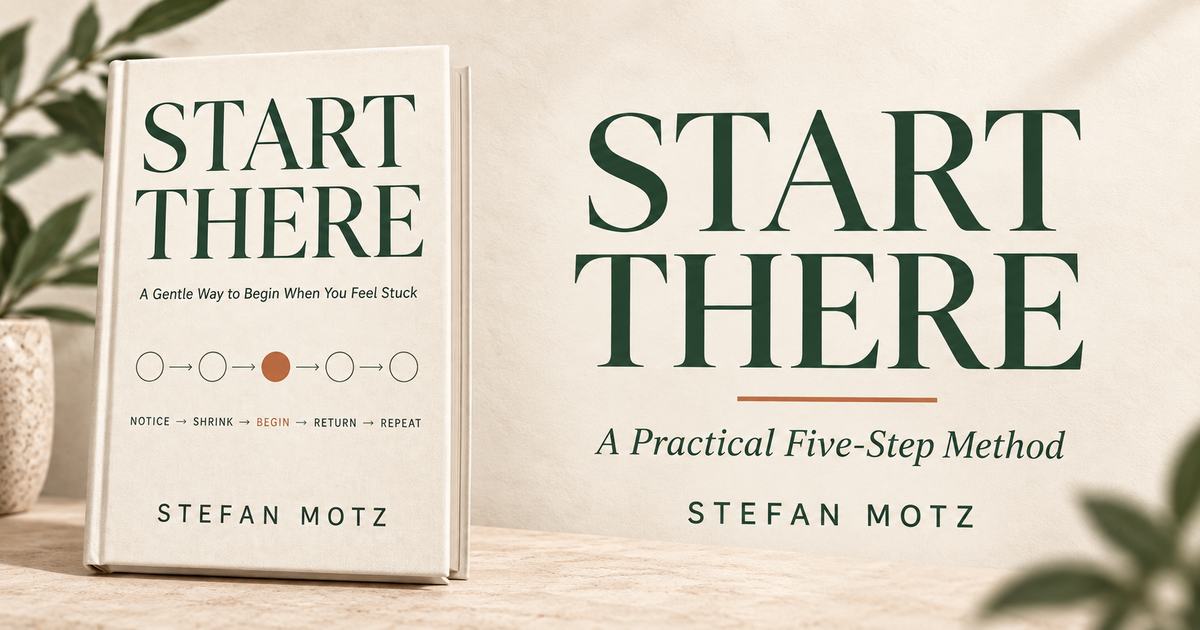
From that insight, Motz develops a five-move loop: NOTICE, SHRINK, BEGIN, RETURN, and REPEAT. In the revised edition, each move has one precise job. NOTICE describes reality accurately without turning behavior into identity. SHRINK reduces the scope of the next useful action until negotiation loses some of its force. BEGIN replaces imagined action with real information. RETURN makes interruption temporary without punishment. REPEAT lets recurrence create evidence about what helps and what deserves to remain part of an ordinary life.
The book does not claim that small habits are a new discovery. Its contribution is an order of operations for moments when resistance is emotional, not merely logistical. It also draws an important distinction: small does not mean easy. A five-minute conversation can be harder than an hour of cleaning, and one call to a lawyer, doctor, therapist, creditor, or family member may be frightening and consequential. “Small” describes a defined scope, not the emotional weight of the action.
Part I, NOTICE, applies the loop to resistance, attention, meditation, overthinking, and habits. Motz argues that procrastination is often less mysterious than it feels. Sometimes people are not avoiding a task so much as the feeling attached to it: boredom, uncertainty, embarrassment, fear of rejection, or fear that reality will disappoint an attractive idea. Instead of asking “What is wrong with me?” he recommends asking “What am I avoiding right now?” and then identifying one real action small enough to take. Opening the bank account, writing one sentence, making one phone call, or walking to the end of the street may not solve the larger problem, but it crosses the line between imagining and acting.
Attention is treated as a form of participation in one’s own life. Motz remembers his mother pointing out flowers, stars, clouds, and mountains when he was a child. Only later did he understand that she was teaching him to notice. The book’s version of mindfulness is not an attempt to become permanently serene. It is the practical act of realizing where attention has gone and bringing it back—to a conversation, a meal, a walk, a person you love, or the simple fact that for this particular minute nothing is wrong. Technology is not blamed; Motz likes technology. The concern is whether a person is choosing where attention goes or merely discovering, forty-five minutes later, where a screen carried it.
The meditation chapter continues the same theme. Motz describes years of believing that noise, restlessness, thoughts, and even an itch meant he was doing meditation badly. His later conclusion is almost the opposite: noticing distraction and returning is the practice. A wandering mind does not produce fifty failures; it can produce fifty repetitions of returning. The book strips meditation of the need for spiritual theater. Three breaths can count. Sitting in a chair can count. Scratching your nose is allowed. What matters is whether the skill becomes available later—when anger rises, worry loops begin, or an irritating message arrives.
Overthinking receives similar treatment. Motz distinguishes reflection, which produces a lesson or an action, from rumination, which keeps circling the same material. He writes about replaying a tasteless joke he made to his wife and about lying awake during a period of serious financial stress involving a totaled car and an IRS dispute. The problems were real, but thinking about them at two in the morning did not mean he was working on them. The useful question became: Is there an action available now? If yes, shrink it and begin. If not, give the problem an appointment—write down what needs to happen and when—and stop requiring the mind to keep the issue open all night.
Habits are framed less as tests of character than as questions of friction. Motz left dumbbells where he could see them, moved his phone away from the bed, put a book where the phone had been, used reminders, and attached new actions to routines that already existed. The principle is simple: reduce friction for behaviors you want more of and add friction to behaviors you want less of. A useful system should work not only for an idealized, highly motivated version of you, but also for the tired version who arrives at the end of an ordinary day.
Parts II and III separate SHRINK from BEGIN. SHRINK reduces the next useful action without minimizing the feeling or problem; BEGIN turns that smaller move into contact with reality. These sections deal with anger, self-judgment, approval, disagreement, relationships, decision-making, and knowing when to leave. Motz does not write about anger as an abstract problem. He acknowledges breaking phones, smashing a laptop, saying things he regretted, and seeking professional help because he did not like what his temper could turn him into. His practical target is not instant sainthood. It is one more second before doing something expensive. A pause, a breath, leaving the room, or delaying a message can prevent five minutes of emotion from damaging five years of work or trust.
That same refusal to turn imperfection into identity appears in the chapters on self-criticism and approval. The book repeatedly separates behavior from worth. A bad decision can be examined without making the entire self the defendant. Being wrong does not mean a person has nothing worth saying; being criticized does not mean the critic is always right; being disliked does not necessarily mean something must be repaired. Motz’s broader argument is that self-honesty works better when it is not confused with self-punishment.
Relationships receive some of the book’s most personal material. Motz writes about learning that love does not automatically make two people compatible, about remaining in a troubled marriage too long, leaving and returning, and eventually leaving for good. He also describes the relationship that followed and the importance of accepting differences rather than treating them as defects to be corrected. In another chapter, he recalls learning that sometimes the most useful response to someone you love is not a solution. When his wife needed him to listen, his instinct was to fix. The lesson was to ask what kind of help is actually being requested before supplying the kind that makes the helper feel useful.
Decision-making is treated with similar skepticism toward hindsight. The book explores sunk costs, impulsive choices, and the temptation to keep investing in something merely because one has already invested heavily. Motz uses his own expensive mistakes rather than presenting himself as someone who mastered decision-making long ago. The larger lesson is that past cost is information, not a command. What matters is what the next decision buys from this point forward.
Parts IV and V focus on RETURN and REPEAT. The chapters widen the lens to asking for help, starting over, comparison, money, curiosity, gratitude, thoughts, acceptance, and the question of what makes a good life. Motz’s life provides much of the connective tissue: growing up in Romania, living in Hungary, moving to the United States, working in different occupations, building Globusz Publishing, learning technology, changing careers, leaving relationships, beginning again, and gradually becoming less interested in proving himself through grand outcomes.
The chapter on asking for help is especially consistent with the book’s central method. Motz describes delaying a request for technical help because he wanted to solve the problem himself. Pride made the problem larger than it needed to be. Asking one person one clear question turned out to be a small action with disproportionate value. Starting over is likewise presented not as a return to zero but as a move made with accumulated experience—even when circumstances force a person into a position that feels frighteningly close to the beginning.
Money receives a deliberately unsentimental treatment. Motz does not claim that mindset makes material problems disappear. Money can solve many real problems, and lack of it can create severe stress. But money also fails to answer questions of attention, relationships, purpose, regret, or inner steadiness. The book resists the common self-help mistake of converting every difficulty into a mindset problem. Some situations require money, expertise, legal help, medical care, boundaries, or leaving. A small step matters because even large changes have an entry point, not because every large problem is secretly small.
The closing chapters become quieter. Curiosity is described as a form of youth: continuing to learn, ask questions, try technology, study a language, or explore an unfamiliar subject keeps life from becoming psychologically finished before it has to. Gratitude is not presented as a demand to feel positive about everything. It is the ability to notice what is already good without requiring life to become perfect first. Thoughts are treated as mental events rather than automatic instructions. Acceptance is separated from passivity: accepting what cannot be changed can free attention for the part that still can.
The revised edition then adds Part VI, WHEN SMALL IS NOT ENOUGH. A small step can restore movement, but it cannot guarantee safety, cure illness, erase grief, repair every relationship, replace money, or force an institution to act fairly. Sometimes the first action reveals that the problem is larger than hoped. The method should move a person toward appropriate medical, psychological, legal, or financial help—not persuade them to handle everything alone. This section also asks readers to notice when shrinking has become avoidance and when persistence is serving an expired goal. The method is not loyal to the goal; it is loyal to reality.
The final question is not how to become an optimized person. It is what makes a good life. Motz’s answer is intentionally ordinary: freedom from unnecessary fear, the ability to choose how to spend a day, time with people who matter, enough self-respect not to waste life on constant comparison or self-attack, curiosity, useful work, small moments of beauty, and the willingness to make the next honest move when something needs to change.
START THERE is therefore less a system for reinvention than a system for re-entry. It assumes you will lose momentum, get distracted, make foolish decisions, become angry, avoid things, and occasionally know better without doing better. The method is designed for that reality. Notice what is happening. Make the next useful move smaller. Begin before you feel completely ready. Return when you wander away. Repeat what proves useful. The promise is modest, but that modesty is part of the book’s strength: you do not have to become a different person before you can begin treating your life differently.
Beyond the summary
What might this book awaken in you?
It may make you less interested in dramatic self-reinvention and more willing to take one honest, useful action today. The deeper shift is from treating inconsistency as proof of failure to treating return as a skill.
Before you commit
Why you might read this
A practical self-development book for the days when motivation and perfect conditions do not show up. Its revised five-move method helps readers notice resistance, shrink the next useful action, begin, return without punishment, and repeat what proves useful—while recognizing when a problem needs more than a small step.
Spoiler sensitivity: lowThis is a nonfiction self-development book; the summary discusses its central method and examples openly.
Themes worth noticing
Behavior change
Change begins by reducing the next useful action until resistance has less room to negotiate.
Attention
A better life is partly a matter of noticing the life already happening instead of spending most of it somewhere else mentally.
Self-honesty
The book favors accurate descriptions of behavior over global judgments about character.
Emotional regulation
Anger, worry, rumination, and self-criticism become more workable when a pause appears between feeling and action.
Relationships
Listening, boundaries, compatibility, disagreement, and knowing when to leave are treated as practical skills rather than slogans.
Starting over
A restart is never truly from zero because experience, scars, skills, and judgment come with you.
Limits of self-help
Small actions can restore agency, but some problems require safety, money, boundaries, professional help, leaving, or an honest decision to stop.
Key ideas, explained
The Too-Small-to-Argue-With principle
When resistance is loud, reduce the beginning until the mind has almost nothing left to negotiate. The first action does not need to accomplish the goal; it needs to cross the line between zero and something.
The START THERE loop
NOTICE describes reality accurately. SHRINK reduces the scope of the next useful action. BEGIN creates real information. RETURN makes interruption temporary. REPEAT creates evidence about what helps.
Small does not mean easy
Small refers to scope, not emotional difficulty or consequence. A short conversation, appointment, boundary, disclosure, or legal call may be one defined action and still be frightening, expensive, or life-changing.
Consistency includes interruption
A broken streak is not the most useful measure. The more revealing question is how long it takes to return. Systems designed only for perfect performance are poorly designed for human lives.
Reflection moves; rumination circles
Useful thinking produces information, a decision, an apology, a lesson, or a next action. When the same mental material keeps repeating without producing anything new, more thinking may no longer be the answer.
Friction shapes behavior
Environment is constantly voting. Visible dumbbells, a phone beside the bed, a book within reach, or a reminder attached to an existing routine can change behavior without requiring a daily contest of willpower.
A pause can be more valuable than control
With anger and other fast emotions, the immediate objective is not to become perfectly calm. It is to create enough space to avoid an action whose consequences will outlast the feeling.
Acceptance and action are partners
Acceptance is not giving up. It means ceasing to spend energy trying to rewrite what is no longer available for change so that attention can return to what still is.
The method is loyal to reality
Persistence is not automatically wise. A goal can expire, a relationship can become unsafe, and new evidence can make the old plan wrong. Sometimes the useful move is professional help, distance, or an ending.
How to Use This Book in Real Life
Shrink one avoided task today
Choose something you have been postponing and reduce it to an action that takes less than five minutes: open the document, make the appointment, read the first page, or send the first sentence.
Give recurring worries an appointment
Write down what the problem is, what action is available, and when you will take it. This gives the mind somewhere to put unfinished business instead of keeping it open continuously.
Redesign one cue
Move one object or change one environmental cue so that the useful behavior becomes easier or the unhelpful behavior requires an extra step.
Practice one return
In meditation, exercise, writing, learning, or another habit, stop treating a lapse as a ceremonial failure. Return once, without punishment or a speech about the new you.
Ask before fixing
In a difficult conversation, find out whether the other person wants advice, practical help, or simply to be heard. Listening is sometimes the entire useful action.
Separate the past cost from the next decision
Ask what continuing will cost and what it will buy from this point forward. Time, money, or pride already spent should not automatically control the next choice.
Test whether the step is real
Ask whether the action changes your contact with reality. A sent message, booked appointment, disclosed number, stated boundary, completed attempt, or decision counts; reorganizing the plan again may not.
Name the help the problem requires
Identify what exceeds ordinary self-help, then choose one qualified person, service, boundary, or decision that can address that part of the problem.
What the book does especially well
- The central method is memorable, simple, and repeatedly applied across very different areas of life.
- Personal stories keep the book grounded; the author does not present himself as someone who has finished improving.
- The revised edition makes modest claims, distinguishes small from easy, and gives the limits of self-help their own section.
- Humor and self-criticism keep potentially preachy material conversational.
- The emphasis on returning after interruption is more realistic than streak-based versions of consistency.
Where the book gets shaky
- Readers who want a formal scientific treatment of behavior change will find the book intentionally more experiential than academic.
- The same five-move framework is applied across many areas, so readers who prefer a shorter, single-purpose argument may still feel they understand the core lesson early.
- The book favors flexible principles over a tightly prescribed program, which may frustrate readers who prefer detailed schedules and worksheets.
Questions to carry with you
- What am I waiting to feel before I allow myself to begin?
- What is the smallest useful action that would move this from zero to something?
- Am I working on the problem, or only thinking about the problem?
- What in my environment is making the behavior I want unnecessarily difficult?
- When I fail to stay consistent, how quickly can I return without turning the interruption into an identity?
- What parts of a good life are already present but receiving too little of my attention?
- Is this small step changing my contact with reality, or only helping me feel busy?
- What part of this problem exceeds ordinary self-help?
The bottom line
START THERE argues that the most useful self-development method is one that still works when you are not at your best. Instead of waiting to become motivated, calm, disciplined, confident, or certain, notice what is happening and find the smallest real action available now.
The book's central contribution is not the claim that small steps matter; that idea is familiar. It is the five-part order of operations for emotional resistance, followed by an explicit test of its limits. NOTICE, SHRINK, BEGIN, RETURN, and REPEAT connect small beginnings with returning after failure, interrupting emotional momentum, reducing environmental friction, separating thinking from action, and accepting the limits of control. Part VI then asks when the honest move is professional help, a boundary, an ending, or a larger intervention.
Its final message is deliberately unglamorous: you do not need to rebuild your identity before you can improve your life. You need enough honesty to see what keeps happening, enough humility to work with the mind you actually have, and enough self-respect to take the next useful step.
Explore the theme
More books about starting over
Continue the journey
Read the revised START THERE in full.
The summary can explain the revised method, but the full book earns much of its value through Stefan Motz's stories: procrastinating at work, learning meditation, damaging things in anger, financial stress, difficult relationships, changing countries and careers, asking for help, starting over, and gradually redefining what a good life means. The new reader edition also tests the method where small actions are insufficient and reality requires qualified help, safety, distance, or stopping.
Read the original if: you want the evidence, stories, examples, nuance, and full argument in the author's own voice.
The summary may be enough if: you only need the central framework or want to decide whether this book suits you.
Is this worth your time if you…?
Readers who know what they should do but struggle to begin consistently
Found an error or outdated detail? Contact Stefan with a correction.