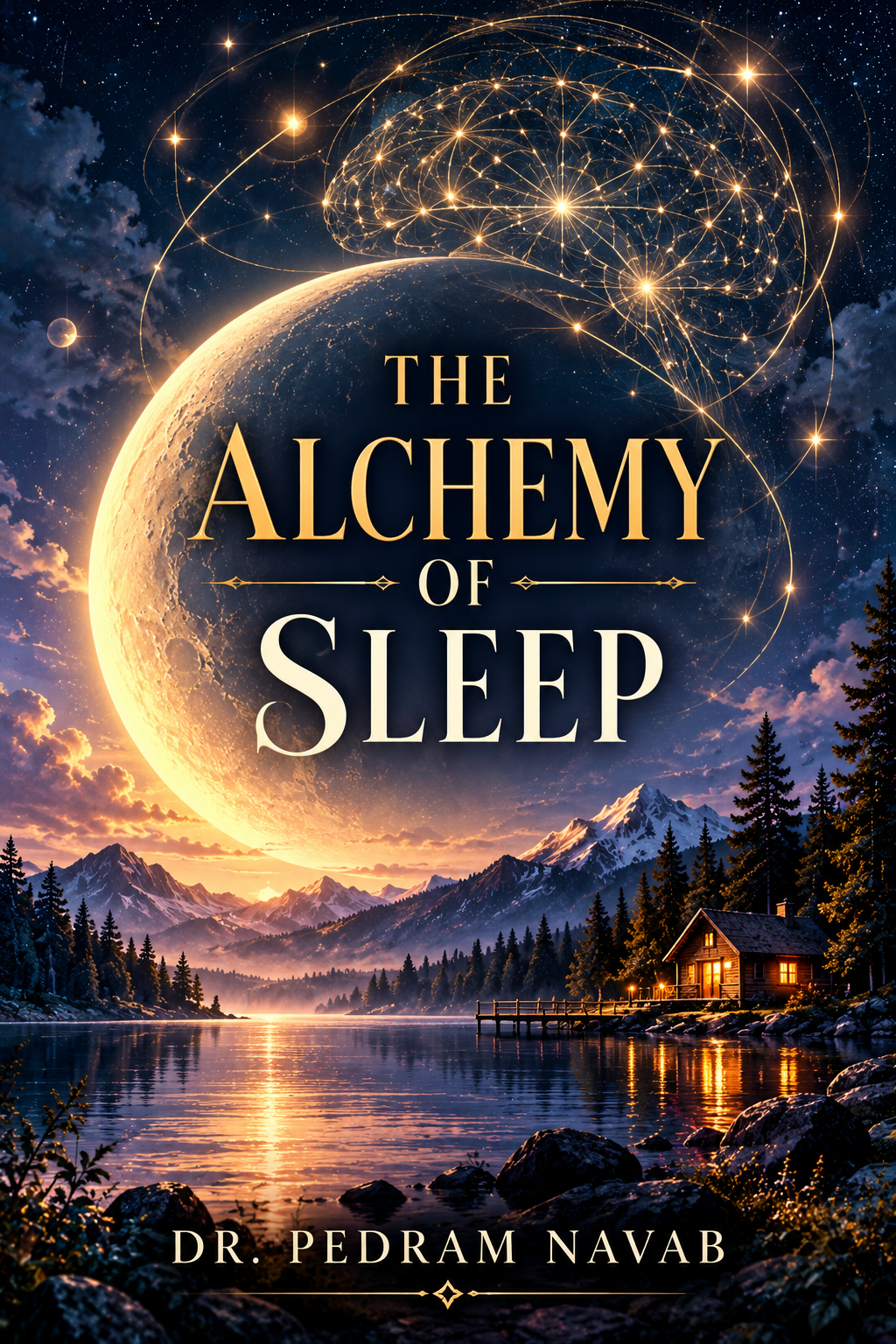
Source-grounded Editorial Overview
The Alchemy of Sleep by Dr. Pedram Navab — Editorial Overview
Dr. Pedram Navab · en
What if a better relationship with sleep begins not with a perfect score, but with a more curious understanding of rest? Dr. Pedram Navab brings sleep science into conversation with dreams, reflection, and spiritual traditions.
About this Editorial Overview: Based on publisher descriptions, author interviews, and trade reviews. The complete book was not reviewed; this is not a chapter-by-chapter or full-text-verified summary.
Read the summary first
The short version: What if a better relationship with sleep begins not with a perfect score, but with a more curious understanding of rest? Dr. Pedram Navab brings sleep science into conversation with dreams, reflection, and spiritual traditions.
Reader suitability: Worth considering for Readers interested in sleep science alongside contemplative practices; less useful if you need a very different level of detail or approach.
5 min review1,069 words
well-beingself-awarenessmindfulnessrest
Editorial Overview
What the book is about
The Alchemy of Sleep: The Science, Mystery, and Magic of a Good Night’s Rest presents sleep as more than a problem to solve or a performance metric to improve. In the publisher’s description, neurologist and sleep specialist Dr. Pedram Navab brings neuroscience and clinical sleep medicine into conversation with psychology, spiritual traditions, and practices intended to deepen reflection. The central invitation is to reconsider what rest means: not only a necessary biological process but also an experience through which people may understand their emotional lives, creativity, and relationship with themselves. This assessment is based on publisher information and an independent trade review, not a reading of the complete book. It therefore describes the documented framework rather than pretending to reconstruct every chapter or instruction.
The scientific dimension matters because sleep is neither passive nor uniform. The independent Publishers Weekly review reports that Navab discusses non-rapid-eye-movement and rapid-eye-movement cycles in connection with physical restoration, memory, and emotional regulation. This is the book’s grounding in recognizable sleep science. A reader encountering the work through its promotional materials should nevertheless distinguish between well-established physiological processes and broader interpretations of what dreams or nighttime experiences signify. The latter may be personally meaningful without having the same evidentiary status as clinical observations.
Navab’s approach also questions the pressure to make every night of sleep perfect. The publisher specifically criticizes chronic exhaustion and a culture preoccupied with data-driven optimization. Sleep trackers can provide information, but information is not automatically reassurance. For someone who monitors every change in a score, the effort to control sleep can become another source of tension. The book’s framing suggests a more compassionate alternative: treat sleep as part of a larger life rather than as a nightly test of discipline or success. That is an interpretation of the publisher’s stated emphasis, not a claim that the book rejects medical monitoring or technology altogether.
The advertised practical repertoire extends beyond conventional sleep-hygiene advice. Shambhala names dream journaling, mindfulness, breathwork, sound therapy, and shadow work as methods the author discusses. These activities are not interchangeable. Mindfulness and breathing exercises can be approached as ways of settling attention or noticing bodily experience; dream journaling can be a reflective practice; shadow work belongs to a particular psychological and interpretive vocabulary. The publisher presents them as invitations to self-discovery. The available sources do not establish which exercises are described in detail, how the author sequences them, or whether each has been tested as a treatment for a diagnosed sleep disorder.
Dreams occupy an especially interesting place in this framework. A dream can be experienced as vivid, strange, emotionally resonant, or creatively suggestive. Recording it may help someone notice recurring concerns or images, even when there is no reliable basis for assigning it a single hidden meaning. The publisher connects sleep to imagination and the unconscious, while the independent review emphasizes the book’s interest in both biological and mystical interpretations. A useful way to read this combination is as an invitation to curiosity with boundaries: personal reflection may be valuable, but it should not be confused with a scientifically verified decoding system.
The publisher description also names sleep-related clinical problems; this overview does not establish the effectiveness of any specific treatment. The publisher names insomnia, sleep apnea, parasomnias, and sleep paralysis. Publishers Weekly likewise identifies disorders as part of the author’s discussion. This is an important counterweight to any romantic picture of the night. Persistent inability to sleep, disrupted breathing, or disturbing nighttime behaviors may warrant professional evaluation. Reflective practices should not be presented as replacements for diagnosis or evidence-based care. In particular, a reader should not infer from the book’s integrative orientation that every condition can be corrected through mindset, food choices, or a bedtime ritual.
An independent review mentions examples such as breathwork, foods including almonds and bananas, and speculation about increasingly personalized sleep medicine as genetic knowledge and monitoring devices develop. These details illustrate the range of subjects under discussion; they do not prove that a particular food reliably treats insomnia or that future technology will fulfill every prediction. The review also reports Navab’s discussion of historically segmented sleep, including the idea that some nighttime waking may have precedents in earlier social patterns. This historical possibility is a prompt to question rigid assumptions about a single ideal sleep pattern, not a reason to dismiss troubling awakenings or persistent symptoms.
A recurring tension in the available description is between control and receptivity. Modern advice often asks people to optimize routines, environments, habits, and numbers. Navab appears to ask what changes when rest is approached with attention rather than constant evaluation. That question reaches beyond sleep: how often do people turn recovery, leisure, or even self-care into another task to perform correctly? The publisher’s language of renewal and personal growth gives the book a reflective dimension. Readers can engage with that dimension while remaining discerning about which claims are clinical, which are philosophical, and which are metaphorical.
The strongest contribution supported by these sources is the breadth of the proposed conversation. Sleep is portrayed simultaneously as a biological necessity, a potential subject for medical care, and a space for subjective experience. This breadth can help readers who feel alienated by narrowly numerical approaches to rest. It also creates a responsibility to separate different standards of evidence. Clinical claims deserve clinical support; contemplative exercises can be judged by their usefulness and fit; spiritual interpretations may be meaningful to some readers without being universally demonstrable. An integrative perspective is most useful when those distinctions remain visible.
For a reader considering The Alchemy of Sleep, the practical takeaway is not to adopt every technique at once. It is to examine one’s relationship with rest: whether sleep is being neglected, feared, overmeasured, or treated as a source of failure. The documented material encourages greater curiosity and compassion while recognizing real sleep disorders. Its appeal will likely be strongest for readers open to a mixture of sleep science, psychological reflection, and spiritual language. Those seeking a strictly clinical manual or a proven treatment protocol should understand that the available description promises something broader.
Editorial scope: This is a source-grounded thematic assessment based on Shambhala’s official description and the Publishers Weekly review dated August 28, 2026. It is not a complete-book or chapter-by-chapter summary. The full text, specific exercises, their ordering, supporting citations, and any additional qualifications by the author have not been independently examined. No medical treatment recommendation is made here.
Beyond the review or preview
What might this book awaken in you?
Rest is not merely an outcome to optimize. The book’s documented premise invites readers to value sleep as a biological need while remaining curious about its subjective meaning—and to distinguish clinical evidence from personal or spiritual interpretation.
Before you commit
Why you might read this
What if a better relationship with sleep begins not with a perfect score, but with a more curious understanding of rest? Dr. Pedram Navab brings sleep science into conversation with dreams, reflection, and spiritual traditions.
Spoiler sensitivity: lowNonfiction thematic overview based on publicly available descriptive sources; complete text not reviewed.
Themes worth noticing
Sleep physiology and recovery
Dreams and reflective self-inquiry
Limits of sleep optimization and tracking
Mindfulness and integrative practices
Sleep disorders and the need for appropriate care
Science, psychology, and spiritual interpretation
Questions to carry with you
- When does tracking rest help, and when does it increase pressure?
- Which ideas about sleep are supported by clinical evidence, and which are interpretive?
- What might a dream journal reveal about attention without claiming to decode dreams?
- How can curiosity about sleep coexist with timely care for persistent symptoms?
- What would it mean to value rest without treating it as another achievement?
If this idea interested you
Related books, with a reason to choose each one.
A different perspective on the same shelfThe Road to JonestownJeff Guinn
Jim Jones was a preacher with a political edge who built a movement promising racial equality and social justice. But beneath his charm lay a hunger for control that turned hope into horror. Jeff Guinn's 'The Road to Jonestown' unravels how idealism morphed into fanaticism with tragic consequences.
Read the summary & review →A useful follow-up for exploring the subject furtherThe Little HeapEdith SödergranEdith Södergran’s "The Little Heap" is a compact burst of modernist poetry that refuses to follow traditional rules. It’s a fragment that demands attention to the small, overlooked pieces of identity and emotion. This isn’t gentle or straightforward—it's a raw, intimate dive into the chaos beneath the surface.
Read the summary & review →Another entry point into this categoryPersepolisMarjane SatrapiMarjane Satrapi’s Persepolis plunges you into a childhood shaped by war, revolution, and relentless political pressure. Through stark black-and-white images, it reveals how a young girl fights to hold onto her identity amid chaos. How do you grow up when your world is constantly being rewritten?
Read the summary & review →Explore the theme
More books about perspective
Continue the journey
Read the original when you are ready.
Globusz Books helps you understand the central ideas before deciding whether the complete book deserves your time.
Read the original if: you want the evidence, stories, examples, nuance, and full argument in the author's own voice.
What this coverage provides: an introduction to the premise, themes, and published commentary. It does not replace reading the novel.
Is this worth your time if you…?
Readers interested in sleep science alongside contemplative practices
Found an error or outdated detail? Contact Stefan with a correction.