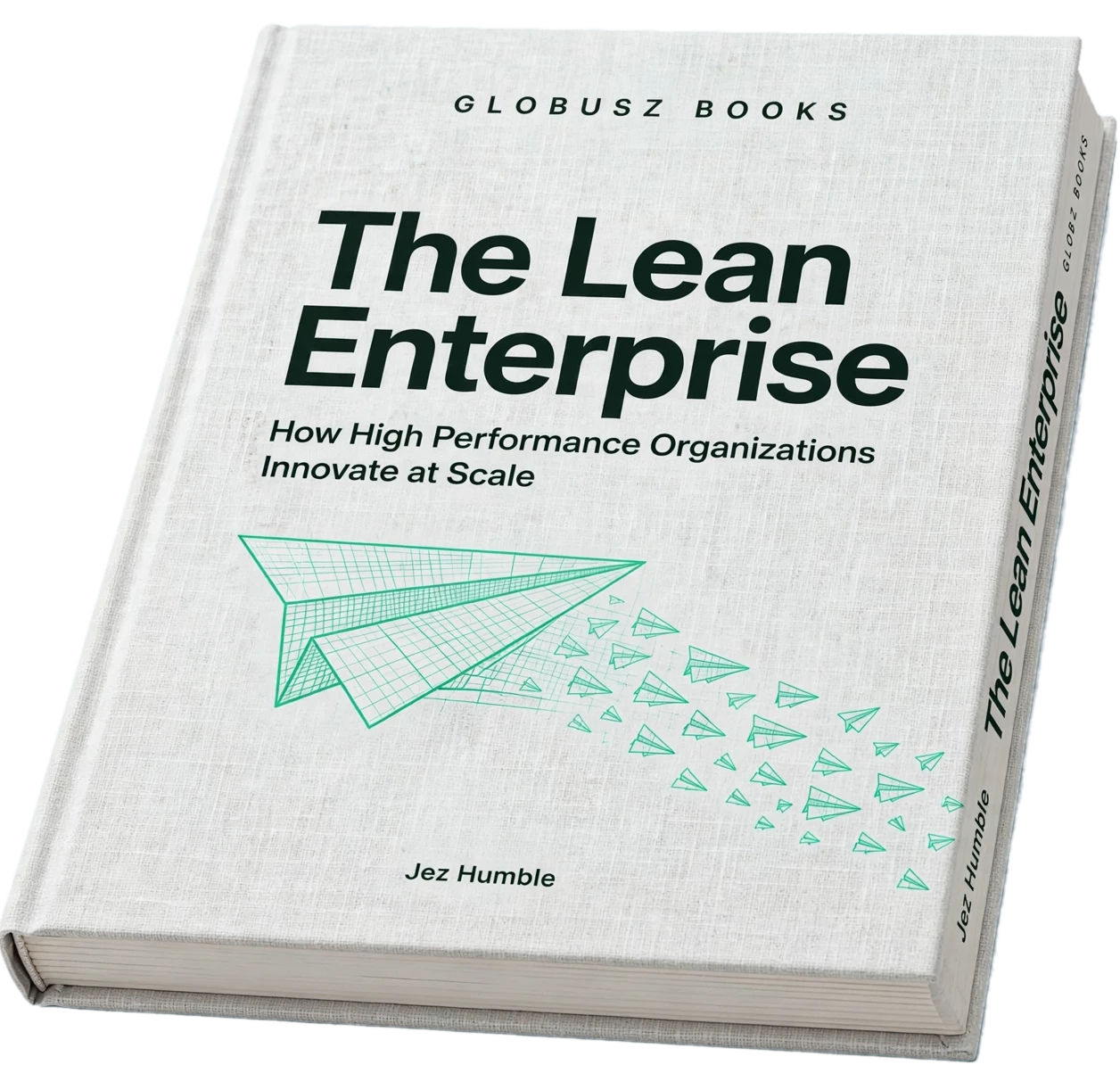
Human-reviewed summary and review
The Lean Enterprise: How High Performance Organizations Innovate at Scale by Jez Humble, Joanne Molesky, Barry O'Reilly — Summary & Review
Jez Humble, Joanne Molesky, Barry O'Reilly · English
Big companies aren’t exactly famous for moving fast or embracing change. Yet, here’s a book that claims you can actually innovate at scale without drowning in bureaucracy or endless meetings. The Lean Enterprise doesn’t sugarcoat how messy that journey is, but it offers a blueprint for turning giant, lumbering organizations into surprisingly nimble beasts.
Read the summary first
The short version: If you’re stuck trying to make a giant, slow-moving company innovate without turning it into chaos, The Lean Enterprise offers a no-nonsense roadmap. It won’t make the journey easy or quick, but it will help you avoid the usual traps of bureaucracy and false starts. Just remember: this is about people, trust, and discipline—not shiny tools or buzzwords.
Stefan's verdict: Worth considering for Executives and senior leaders in large companies responsible for innovation and transformation.; less useful if Startup founders and small business owners who need lean, fast-moving tactics rather than enterprise-scale frameworks..
3 min review500 wordsOriginal book: Introductory
LeadershipOrganizational ChangeInnovation ManagementLean ThinkingAgile Transformation
Globusz Books summary
What the book is about
The Lean Enterprise is a no-nonsense guide for leaders stuck in the middle of massive organizations trying to innovate without getting strangled by their own size. Jez Humble, Joanne Molesky, and Barry O’Reilly cut through the usual corporate fluff and lay out a practical approach to help big companies adopt Lean and Agile principles—not just in a pilot project or a shiny startup team, but across the entire enterprise.
At its core, the book argues that enterprises are human systems, not machines. That means traditional top-down command-and-control structures are a straight-up handicap when you want to innovate. Instead, the authors push for decentralized decision-making and what they call “mission command,” borrowed from military thinking. The idea is simple: give teams clear intent, then let them figure out the best way to get there. This creates alignment without suffocation.
But don’t get the wrong idea. This isn’t about handing out autonomy and hoping for the best. The Lean Enterprise stresses the need for rigorous measurement, experimentation, and managing risk like a scientist—not a gambler. They want organizations to balance exploration (trying new ideas) with exploitation (scaling proven models), which is trickier than it sounds when you’re dealing with multiple products, markets, and legacy systems.
One of the book’s stronger points is its focus on portfolio management. Instead of blindly funding projects based on political clout or gut feelings, the authors advocate for modeling investment risk and applying the scientific method throughout product development. This means running controlled experiments, validating assumptions early, and killing ideas that don’t pan out. It’s a practical antidote to the “build it and hope they come” mentality that haunts many big firms.
The book also dives deep into flow and value. It shows how identifying what truly matters to customers and eliminating waste across the value stream can unlock significant improvements. Continuous improvement isn’t just a buzzword here; it’s a culture that needs to be baked into every level of the organization. And yes, that culture shift is arguably the hardest part.
Real-world examples pepper the book, but they’re not the Hollywood-style success stories you often get. Instead, they’re gritty accounts of how companies wrestled with bureaucracy, resistance, and entrenched habits. The authors don’t pretend this is easy or quick. It requires patience, persistence, and leaders willing to tolerate ambiguity.
That said, the book is squarely aimed at large enterprises. If you’re running a startup or a small team, much of this will feel like overkill or just plain irrelevant. Also, the emphasis on decentralized decision-making and mission command assumes a level of trust and maturity that many companies simply don’t have yet. If your organization is still stuck in command-and-control mode, you’ll need to prepare for a long haul before these ideas stick.
In sum, The Lean Enterprise is a grounded, experience-backed playbook for turning big organizations into innovation machines without falling for hype or magic bullets. It’s less about quick wins and more about building lasting capabilities that can handle complexity and uncertainty at scale.
Beyond the summary
What might this book awaken in you?
If you’re stuck trying to make a giant, slow-moving company innovate without turning it into chaos, The Lean Enterprise offers a no-nonsense roadmap. It won’t make the journey easy or quick, but it will help you avoid the usual traps of bureaucracy and false starts. Just remember: this is about people, trust, and discipline—not shiny tools or buzzwords.
Before you commit
Why you might read this
Big companies aren’t exactly famous for moving fast or embracing change. Yet, here’s a book that claims you can actually innovate at scale without drowning in bureaucracy or endless meetings. The Lean Enterprise doesn’t sugarcoat how messy that journey is, but it offers a blueprint for turning giant, lumbering organizations into surprisingly nimble beasts.
Spoiler sensitivity: lowThis is a nonfiction summary.
Themes worth noticing
Innovation at Scale
How to foster new ideas and adapt quickly within the constraints of large, complex organizations.
Leadership and Culture
The critical role of leadership styles and organizational culture in enabling or blocking change.
Risk Management and Experimentation
Using scientific methods and data-driven decision-making to reduce uncertainty in product development.
Decentralization and Autonomy
Empowering teams with clear intent rather than micromanagement to speed up innovation.
Value Stream and Flow
Optimizing processes to deliver maximum value to customers efficiently.
Key ideas, explained
Enterprise as a Human System
The book insists that organizations are collections of people, not just processes or machines. This means leadership should focus on enabling teams with clear goals and trust, rather than micromanaging every detail. Decentralized decision-making isn’t just a nice-to-have; it’s essential for speed and adaptability.
Balancing Exploration and Exploitation
Innovation isn’t just about new ideas; it’s also about scaling what works. The authors highlight the need to manage a portfolio of initiatives that includes risky experiments alongside stable, revenue-generating products. This balance requires careful investment decisions and continuous validation.
Scientific Approach to Product Development
Throwing resources at a project and hoping it succeeds is a recipe for waste. Instead, the book promotes using experiments, metrics, and feedback loops to test hypotheses early and often. This minimizes risk and helps teams pivot or kill projects that aren’t delivering value.
Value and Flow Optimization
Understanding what customers truly value and streamlining the delivery process is crucial. The authors push for identifying bottlenecks, removing waste, and fostering a culture where continuous improvement is the norm—not a one-off event.
Culture and Leadership Matter More Than Tools
All the frameworks and techniques in the world won’t help if the leadership clings to old habits or the culture resists change. The book stresses that creating a learning organization and embracing ambiguity are leadership challenges that must be tackled head-on.
How to Use This Book in Real Life
Start with Clear Intent, Not Detailed Control
Give teams a clear mission and let them decide the best way to achieve it. This builds ownership and speeds up decision-making.
Treat Product Development Like a Series of Experiments
Test assumptions early with real data. Don’t waste time building features no one wants.
Manage Your Portfolio Like an Investment Portfolio
Balance risk by funding both safe bets and bold experiments. Monitor and adjust based on evidence.
Identify Real Customer Value and Eliminate Waste
Focus relentlessly on what moves the needle for customers, and cut out anything that doesn’t add value.
Build a Culture That Learns and Adapts
Encourage feedback, tolerate failure, and keep improving. Without cultural change, even the best processes will fail.
What the book does especially well
- Offers a realistic, experience-backed approach to innovation in large, complex organizations.
- Balances practical frameworks with cultural and leadership insights.
- Avoids hype and magic bullets, focusing on disciplined experimentation and measurement.
- Addresses the often-overlooked challenge of portfolio management in innovation.
- Includes gritty, relatable examples rather than polished success stories.
Where the book gets shaky
- Primarily aimed at large enterprises; less relevant for startups or small teams.
- Assumes a level of organizational maturity and trust that many companies lack.
- Cultural transformation advice can feel abstract and challenging to implement.
- Some readers may find the balance of theory and practice uneven depending on their background.
- Decentralized decision-making requires significant mindset shifts that aren’t easy or fast.
Questions to carry with you
- How can we truly decentralize decision-making without losing alignment?
- What assumptions are we making that need real-world testing before scaling?
- Are we balancing our portfolio between new ideas and proven products effectively?
- What cultural barriers exist that might kill innovation before it starts?
- How do we measure value and flow beyond just output or activity?
The bottom line
If you’re stuck trying to make a giant, slow-moving company innovate without turning it into chaos, The Lean Enterprise offers a no-nonsense roadmap. It won’t make the journey easy or quick, but it will help you avoid the usual traps of bureaucracy and false starts. Just remember: this is about people, trust, and discipline—not shiny tools or buzzwords.
If this idea interested you
Related books, with a reason to choose each one.
A different perspective on the same shelfEthical Machines: The Role of Ethics in AI and Machine LearningWendell Wallach
Machines are getting smarter, but do they know right from wrong? Wendell Wallach isn’t just asking if AI can make ethical decisions—he’s digging into how and whether we should even let them try. This isn’t sci-fi daydreaming; it’s a messy, urgent conversation about the moral code behind the algorithms shaping our lives.
Read the summary & review →A useful follow-up for exploring the subject furtherProgramming PearlsJon BentleyProgramming isn’t just banging out lines of code until something works. Jon Bentley’s "Programming Pearls" throws you right into the gritty reality that good programming is about crafting clever, efficient solutions—pearls, if you will—out of messy problems. This book doesn’t hand you magic spells or trendy frameworks; it forces you to think like a problem solver, not a code monkey.
Read the summary & review →Another entry point into this categoryAlgorithms UnlockedThomas H. CormenAlgorithms are the unseen engines running everything from your GPS to your online bank. But if the word makes you glaze over, Thomas Cormen’s 'Algorithms Unlocked' is your chance to get the basics without drowning in jargon. It’s like having a patient friend explain what’s under the hood of your smartphone — minus the tech-speak and with just enough grit to keep it real.
Read the summary & review →Explore the theme
More books about starting over
Technology relevance
Still relevant in 2026: Yes
Essential insights for innovation and management in enterprise tech.
Topics: enterprise software · lean methodology · engineering management
Continue the journey
Read the original when you are ready.
The full book dives deeper into how to actually implement these ideas in the messy real world of big organizations. It offers detailed case studies, practical tools, and nuanced discussions that go beyond the high-level summary. If you’re serious about transforming enterprise innovation, the authors’ combined experience and insights make it worth the time. You’ll get a clearer sense of how to navigate resistance, measure progress, and build the kind of culture that sustains innovation long-term.
Read the original if: you want the evidence, stories, examples, nuance, and full argument in the author's own voice.
The summary may be enough if: you only need the central framework or want to decide whether this book suits you.
Is this worth your time if you…?
Executives and senior leaders in large companies responsible for innovation and transformation.
Found an error or outdated detail? Contact Stefan with a correction.