Human-reviewed summary and review
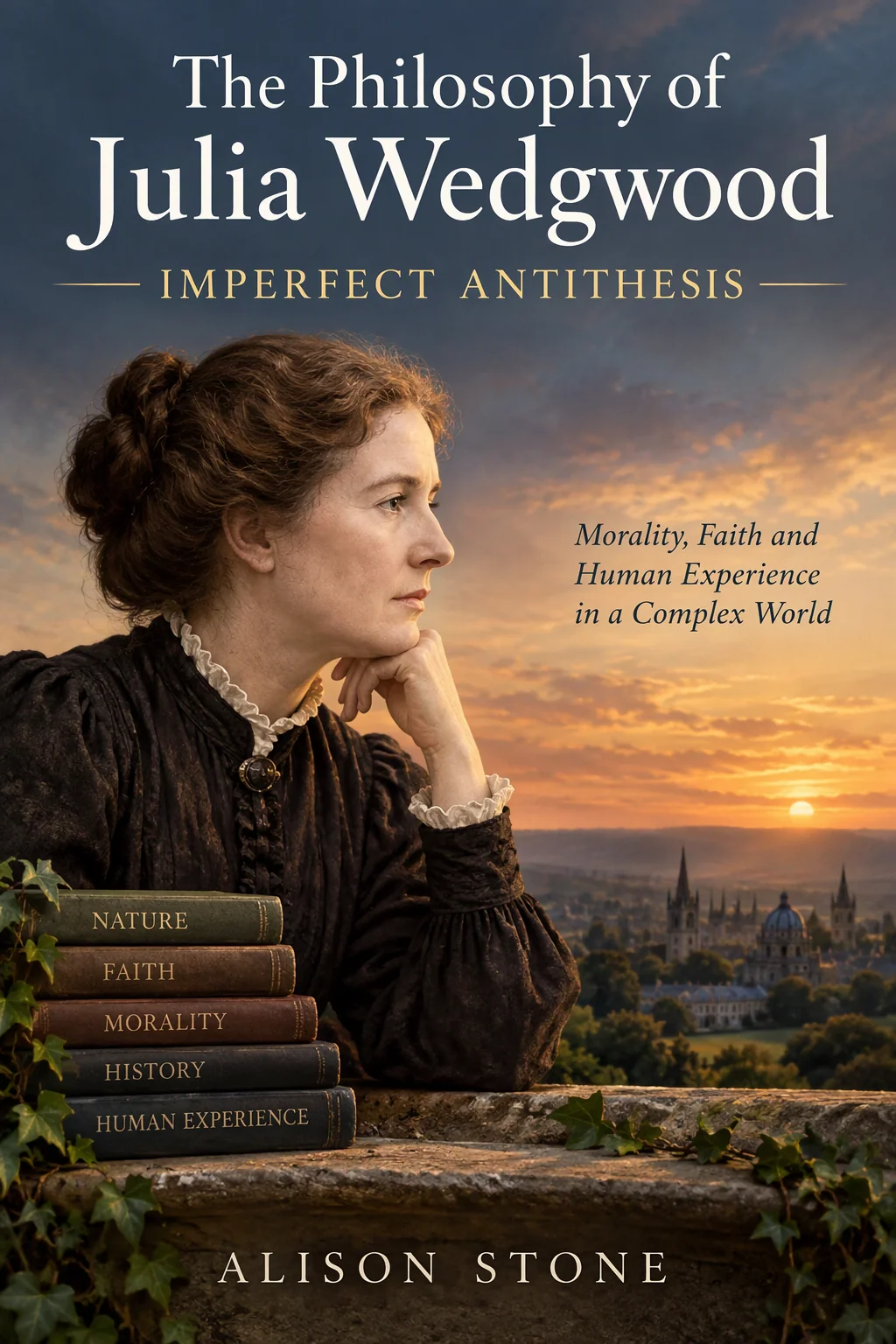
The Philosophy of Julia Wedgwood by Alison Stone — Summary & Review
Alison Stone · English
What if the opposites through which we understand morality, freedom, faith and history are rarely perfect opposites?
Read the summary first
The short version: Alison Stone's study invites readers to encounter Julia Wedgwood as an original philosopher rather than merely a historical curiosity. Her central insight is that real oppositions can be enduring, meaningful and structurally uneven. That insight helps explain why moral aspiration need not produce indiscriminate blame, why human motivation cannot easily be reduced to pleasure, and why historical transformations rarely erase their inheritance. Wedgwood's Christian metaphysics and historical assumptions remain open to serious criticism. We need not accept them to appreciate the intellectual discipline of attending closely to experience before imposing a tidy explanation upon it. The enduring challenge of imperfect antithesis is to think coherently without mistaking coherence for uniformity.
Stefan's verdict: Worth considering for Philosophy readers; less useful if Readers seeking light entertainment.
14 min review3,044 wordsOriginal book: Intermediate
Critical ThinkingEthicsPerspectiveHuman RelationshipsIntellectual Independence
Globusz Books summary
What the book is about
The Philosophy of Julia Wedgwood
Imperfect Antithesis — Alison Stone
The Central Idea
The opposite of something good need not be something equally bad. A person who makes an extraordinary sacrifice may deserve admiration, but another person who does not make that sacrifice need not deserve condemnation. This deceptively simple insight opens a much larger philosophical investigation in Alison Stone's study of Julia Wedgwood (1833–1913), a prominent Victorian intellectual whose reputation has largely disappeared from conventional histories of philosophy.
Stone argues that a significant portion of Wedgwood's writings possesses an organic unity organized around what Wedgwood calls imperfect antithesis. Reality presents genuine oppositions, but their two sides frequently differ in structure, dependence and significance. The desire to make these oppositions perfectly symmetrical can obscure precisely what makes them philosophically interesting. Stone explores this possibility through ethics, personal identity, freedom, religious belief and historical development.
The book is not a comprehensive biography or an attempt to establish Wedgwood as the single most important forgotten woman philosopher. Instead, Stone reconstructs one extensive strand of her thought, particularly its development from the 1870s into her major historical study, The Moral Ideal (1888). Wedgwood published extensively in Victorian periodicals, including the Spectator, where anonymous authorship was customary. Her intellectual relationships included Charles Darwin, her uncle, Harriet Martineau, George Eliot and Frances Power Cobbe. These connections provide context, but Stone emphasizes Wedgwood's independent philosophical contribution.
The result is both historical recovery and philosophical criticism. Stone finds considerable insight in Wedgwood's resistance to rigid binaries while identifying serious problems in her metaphysics, Christian interpretation of history and gendered ideal of sacrifice. The following five ideas explain that reconstruction rather than presenting Wedgwood's views as established truths.
Five Key Ideas
1. Opposites do not have to be symmetrical
Stone's reconstruction of Wedgwood's argument — Chapters 1–2 and 8, pp. 1–42, 139–146.
Wedgwood's imperfect antithesis challenges a familiar intellectual temptation: once two ideas have been identified as opposites, we assume that each is the exact inversion of the other. Yet moral experience does not consistently support that assumption. We may celebrate a virtue without treating every failure to attain it as a vice. Our positive aspirations and our aversions need not form equivalent scales. One member of an opposition can even presuppose the other without being presupposed by it in return.
This is not a rejection of distinctions. Wedgwood takes oppositions seriously and thinks their tensions can be real features of existence. Her objection is to the transformation of living, uneven contrasts into tidy logical structures. When an intellectual system requires experience to exhibit greater symmetry than it actually does, the system can become an obstacle to understanding.
Stone compares this organizing idea with Hegelian dialectic. Both approaches enable a philosopher to connect apparently disparate domains, and Wedgwood was influenced by Hegel. Nevertheless, Stone emphasizes a difference: Wedgwood mistrusts the impulse to resolve diverse phenomena into a unified logical structure. Her own approach is a flexible interpretive lens, not an initial axiom from which all subsequent conclusions are deduced. Stone also avoids reducing Hegel himself to the familiar but misleading three-stage formula of thesis, antithesis and synthesis.
The comparison matters because the absence of a formal system does not imply the absence of philosophical coherence. Wedgwood's essays can illuminate each other across disciplinary boundaries without every proposition being derivable from the same abstract principle. Her work demonstrates the possibility of an integrated philosophy that retains the irregularities of experience.
Editorial interpretation: A useful way to read imperfect antithesis today is as a warning against false symmetry. Rejecting an extreme does not oblige us to embrace its opposite; acknowledging an excellence does not require condemning everyone who lacks it. This is an application of the conceptual framework, not a claim that Wedgwood anticipated every contemporary debate about binary thinking.
2. Avoiding suffering is not the same as pursuing pleasure
Stone's reconstruction — Chapter 3, pp. 43–60.
Wedgwood's analysis of pleasure and pain provides a foundational example of imperfect antithesis. In her account, intense physical pain imposes itself on consciousness and demands relief. It can make one's embodiment overwhelmingly present. Yet people do not share an equivalently universal positive aspiration toward one identifiable kind of pleasure. Their purposes vary: one may seek understanding, another affection, another influence or moral excellence.
This distinction informs her criticism of utilitarianism, especially the philosophy associated with John Stuart Mill. Wedgwood disputes the reduction of diverse human aspirations to pleasure seeking. She does not deny that pleasure matters. Rather, she rejects the inference that because people recoil from pain, pleasure must be the sole or ultimate goal of their actions. She also challenges the idea that judgments about moral worth can be settled through comparisons of pleasurable experiences.
The analysis becomes more difficult when Wedgwood introduces self-sacrifice. If suffering is so compellingly undesirable, how can people deliberately accept it for another person's sake? Her response distinguishes bodily aversion from spiritual aspiration. A person can judge the moral cost of abandoning another to be more serious than the pain involved in helping. For Wedgwood, this conflict reveals a fundamental division in human existence rather than a straightforward maximization of satisfaction.
Stone notes a tension here. Wedgwood depicts pain as something from which we necessarily seek relief while also affirming our capacity to accept it voluntarily. She does not entirely dissolve that difficulty. Wedgwood's philosophy nevertheless insists that suffering is genuinely bad even when it develops sympathy. Her discussion of animal suffering and opposition to vivisection likewise prevent us from treating pain as automatically justified by whatever benefits might follow.
Editorial interpretation: The absence of discomfort is not a complete definition of a meaningful life. However, the value of a commitment does not establish that the suffering it entails is necessary. We can honor a difficult moral choice while continuing to reduce avoidable harm.
3. Selfhood, relationships and sacrifice form an uneven moral structure
Stone's reconstruction — Chapters 4–5, pp. 61–96.
Wedgwood maintains that some degree of self-concern belongs to the condition of being a self. Each person experiences the world from a particular standpoint and naturally attends to their own needs. Against accounts in which moral education could ultimately eliminate the opposition between selfishness and unselfishness, she argues that ethical life begins with this persistent conflict.
Self-sacrifice is therefore not identical to achieving a more sophisticated version of personal fulfillment. Genuine sacrifice may involve losing something that matters to us. Wedgwood draws inspiration from George Eliot's fiction, whose morally admirable characters sometimes renounce deeply felt desires without receiving a compensating worldly reward. She regards such sacrifice as a central Christian virtue.
Here the asymmetric structure becomes especially clear. Unselfishness requires a self whose interests can be relinquished, whereas possessing a self does not require striving for unselfishness. Moreover, an independent self is not the same as an isolated self. Wedgwood examines the relations between I, you and we, arguing that our identity depends upon a shared world in which other people have their own centers of experience. Treating their independent concerns merely as failures to attend to us distorts our perception of them. She describes this perspectival distortion through the idea of mental parallax.
Stone also traces Wedgwood's exploration of relational ethics and her reservations about restoring an ancient model of corporate social identity. Modern individuality cannot simply be discarded in favor of an imagined communal past. The ethical challenge is to recognize both the distinctness of persons and their dependence upon relations.
Yet Stone questions whether Wedgwood's emphasis on sacrifice risks making virtue into a form of moral self-enhancement. If the individual sacrifices a worldly advantage to acquire superior spiritual standing, has the self truly relinquished anything? Wedgwood's eventual response depends on a conception of spiritual community rather than individual moral accumulation. This connects her ethics to her controversial metaphysical commitments.
Editorial interpretation: Care for other people should acknowledge both their independence and one's own legitimate needs. Admiring generous action need not mean rewarding self-erasure or expecting unlimited sacrifice from caregivers.
4. Free agency and natural necessity remain difficult to reconcile
Stone's reconstruction — Chapters 6–7, pp. 97–138.
Wedgwood's account of freedom begins from two kinds of experience. Much of human conduct appears governed by habits, circumstances and natural processes. Yet people sometimes experience themselves as genuinely able to choose between alternatives, particularly at moments of moral conflict. Wedgwood does not think one of these descriptions should be discarded simply to make the other more philosophically convenient.
Her solution is unusual: she affirms that human beings are determined most of the time but have intermittent opportunities to exercise a stronger, transcendent freedom. She also maintains that nature operates through uninterrupted continuity. Her acceptance of evolutionary science and her interest in the continuity and transformation of natural forces inform this position. She does not reject scientific explanation or defend a world in which supernatural events routinely disrupt physical regularity.
Nevertheless, her moral philosophy requires more than natural processes. Wedgwood regards the capacity to transcend selfish impulses as evidence of humanity's participation in a supernatural order. The spiritual realm is not simply another name for unexplained physical phenomena; it is essential to her understanding of ideals, community and moral obligation. Her Christianity is structurally important to this argument, not a detachable historical decoration.
Stone identifies a fundamental difficulty. Even if free choices occur only occasionally, how can they alter conduct without interrupting the continuous natural processes Wedgwood accepts? If spiritual agency is already active within nature, the supposed self-contained character of nature becomes questionable. Stone considers Wedgwood's attempts to connect spiritual agency and natural force but concludes that the underlying contradiction remains unresolved.
There is also an evidential problem. A person's experience of obligation, freedom or spiritual communion does not necessarily compel everyone to adopt the same metaphysical interpretation. Stone takes Wedgwood's appeal to lived experience seriously without treating it as conclusive proof of supernatural reality.
Editorial interpretation: Distinguish what we experience from the explanations we offer for it. Recognizing both the influence of circumstances and the felt importance of choice may improve our moral judgment, even if we do not accept Wedgwood's account of transcendent freedom.
5. Historical change proceeds through uneven reactions, not clean reversals
Stone's reconstruction — Chapters 9–14, pp. 147–280.
Wedgwood extends imperfect antithesis into historical interpretation through the law of recoil. Social and intellectual movements emerge partly by reacting against earlier arrangements. Their reactions can be exaggerated and can retain important elements of the conditions they oppose. Consequently, historical change is not a sequence of perfectly opposed systems replacing one another without remainder.
Her account of women's changing social position illustrates the approach. Wedgwood hypothesizes early maternal authority followed by a patriarchal reaction and, later, women's resistance to male dominance. Stone treats the proposed prehistoric matriarchy as doubtful history while acknowledging its critical value: it helps make patriarchal institutions appear contingent rather than inevitable. Wedgwood also wants women's experience of care to contribute to public moral life. Yet her assignment of distinctive moral qualities to women and men restricts the range of lives her vision accommodates.
The same historical logic appears in her comparisons of Greeks, Romans and Christians. For example, Wedgwood interprets Christianity as distinguishing moral ideals from existing political power in ways that transform Roman assumptions while retaining aspects of Roman individuality. Stone shows how these imperfect transitions allow historical learning rather than mere cancellation. Wedgwood's discussions of Virgil, ancient shame and modern dignity illuminate particular cultural differences within her larger narrative.
Her growing concern about scientific naturalism helps explain why she increasingly turns from describing moral experience to reconstructing its history. If religiously informed moral experiences are universal, how could naturalism undermine them? If they depend entirely upon Christianity, how can they establish universal truths about humanity? Stone interprets Wedgwood's historical progressivism as an attempt to bridge these alternatives: historical developments can gradually disclose features of moral existence that were always present but insufficiently recognized.
Stone's assessment is critical. Wedgwood retains a directional understanding of history culminating in Christianity and privileges European developments over other traditions. Her zigzag model modifies linear progress rather than fully escaping it. The concluding archival chapter adds a different kind of achievement: Stone uses correspondence, textual parallels, digital concordance and stylometry to substantiate new attributions of anonymous Victorian essays. The philosophical reconstruction depends in part on that recovery of evidence.
Editorial interpretation: When evaluating reforms, ask what they retain from their predecessors and what they genuinely transform. Avoid assuming that every historical reversal constitutes progress or that societies must travel along one universal path.
Practical Applications
The following applications are Globusz Books editorial extrapolations, not exercises prescribed by Stone or Wedgwood.
In personal relationships, imperfect antithesis can help separate disappointment from wrongdoing. A friend may have commitments that prevent them from offering the support we hoped for. Their independent priorities are not necessarily an expression of hostility. This distinction can enable a more accurate conversation without requiring us to ignore actual neglect or harmful behavior.
In leadership and education, distinguish exceptional performance from ordinary competence. A teacher who praises extraordinary initiative need not shame students who meet reasonable expectations. Similarly, recognition of voluntary generosity should not quietly turn generosity into an obligation. Explicitly separating baseline duties from optional excellence can make standards fairer.
In public debate, examine whether opposing positions really have equivalent implications. Rejecting one policy does not require endorsing its most extreme alternative. Historical reforms can preserve valuable practices from institutions they criticize. Evaluating specific consequences, dependencies and evidence is more useful than assuming the two sides of a dispute mirror one another.
Critical Assessment
Stone's achievement is to recover an intellectually ambitious philosopher without sanitizing her commitments. Wedgwood's conception of imperfect antithesis has explanatory reach, while her account of pain and aspiration challenges reductive theories of motivation. Her distinction between admiration and blame offers a humane corrective to moral perfectionism. The research on anonymous authorship also exposes how the organization of historical publishing can influence which thinkers later generations remember.
Stone's strongest criticisms concern the very connections that make Wedgwood original. Her metaphysics struggles to reconcile supernatural freedom with uninterrupted natural continuity. Her praise of sacrifice can reinforce unequal expectations, especially for women, and her historical narrative is constrained by Christian teleology and Eurocentrism. Her reliance on a heterosexual family ideal also excludes other ways of organizing meaningful relationships.
An additional editorial question concerns the scope of imperfect antithesis itself. A flexible interpretive lens may reveal overlooked asymmetries, but it should not become a presumption that all oppositions are uneven. Each case requires evidence. Similarly, resisting rigid systems does not remove the need to examine contradictions where a philosophical argument depends on them. Stone's willingness to distinguish an illuminating tension from an unresolved explanatory problem makes the book especially useful for critical readers.
Five Practical Lessons
1. Separate excellence from obligation
Admire extraordinary contributions without automatically condemning those who fulfill ordinary responsibilities. Establish clear standards for what is owed before evaluating what goes beyond them.
2. Distinguish relief from purpose
Ask whether an activity merely removes discomfort or serves a positive aspiration. A worthwhile goal may involve difficulty, but pain alone is not evidence of value.
3. Recognize another person's independent perspective
When someone makes a choice you dislike, investigate their reasons rather than treating their independence as rejection. Maintain appropriate boundaries when there is genuine harm.
4. Respect generosity without romanticizing sacrifice
Acknowledge the real costs of caring for others. Consider whether burdens can be shared more fairly instead of assuming that the most generous person should continue absorbing them.
5. Examine what a reversal preserves
When changing a habit or institution, identify useful features of the previous arrangement. Build on what works rather than replacing everything simply because the old approach was imperfect.
A Seven-Day Reflection Plan
An original Globusz Books reading companion.
Day 1 — Uneven opposites: Identify one pair of ideas you normally treat as exact opposites. Write down a circumstance in which they do not behave symmetrically.
Day 2 — Motivation: List two activities you pursue because they matter to you, even when they are not especially pleasurable. Consider what values explain your commitment.
Day 3 — Perspective: Recall a disagreement and write a fair account of the other person's independent concerns. Distinguish observable facts from your interpretation.
Day 4 — Moral judgment: Identify a person whose generosity you admire. Ask which aspects of their conduct are reasonable duties and which are voluntary acts of excellence.
Day 5 — Agency: Examine one decision shaped by habit or circumstance. Identify the options genuinely available to you without assuming that every constraint can be overcome.
Day 6 — Historical recoil: Choose a social or institutional change familiar to you. Identify what it rejected, what it preserved and whether its consequences matched its stated intentions.
Day 7 — Integration: Review your notes and select one assumption to reconsider. Formulate a more precise judgment that acknowledges complexity without abandoning accountability or evidence.
Final Takeaway
Alison Stone's study invites readers to encounter Julia Wedgwood as an original philosopher rather than merely a historical curiosity. Her central insight is that real oppositions can be enduring, meaningful and structurally uneven. That insight helps explain why moral aspiration need not produce indiscriminate blame, why human motivation cannot easily be reduced to pleasure, and why historical transformations rarely erase their inheritance. Wedgwood's Christian metaphysics and historical assumptions remain open to serious criticism. We need not accept them to appreciate the intellectual discipline of attending closely to experience before imposing a tidy explanation upon it. The enduring challenge of imperfect antithesis is to think coherently without mistaking coherence for uniformity.
Editorial Metadata
- Original source: Alison Stone, The Philosophy of Julia Wedgwood: Imperfect Antithesis. Cambridge, UK: Open Book Publishers, 2026.
- DOI and full book: https://doi.org/10.11647/OBP.0543
- Source license: https://creativecommons.org/licenses/by-nc/4.0/ (noncommercial license; assess permissions separately before commercial reuse of licensed material).
- PDF ISBN: 978-1-80511-963-0.
- Research basis: Supplied complete scholarly monograph; references use printed page numbers.
- Editorial approach: Independent paraphrase, critical commentary and original practical exercises; no author endorsement implied.
- Reader fit: Intermediate to advanced readers interested in ethics, philosophy of religion, Victorian intellectual history and women philosophers.
- Discovery hook: What if the opposite of a virtue were not necessarily a vice?
Beyond the summary
What might this book awaken in you?
Opposing ideas need not be symmetrical, and human experience often exceeds the boundaries of formal logic.
Before you commit
Why you might read this
What if the opposites through which we understand morality, freedom, faith and history are rarely perfect opposites?
Spoiler sensitivity: lowNonfiction philosophy.
Themes worth noticing
Imperfect Antithesis
The asymmetrical structure of philosophical and experiential oppositions.
Moral Philosophy
Pleasure, pain, moral responsibility and self-sacrifice.
Free Will
The relationship between moral agency and natural determination.
Science and Faith
Wedgwood's attempt to reconcile natural laws with supernatural moral commitments.
Historical Transformation
The law of recoil and the uneven movement between opposing historical forms.
Key ideas, explained
Opposites do not have to be symmetrical
Stone's reconstruction of Wedgwood's argument — Chapters 1–2 and 8, pp. 1–42, 139–146.
Wedgwood's imperfect antithesis challenges a familiar intellectual temptation: once two ideas have been identified as opposites, we assume that each is the exact inversion of the other. Yet moral experience does not consistently support that assumption. We may celebrate a virtue without treating every failure to attain it as a vice. Our positive aspirations and our aversions need not form equivalent scales. One member of an opposition can even presuppose the other without being presupposed by it in return.
This is not a rejection of distinctions. Wedgwood takes oppositions seriously and thinks their tensions can be real features of existence. Her objection is to the transformation of living, uneven contrasts into tidy logical structures. When an intellectual system requires experience to exhibit greater symmetry than it actually does, the system can become an obstacle to understanding.
Stone compares this organizing idea with Hegelian dialectic. Both approaches enable a philosopher to connect apparently disparate domains, and Wedgwood was influenced by Hegel. Nevertheless, Stone emphasizes a difference: Wedgwood mistrusts the impulse to resolve diverse phenomena into a unified logical structure. Her own approach is a flexible interpretive lens, not an initial axiom from which all subsequent conclusions are deduced. Stone also avoids reducing Hegel himself to the familiar but misleading three-stage formula of thesis, antithesis and synthesis.
The comparison matters because the absence of a formal system does not imply the absence of philosophical coherence. Wedgwood's essays can illuminate each other across disciplinary boundaries without every proposition being derivable from the same abstract principle. Her work demonstrates the possibility of an integrated philosophy that retains the irregularities of experience.
Editorial interpretation: A useful way to read imperfect antithesis today is as a warning against false symmetry. Rejecting an extreme does not oblige us to embrace its opposite; acknowledging an excellence does not require condemning everyone who lacks it. This is an application of the conceptual framework, not a claim that Wedgwood anticipated every contemporary debate about binary thinking.
Avoiding suffering is not the same as pursuing pleasure
Stone's reconstruction — Chapter 3, pp. 43–60.
Wedgwood's analysis of pleasure and pain provides a foundational example of imperfect antithesis. In her account, intense physical pain imposes itself on consciousness and demands relief. It can make one's embodiment overwhelmingly present. Yet people do not share an equivalently universal positive aspiration toward one identifiable kind of pleasure. Their purposes vary: one may seek understanding, another affection, another influence or moral excellence.
This distinction informs her criticism of utilitarianism, especially the philosophy associated with John Stuart Mill. Wedgwood disputes the reduction of diverse human aspirations to pleasure seeking. She does not deny that pleasure matters. Rather, she rejects the inference that because people recoil from pain, pleasure must be the sole or ultimate goal of their actions. She also challenges the idea that judgments about moral worth can be settled through comparisons of pleasurable experiences.
The analysis becomes more difficult when Wedgwood introduces self-sacrifice. If suffering is so compellingly undesirable, how can people deliberately accept it for another person's sake? Her response distinguishes bodily aversion from spiritual aspiration. A person can judge the moral cost of abandoning another to be more serious than the pain involved in helping. For Wedgwood, this conflict reveals a fundamental division in human existence rather than a straightforward maximization of satisfaction.
Stone notes a tension here. Wedgwood depicts pain as something from which we necessarily seek relief while also affirming our capacity to accept it voluntarily. She does not entirely dissolve that difficulty. Wedgwood's philosophy nevertheless insists that suffering is genuinely bad even when it develops sympathy. Her discussion of animal suffering and opposition to vivisection likewise prevent us from treating pain as automatically justified by whatever benefits might follow.
Editorial interpretation: The absence of discomfort is not a complete definition of a meaningful life. However, the value of a commitment does not establish that the suffering it entails is necessary. We can honor a difficult moral choice while continuing to reduce avoidable harm.
Selfhood, relationships and sacrifice form an uneven moral structure
Stone's reconstruction — Chapters 4–5, pp. 61–96.
Wedgwood maintains that some degree of self-concern belongs to the condition of being a self. Each person experiences the world from a particular standpoint and naturally attends to their own needs. Against accounts in which moral education could ultimately eliminate the opposition between selfishness and unselfishness, she argues that ethical life begins with this persistent conflict.
Self-sacrifice is therefore not identical to achieving a more sophisticated version of personal fulfillment. Genuine sacrifice may involve losing something that matters to us. Wedgwood draws inspiration from George Eliot's fiction, whose morally admirable characters sometimes renounce deeply felt desires without receiving a compensating worldly reward. She regards such sacrifice as a central Christian virtue.
Here the asymmetric structure becomes especially clear. Unselfishness requires a self whose interests can be relinquished, whereas possessing a self does not require striving for unselfishness. Moreover, an independent self is not the same as an isolated self. Wedgwood examines the relations between I, you and we, arguing that our identity depends upon a shared world in which other people have their own centers of experience. Treating their independent concerns merely as failures to attend to us distorts our perception of them. She describes this perspectival distortion through the idea of mental parallax.
Stone also traces Wedgwood's exploration of relational ethics and her reservations about restoring an ancient model of corporate social identity. Modern individuality cannot simply be discarded in favor of an imagined communal past. The ethical challenge is to recognize both the distinctness of persons and their dependence upon relations.
Yet Stone questions whether Wedgwood's emphasis on sacrifice risks making virtue into a form of moral self-enhancement. If the individual sacrifices a worldly advantage to acquire superior spiritual standing, has the self truly relinquished anything? Wedgwood's eventual response depends on a conception of spiritual community rather than individual moral accumulation. This connects her ethics to her controversial metaphysical commitments.
Editorial interpretation: Care for other people should acknowledge both their independence and one's own legitimate needs. Admiring generous action need not mean rewarding self-erasure or expecting unlimited sacrifice from caregivers.
Free agency and natural necessity remain difficult to reconcile
Stone's reconstruction — Chapters 6–7, pp. 97–138.
Wedgwood's account of freedom begins from two kinds of experience. Much of human conduct appears governed by habits, circumstances and natural processes. Yet people sometimes experience themselves as genuinely able to choose between alternatives, particularly at moments of moral conflict. Wedgwood does not think one of these descriptions should be discarded simply to make the other more philosophically convenient.
Her solution is unusual: she affirms that human beings are determined most of the time but have intermittent opportunities to exercise a stronger, transcendent freedom. She also maintains that nature operates through uninterrupted continuity. Her acceptance of evolutionary science and her interest in the continuity and transformation of natural forces inform this position. She does not reject scientific explanation or defend a world in which supernatural events routinely disrupt physical regularity.
Nevertheless, her moral philosophy requires more than natural processes. Wedgwood regards the capacity to transcend selfish impulses as evidence of humanity's participation in a supernatural order. The spiritual realm is not simply another name for unexplained physical phenomena; it is essential to her understanding of ideals, community and moral obligation. Her Christianity is structurally important to this argument, not a detachable historical decoration.
Stone identifies a fundamental difficulty. Even if free choices occur only occasionally, how can they alter conduct without interrupting the continuous natural processes Wedgwood accepts? If spiritual agency is already active within nature, the supposed self-contained character of nature becomes questionable. Stone considers Wedgwood's attempts to connect spiritual agency and natural force but concludes that the underlying contradiction remains unresolved.
There is also an evidential problem. A person's experience of obligation, freedom or spiritual communion does not necessarily compel everyone to adopt the same metaphysical interpretation. Stone takes Wedgwood's appeal to lived experience seriously without treating it as conclusive proof of supernatural reality.
Editorial interpretation: Distinguish what we experience from the explanations we offer for it. Recognizing both the influence of circumstances and the felt importance of choice may improve our moral judgment, even if we do not accept Wedgwood's account of transcendent freedom.
Historical change proceeds through uneven reactions, not clean reversals
Stone's reconstruction — Chapters 9–14, pp. 147–280.
Wedgwood extends imperfect antithesis into historical interpretation through the law of recoil. Social and intellectual movements emerge partly by reacting against earlier arrangements. Their reactions can be exaggerated and can retain important elements of the conditions they oppose. Consequently, historical change is not a sequence of perfectly opposed systems replacing one another without remainder.
Her account of women's changing social position illustrates the approach. Wedgwood hypothesizes early maternal authority followed by a patriarchal reaction and, later, women's resistance to male dominance. Stone treats the proposed prehistoric matriarchy as doubtful history while acknowledging its critical value: it helps make patriarchal institutions appear contingent rather than inevitable. Wedgwood also wants women's experience of care to contribute to public moral life. Yet her assignment of distinctive moral qualities to women and men restricts the range of lives her vision accommodates.
The same historical logic appears in her comparisons of Greeks, Romans and Christians. For example, Wedgwood interprets Christianity as distinguishing moral ideals from existing political power in ways that transform Roman assumptions while retaining aspects of Roman individuality. Stone shows how these imperfect transitions allow historical learning rather than mere cancellation. Wedgwood's discussions of Virgil, ancient shame and modern dignity illuminate particular cultural differences within her larger narrative.
Her growing concern about scientific naturalism helps explain why she increasingly turns from describing moral experience to reconstructing its history. If religiously informed moral experiences are universal, how could naturalism undermine them? If they depend entirely upon Christianity, how can they establish universal truths about humanity? Stone interprets Wedgwood's historical progressivism as an attempt to bridge these alternatives: historical developments can gradually disclose features of moral existence that were always present but insufficiently recognized.
Stone's assessment is critical. Wedgwood retains a directional understanding of history culminating in Christianity and privileges European developments over other traditions. Her zigzag model modifies linear progress rather than fully escaping it. The concluding archival chapter adds a different kind of achievement: Stone uses correspondence, textual parallels, digital concordance and stylometry to substantiate new attributions of anonymous Victorian essays. The philosophical reconstruction depends in part on that recovery of evidence.
Editorial interpretation: When evaluating reforms, ask what they retain from their predecessors and what they genuinely transform. Avoid assuming that every historical reversal constitutes progress or that societies must travel along one universal path.
How to Use This Book in Real Life
Question false symmetries
Do not assume that opposing ideas or experiences have identical logical and moral structures.
Respect lived experience
Test abstract theories against the complexity of actual human experience.
Recognize the cost of sacrifice
Acknowledge that caring for others can involve genuine loss without romanticizing suffering.
Examine historical reactions
Consider how reactions against earlier beliefs can preserve elements of those beliefs or produce new extremes.
Remain open to complexity
Explore philosophical tensions without assuming that every disagreement has a simple resolution.
What the book does especially well
- Recovers a neglected Victorian woman philosopher.
- Connects ethics, metaphysics and intellectual history.
- Combines philosophical reconstruction with archival research.
Where the book gets shaky
- Wedgwood's supernatural account of morality raises unresolved philosophical questions.
- Some historical and gender assumptions require critical examination.
- The study focuses on imperfect antithesis rather than Wedgwood's entire intellectual output.
Questions to carry with you
- Are moral opposites necessarily symmetrical?
- Can self-sacrifice be valued without glorifying suffering?
- How can freedom coexist with natural causation?
- Why do historical movements sometimes overreact against their predecessors?
The bottom line
Alison Stone's study invites readers to encounter Julia Wedgwood as an original philosopher rather than merely a historical curiosity. Her central insight is that real oppositions can be enduring, meaningful and structurally uneven. That insight helps explain why moral aspiration need not produce indiscriminate blame, why human motivation cannot easily be reduced to pleasure, and why historical transformations rarely erase their inheritance. Wedgwood's Christian metaphysics and historical assumptions remain open to serious criticism. We need not accept them to appreciate the intellectual discipline of attending closely to experience before imposing a tidy explanation upon it. The enduring challenge of imperfect antithesis is to think coherently without mistaking coherence for uniformity.
If this idea interested you
Related books, with a reason to choose each one.
A different perspective on the same shelf1984George Orwell
In Orwell’s 1984, the Party doesn’t just watch you—it controls what you believe, remember, and even think. Winston Smith’s quiet rebellion reveals how totalitarianism can rewrite reality itself. How far would you go to keep your mind your own?
Read the summary & review →A useful follow-up for exploring the subject further1Q84Haruki MurakamiIn 1Q84, Tokyo in 1984 is just familiar enough to feel real—until you notice the second moon hanging in the sky. A fitness instructor moonlights as an assassin, and a math teacher rewrites a mysterious novel, both drawn into a parallel world where reality bends and cults pull the strings. It’s Murakami’s sprawling, strange meditation on loneliness, power, and the stories that shape us.
Read the summary & review →Another entry point into this category2666Roberto BolañoIn '2666,' four academics’ obsession with a mysterious author pulls them into the violent underbelly of a border city where unsolved murders cast a long shadow. This sprawling novel refuses neat answers, weaving fragmented lives and histories into a haunting meditation on evil and the limits of art. It’s a challenging read that stays with you long after the last page.
Read the summary & review →Explore the theme
More books about perspective
Continue the journey
Read the original when you are ready.
Alison Stone's complete study provides the historical evidence, philosophical arguments and archival discoveries necessary to appreciate the originality and tensions of Wedgwood's thought.
Read the original if: you want the evidence, stories, examples, nuance, and full argument in the author's own voice.
The summary may be enough if: you only need the central framework or want to decide whether this book suits you.
Is this worth your time if you…?
Philosophy readers
Found an error or outdated detail? Contact Stefan with a correction.