Human-reviewed summary and review
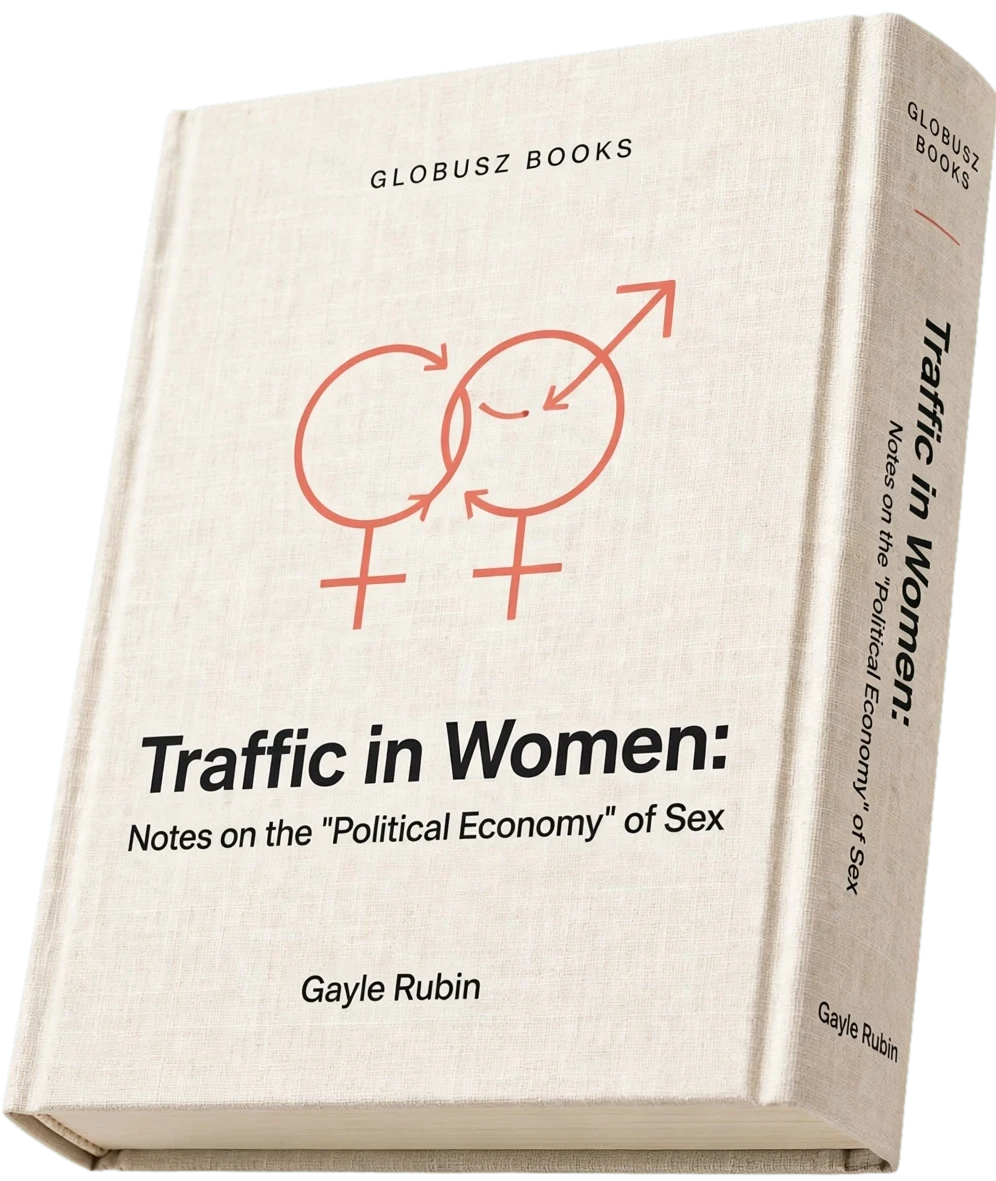
Traffic in Women: Notes on the 'Political Economy' of Sex by Gayle Rubin — Summary & Review
Gayle Rubin · English
Gayle Rubin’s essay exposes how women have been treated as objects of exchange in marriage and kinship systems to uphold male dominance. It’s a sharp critique that goes beyond capitalism to reveal the deep cultural roots of gender oppression. What does it mean to see gender as a social system rather than just biology or economics?
Read the summary first
The short version: Rubin’s essay is a sharp reminder that women’s oppression isn’t just about money or biology. It’s about a whole social system that turns bodies into bargaining chips and roles into cages. It’s messy, it’s baked into culture, and it’s still with us. If you want to understand why gender inequality sticks around, you’ll need to reckon with this uncomfortable truth.
Stefan's verdict: Worth considering for Anyone interested in feminist theory and the roots of gender inequality.; less useful if Readers seeking a practical self-help or straightforward guide to gender issues..
3 min review551 wordsOriginal book: Introductory
Gender StudiesFeminist TheorySocial AnthropologyPower DynamicsSexuality and Society
Globusz Books summary
What the book is about
Gayle Rubin’s 1975 essay, “Traffic in Women,” stands as a foundational text that reshaped feminist theory and gender studies by challenging prevailing explanations of women’s oppression. Rubin critiques the dominant Marxist view that reduces women’s subjugation to a byproduct of capitalist economic exploitation. Instead, she argues that women’s oppression is embedded in a broader and more intricate "sex/gender system"—a cultural and social framework that transforms biological sex into socially constructed gender roles and regulates these roles through complex mechanisms of exchange and control.
At the core of Rubin’s argument is the idea that women have historically been treated as objects of exchange within kinship and marriage systems. This "traffic" of women is not a literal market transaction but a social process through which societies regulate sexuality, reproduction, and alliances between groups. Drawing on anthropological theories, particularly those of Claude Lévi-Strauss, Rubin demonstrates how kinship systems function as social contracts that organize human relationships by controlling access to women. These exchanges serve to maintain male dominance and uphold hierarchical social structures.
Rubin also incorporates psychoanalytic insights, referencing Sigmund Freud and others, to explore how unconscious desires and cultural norms intertwine to perpetuate gender hierarchies. She reveals that marriage and kinship are not merely personal or romantic arrangements but are deeply political institutions that enforce gendered power relations by controlling women’s bodies and sexuality.
What makes Rubin’s essay especially powerful is its interdisciplinary approach. She synthesizes anthropology, psychoanalysis, and feminist theory to offer a nuanced critique of existing paradigms, particularly Marxism, which she finds insufficient for explaining the persistence of gender oppression. Rubin’s framework reveals that the sex/gender system predates capitalism and continues to operate independently of economic systems, highlighting the cultural and symbolic dimensions of gender inequality.
However, Rubin’s work is not without its limitations. While groundbreaking, her essay focuses heavily on theoretical constructs and may underrepresent the lived experiences of women, especially those marginalized by race, class, and sexuality. The framework she proposes does not fully engage with intersectionality, a gap that later feminist scholars have sought to address by expanding the analysis to include multiple, overlapping systems of oppression.
Contextually, “Traffic in Women” emerged during the second wave of feminism, a period marked by vigorous debates about the roots of women’s oppression and the nature of gender itself. Rubin’s essay helped shift feminist discourse away from purely economic explanations toward a more complex understanding of gender as a social construct maintained through cultural practices. This shift laid important groundwork for the development of gender studies as an interdisciplinary field.
For contemporary readers, Rubin’s essay remains vital. It challenges us to reconsider everyday social rituals—like marriage and family ties—not as benign or purely personal choices but as mechanisms deeply implicated in sustaining gender inequality. By exposing the social "traffic" of women, Rubin invites us to question how gender roles are produced and maintained, and how these roles continue to shape power dynamics in modern societies.
Ultimately, “Traffic in Women” is a demanding but rewarding read. It offers a rich theoretical toolkit for understanding the complex interplay between biology, culture, and power. Rubin’s insights compel us to look beyond simplistic explanations and recognize the enduring social systems that keep gender hierarchies intact. While her framework is not exhaustive, it provides a critical foundation for ongoing conversations about gender, sexuality, and social justice.
Beyond the summary
What might this book awaken in you?
Rubin’s essay is a sharp reminder that women’s oppression isn’t just about money or biology. It’s about a whole social system that turns bodies into bargaining chips and roles into cages. It’s messy, it’s baked into culture, and it’s still with us. If you want to understand why gender inequality sticks around, you’ll need to reckon with this uncomfortable truth.
Before you commit
Why you might read this
Gayle Rubin’s essay exposes how women have been treated as objects of exchange in marriage and kinship systems to uphold male dominance. It’s a sharp critique that goes beyond capitalism to reveal the deep cultural roots of gender oppression. What does it mean to see gender as a social system rather than just biology or economics?
Spoiler sensitivity: lowThis is a nonfiction summary.
Themes worth noticing
Gender as Social Construction
Explores how societies shape and enforce gender roles beyond biological differences.
Power and Exchange
Examines how women have been treated as objects of exchange to maintain social hierarchies.
Critique of Economic Reductionism
Challenges the idea that capitalism alone explains women’s oppression.
Interdisciplinary Analysis
Combines anthropology, psychoanalysis, and feminist theory for a richer understanding.
Social Rituals as Mechanisms of Control
Analyzes how everyday practices like marriage function to enforce gender roles and power.
Limitations and Evolution of Feminist Theory
Highlights the essay’s foundational role while acknowledging its gaps, especially regarding intersectionality.
Key ideas, explained
Women as Social Currency
Rubin argues that women have historically been 'exchanged' between men through marriage and kinship systems. This exchange isn’t just about personal relationships but serves a larger social function—regulating sexuality and sustaining male power structures.
The Sex/Gender System Is Bigger Than Capitalism
Oppression of women can’t be fully explained by capitalism alone. Rubin introduces the 'sex/gender system' as a cultural framework that transforms biological sex into socially enforced gender roles, which exist independently and often prior to economic systems.
Interdisciplinary Approach to Gender
Rubin pulls from anthropology, psychoanalysis, and feminist theory to build a nuanced picture of gender oppression. She critiques Marxism for being too narrow and emphasizes the importance of understanding cultural practices in maintaining gender hierarchies.
Kinship and Marriage as Power Mechanisms
Drawing on Lévi-Strauss, Rubin shows how kinship systems aren’t just family trees but complex social contracts that control who gets access to whom and reinforce gendered power dynamics through the 'traffic' of women.
Limitations on Intersectionality
While groundbreaking, Rubin’s essay doesn’t fully explore how gender oppression intersects with race, class, and sexuality, a gap later feminist scholars have worked to fill.
How to Use This Book in Real Life
Question Social Rituals You Take for Granted
Next time you hear about marriage or family traditions, remember these aren’t just personal choices but social mechanisms that have historically regulated gender and power. Being aware helps you see where inequality hides in plain sight.
Look Beyond Economics to Understand Gender
Don’t buy the idea that capitalism alone explains women’s oppression. Gender roles are shaped by culture, history, and social structures that can persist even outside economic systems.
Use an Interdisciplinary Lens
When thinking about gender, try mixing anthropology, psychology, and social theory. This broader view can reveal hidden power dynamics and challenge simplistic explanations.
Recognize the Limits of Theory
Rubin’s framework is powerful but incomplete. Keep an eye on how race, class, and sexuality also shape gender experiences, and be ready to seek out voices that address these intersections.
What the book does especially well
- Interdisciplinary approach that combines anthropology, psychoanalysis, and feminist theory for a rich analysis.
- Challenges narrow Marxist explanations, opening new avenues for understanding gender oppression.
- Introduces the sex/gender system as a foundational concept still influential in gender studies.
- Highlights the social function of marriage and kinship beyond romantic or economic terms.
Where the book gets shaky
- Focuses heavily on theory, sometimes at the expense of women’s lived experiences.
- Does not fully address intersectionality with race, class, and sexuality.
- Some psychoanalytic and anthropological references may feel dated or less relevant to contemporary readers.
- May oversimplify complex social dynamics by emphasizing 'exchange' without enough nuance on individual agency.
Questions to carry with you
- How do social rituals like marriage reinforce gender inequality today?
- What systems beyond capitalism shape and sustain women’s oppression?
- In what ways are women still treated as objects of exchange in modern society?
- How can an interdisciplinary approach deepen our understanding of gender?
- What voices or perspectives might Rubin’s framework be missing?
The bottom line
Rubin’s essay is a sharp reminder that women’s oppression isn’t just about money or biology. It’s about a whole social system that turns bodies into bargaining chips and roles into cages. It’s messy, it’s baked into culture, and it’s still with us. If you want to understand why gender inequality sticks around, you’ll need to reckon with this uncomfortable truth.
Reader feedback
Was this summary useful?
Rate the Globusz summary of Traffic in Women: Notes on the 'Political Economy' of Sex, not the book itself.
Loading reader ratings…
Explore the theme
More books about starting over
Continue the journey
Read the original when you are ready.
The full essay offers a detailed, nuanced argument that’s hard to capture in a summary. Rubin’s weaving of anthropology, psychoanalysis, and feminist critique gives you a multi-layered toolkit to analyze gender and power beyond simple slogans. You’ll find examples and reasoning that challenge easy answers and push you to think differently about social structures. If you care about how gender shapes society—and why it’s so stubborn—you’ll want to dive into the original text.
Read the original if: you want the evidence, stories, examples, nuance, and full argument in the author's own voice.
The summary may be enough if: you only need the central framework or want to decide whether this book suits you.
Is this worth your time if you…?
Anyone interested in feminist theory and the roots of gender inequality.
Found an error or outdated detail? Contact Stefan with a correction.