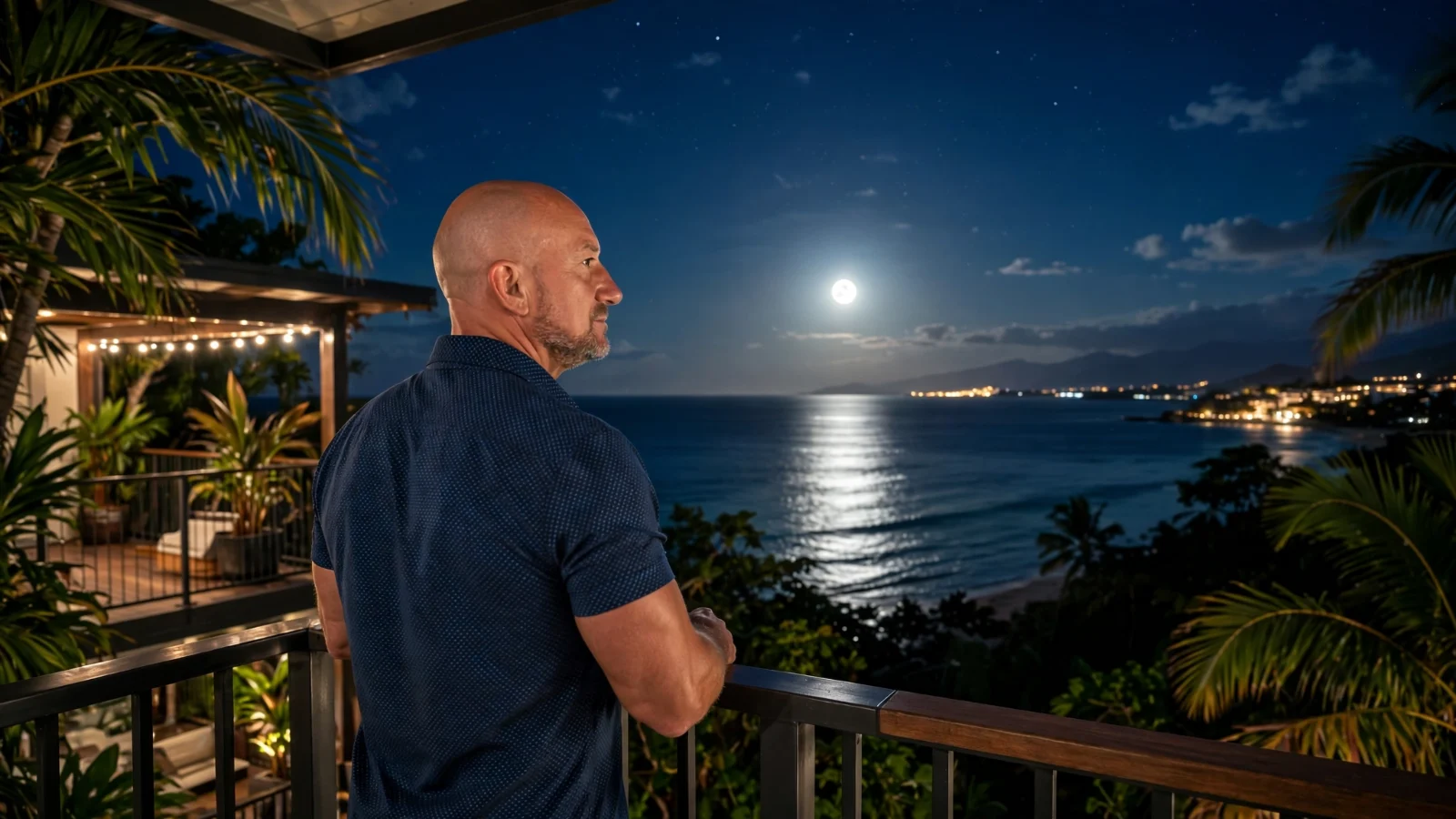
The other night, I stepped onto my balcony for some air.
I was not looking for inspiration.
I was not trying to be mindful.
I was just walking outside.
Then I saw the moon hanging over the ocean.
Its reflection stretched across the water in a long silver line.
And for a few seconds, everything stopped feeling ordinary.
I Had Somehow Gotten Used to It
I live on a beautiful island.
I can see the ocean.
I can walk outside and find views that people travel thousands of miles to see.
And yet some days I move through all of it half-asleep.
I get used to it.
The ocean becomes background.
The sky becomes background.
The weather becomes background.
The place I once would have considered extraordinary becomes simply where I live.
Standing there that night, I had one very clear thought:
I forget how beautiful my life is.
Not Because I Am Ungrateful
I do not think this happens because we are bad or ungrateful people.
I think the brain is simply efficient.
What stays around long enough becomes normal.
We stop reacting to it.
That is useful in some ways.
If every familiar sound, object, person, and view felt brand new every day, we would probably never get anything done.
But there is a cost.
Familiarity can reduce attention without reducing value.
Even Paradise Can Become Wallpaper
That is the strange part.
Something can remain objectively beautiful while becoming almost invisible to the person who sees it every day.
The same thing happens with relationships.
Health.
Freedom.
A quiet home.
A functioning body.
A familiar voice.
A favorite chair.
A daily walk.
A view from a window.
The things that support us every day can become so normal that we barely register them.
We Often Notice Value After It Is Gone
Loss has a brutal way of restoring attention.
The moment something disappears, we remember every detail.
The sound of someone’s voice.
The freedom of moving without pain.
The routine we used to complain about.
The house we thought was too small.
The ordinary evening that turns out not to have been ordinary at all.
I do not want loss to be the only thing capable of making me pay attention.
Gratitude Is Often Presented Too Dramatically
There is a lot of advice telling us to be grateful.
Sometimes it becomes another assignment.
Write ten things.
Repeat affirmations.
Force yourself to feel positive.
That can become exhausting.
I am more interested in something simpler.
Notice what is there.
Actually look at it.
That is enough.
The Moon Did Not Change
This is what struck me.
The moon was not more beautiful that night because I noticed it.
The ocean had not improved.
My balcony had not changed.
The only thing that changed was my attention.
And yet the experience of my life changed immediately.
That is a useful reminder.
Attention Is Part of Experience
We tend to think life quality depends only on circumstances.
Sometimes it does.
A safe home is better than an unsafe one.
Good health is better than illness.
Enough money is better than constant financial crisis.
Those differences are real.
But attention also matters.
Two people can stand in the same place and have completely different experiences depending on what they notice.
The Goalposts Move Quietly
Another reason we miss what is good is that the mind keeps adjusting.
We get something we wanted.
For a while, it feels wonderful.
Then it becomes normal.
Then we start thinking about the next thing.
A better place.
More money.
A newer car.
A different job.
A bigger project.
Another trip.
There is nothing wrong with wanting more.
The problem begins when wanting the next thing makes the current thing disappear from view.
Ordinary Does Not Mean Unimportant
This is a distinction I want to remember.
Ordinary simply means familiar.
It does not mean worthless.
A person can be familiar and still precious.
A routine can be familiar and still meaningful.
A view can be familiar and still breathtaking.
A body can be familiar and still astonishing.
A quiet evening can be familiar and still worth having.
Sometimes We Need to Borrow a Stranger’s Eyes
One way to interrupt familiarity is to imagine seeing our life for the first time.
If someone visited my balcony for the first time and saw the moon over the Pacific, would they shrug?
Probably not.
They might take a picture.
They might stand there longer than I do.
They might tell someone later how beautiful it was.
That thought helps.
Sometimes I need to borrow a visitor’s eyes for five minutes.
Noticing Is Not the Same as Pretending
This matters too.
Noticing something good does not require denying what is difficult.
I can have worries and still appreciate the moon.
I can have financial concerns and still enjoy the ocean.
I can be tired and still notice a beautiful evening.
Gratitude does not have to cancel reality.
It can simply widen it.
A Small Pause Can Change the Texture of a Day
That night, I did not solve a problem.
I did not accomplish anything.
I did not improve myself.
I stood on a balcony and looked.
And somehow that was enough to make the day feel fuller.
I think we underestimate these small pauses.
They do not change the facts of our life.
They change how much of those facts we actually experience.
Try This Today
Pick one ordinary thing in your life.
Something you see, use, hear, or experience often.
Then ask:
If this disappeared tomorrow, how much would I miss it?
Maybe it is a person.
A pet.
A view.
Your ability to walk.
Your morning coffee.
A familiar room.
Your bed.
Your neighborhood.
A friend who always answers.
Do not turn it into a gratitude performance.
Just give it thirty seconds of full attention.
The moon over the Pacific reminded me that beauty does not always announce itself.
Sometimes it has been sitting in front of us for years, waiting for us to stop moving long enough to notice.
I do not want to spend my life waiting until something is gone before I understand what it meant.