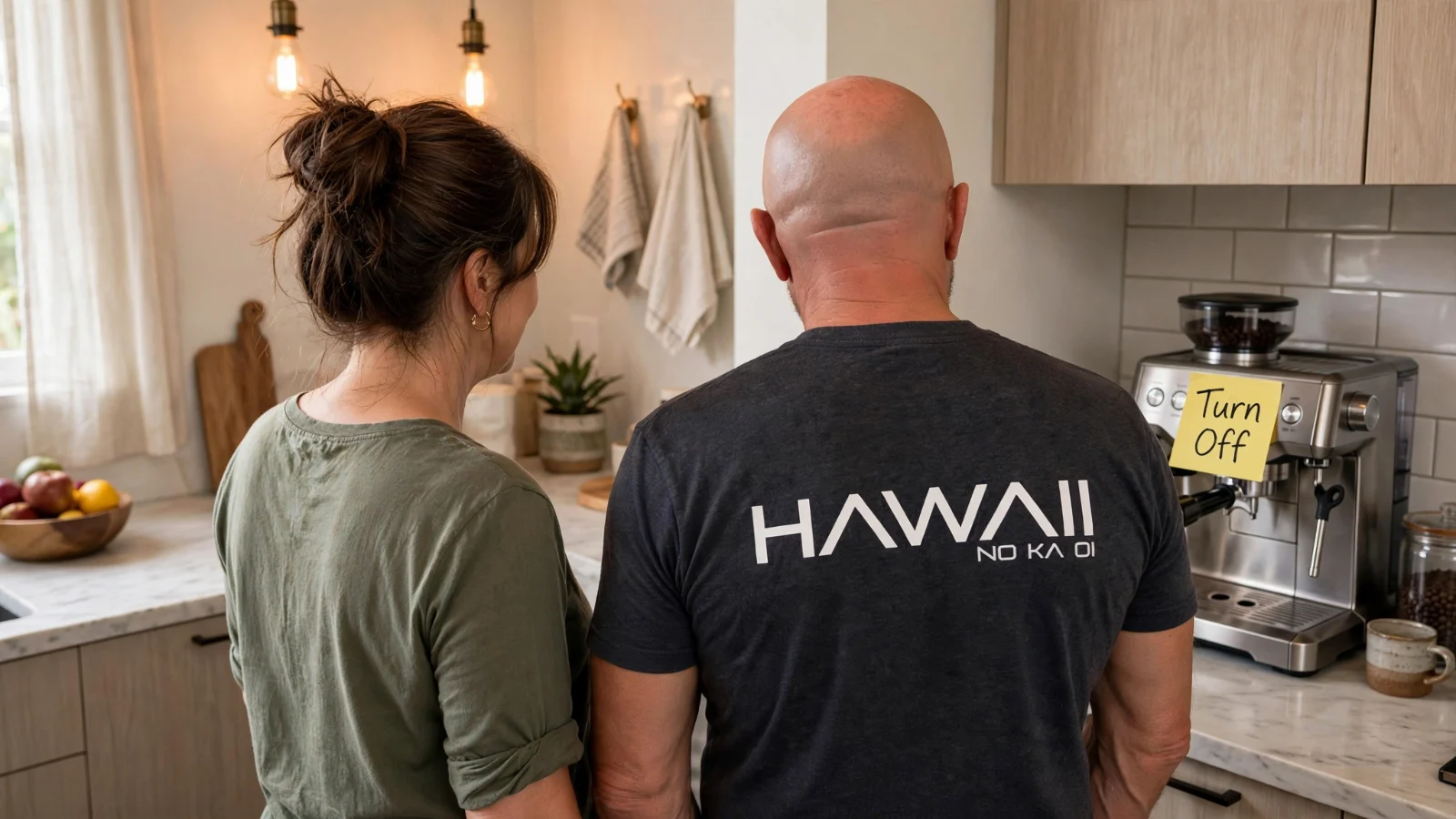
I have a bad habit with the coffee machine.
I turn it off.
At least, I think I turn it off.
Sometimes I walk away convinced the job is done, and my wife notices that the machine is still on.
She tells me.
Then I do something even less useful than forgetting the machine.
I defend myself.
I Was About to Do It
My reaction used to come quickly.
“I was just about to turn it off.”
“I didn’t forget.”
“I was going to do it.”
The interesting thing is that none of those sentences actually turned the coffee machine off.
They also did not make my wife less irritated.
They mainly protected me from having to say the much simpler sentence:
“You’re right. I forgot.”
A Tiny Mistake Became a Big Argument
One day the whole thing escalated so badly that my wife unplugged the coffee machine and was ready to throw it away.
Fortunately, the machine survived.
Instead, she attached a bright little note to it:
TURN OFF
It was not subtle.
Apparently my household had moved from verbal reminders to signage.
And Then I Forgot Again
Of course I did.
The note was right there.
The machine was still on.
My wife noticed.
This was the moment when the familiar argument could have started again.
I could already have reached for my usual defense.
I was going to do it.
I only stepped away for a second.
I did not really forget.
Instead, something different came out.
“You’re right. I forgot. I’m sorry.”
The Argument Disappeared
That was it.
No explanation.
No counterattack.
No courtroom presentation proving that I was technically about to remember.
The tension disappeared almost immediately.
It felt like flipping a switch.
I had made the same mistake, but I had not added a second mistake on top of it.
Defensiveness Is Often More Expensive Than the Original Problem
This is what stayed with me.
The coffee machine was a small issue.
Forgetting to turn it off was annoying, but fixable.
The real damage came from turning a small correction into a fight about whether I was at fault.
That is something we do in relationships all the time.
Someone points out a small mistake.
We hear an accusation.
We defend our character.
Then the conversation is no longer about the thing that happened.
Now it is about tone, respect, memory, fairness, and who does more around the house.
A five-second problem grows legs.
An Apology Does Not Mean You Are a Bad Person
Part of defensiveness comes from confusing a mistake with identity.
If I admit I forgot, does that mean I am careless?
If I apologize, does that mean I am always wrong?
If I accept criticism, am I giving the other person power over me?
No.
It means one specific thing happened, and I am acknowledging my part in it.
That is all.
A Clean Apology Is Short
One reason apologies fail is that we attach a defense to them.
“I’m sorry, but…”
“I’m sorry you feel that way.”
“I’m sorry, but you also…”
Those are usually negotiations wearing apology clothing.
A clean apology is much simpler.
“You’re right. I forgot. I’m sorry.”
Nothing else was needed.
Speed Matters
There is also something powerful about repairing quickly.
The longer we wait, the more pride joins the conversation.
Then we start rehearsing our case.
We remember every unfair thing the other person has ever done.
We tell ourselves why we were justified.
By the next morning, we are no longer apologizing for a coffee machine.
We are defending a legal brief.
Fast repair prevents that accumulation.
Five Bad Minutes Do Not Need to Become Five Bad Days
This is probably the simplest lesson from the whole incident.
Relationships will contain irritation.
People will forget things.
Someone will use the wrong tone.
Someone will be tired.
Someone will overreact.
The goal is not to eliminate every small rupture.
That is unrealistic.
The useful skill is learning how quickly to repair it.
Owning Your Part Is Not the Same as Taking All the Blame
This distinction matters.
A quick apology should not become a habit of accepting responsibility for everything.
If another person behaves badly, that still matters.
If a conflict is serious, it may need a real conversation.
If the same harmful pattern keeps repeating, a two-word apology is not enough.
But for ordinary relationship friction, owning your own piece can prevent a lot of unnecessary damage.
Sometimes the Most Mature Sentence Is the Least Interesting One
We like clever explanations.
We like context.
We like to prove why our mistake was understandable.
But the sentence that helped most in my kitchen was painfully boring:
“I forgot. I’m sorry.”
No philosophy.
No self-development theory.
Just ownership.
The Note Helped Too
I should also give credit to the bright “Turn Off” note.
It was a practical reminder.
That matters because apologies are not a substitute for trying to improve.
If I keep making the same mistake and only apologize, eventually the apology becomes cheap.
So the better combination is:
Own the mistake.
Repair the relationship.
Then change something that makes the mistake less likely next time.
Try This Today
Think about one recent moment when you were unnecessarily sharp, defensive, dismissive, or impatient with someone you care about.
If your part is clear, do not prepare a speech.
Try one simple sentence:
“I didn’t handle that well. I’m sorry.”
Or:
“You were right. I got defensive.”
Then stop.
Do not explain unless explanation is actually needed.
See what happens when you remove the fight over who gets to be right.
I still forget things.
The coffee machine may continue testing both my memory and my marriage.
But I learned something useful from that bright little note.
A quick apology really can feel like magic.
Not because it erases the mistake.
Because it keeps one small mistake from recruiting a whole army of new ones.