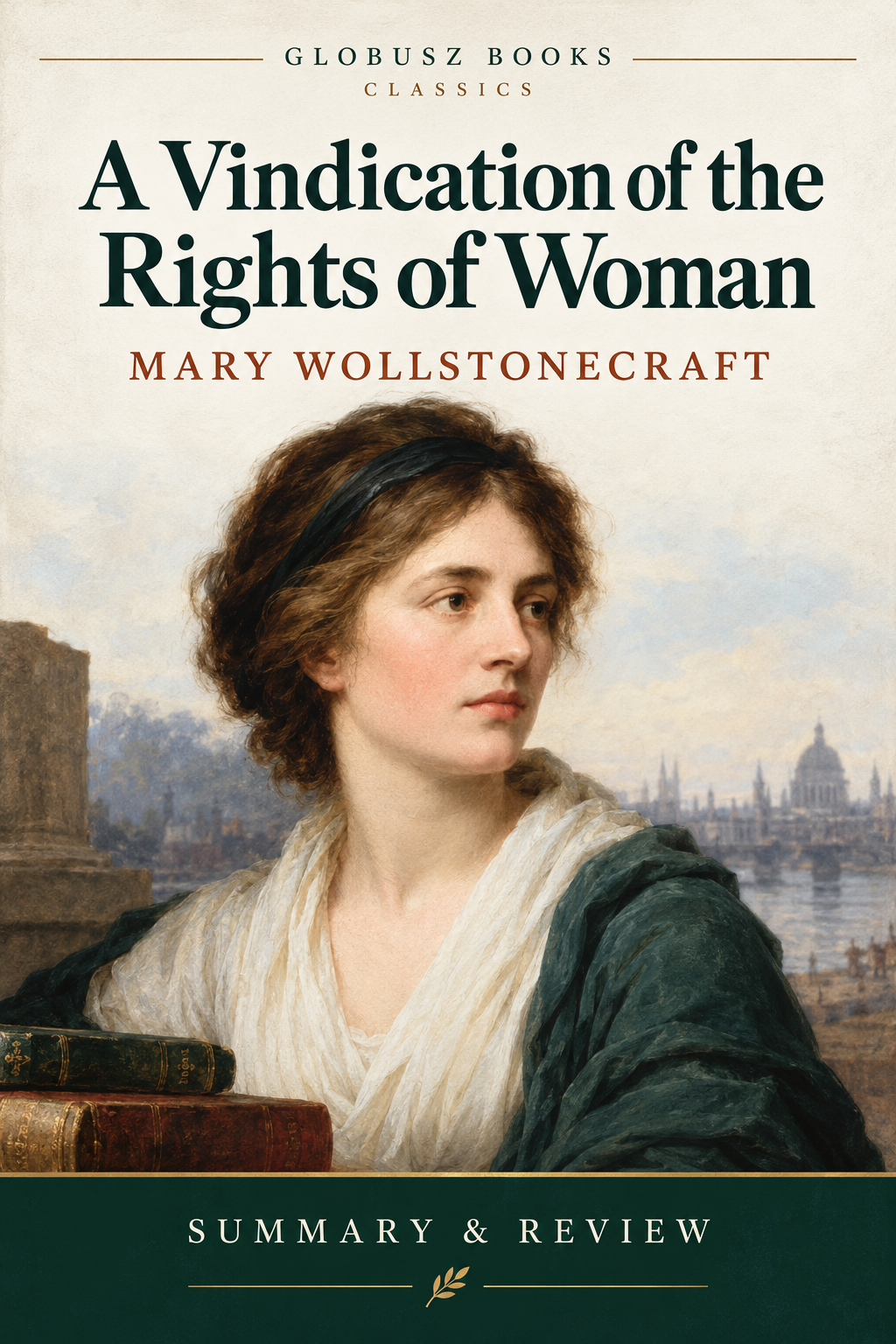
Human-reviewed summary and review
A Vindication of the Rights of Woman by Mary Wollstonecraft — Summary & Review
Mary Wollstonecraft · English
Can society judge women's abilities fairly when it has denied them the opportunity to develop?
Read the summary first
The short version: Women must be respected and educated as rational, morally responsible human beings.
Stefan's verdict: Worth considering for Readers interested in women's rights and the history of feminist thought.; less useful if Readers seeking a short, contemporary introduction to feminism..
8 min review1,758 wordsOriginal book: Moderate
critical-thinkingeducationequality
Globusz Books summary
What the book is about
THE BOOK AND ITS CENTRAL QUESTION
Published in 1792, Mary Wollstonecraft's A Vindication of the Rights of Woman challenges a contradiction at the heart of her society. Women are described as less rational, less capable of independent judgment, and more concerned with appearance than men, yet the education offered to them encourages precisely those habits. Wollstonecraft asks whether the supposed evidence of natural inferiority is actually evidence of restricted development. Her answer is that women must be educated as human beings capable of reason and virtue, rather than trained primarily to secure male admiration and protection.
The work is not a contemporary policy manifesto or a straightforward narrative of women's experiences. It is a philosophical argument, written in the language of eighteenth-century moral and political thought. Wollstonecraft repeatedly moves between principles of human nature, criticisms of fashionable conduct, disputes with influential writers, and proposals for education. That movement can make the book demanding, but it also reveals its ambition: to connect women's treatment with society's broader understanding of what makes a person morally responsible.
1. REASON AND VIRTUE BELONG TO HUMANITY, NOT TO ONE SEX
Author's argument ? Chapter 1 begins from the relationship between reason, virtue, and knowledge. Wollstonecraft treats the cultivation of these capacities as central to human improvement. If reason is what enables people to judge their conduct and pursue virtue, it cannot coherently be celebrated in men while discouraged in women. Her challenge concerns the consistency of moral standards: women should not be praised for dependence when men are praised for judgment.
Globusz Books interpretation ? This is the philosophical foundation of the book. Wollstonecraft is not asking merely for more accomplished women within the existing social order. She disputes the premise that the sexes should be trained toward fundamentally different moral ideals. The distinction matters because a society can appear to value virtue while defining it so differently for different groups that equal moral development becomes impossible.
A productive question for readers is whether moral responsibility can exist without meaningful freedom to think and decide. Wollstonecraft's position suggests that obedience may sometimes produce orderly behavior, but it is a poor substitute for the capacity to evaluate reasons and act on conviction. Her account is especially forceful when read as an argument about the conditions necessary for agency, not simply as a historical appeal for schooling.
2. EDUCATION CAN PRODUCE THE CHARACTER IT CLAIMS TO DESCRIBE
Author's argument ? In Chapters 2 through 4, Wollstonecraft criticizes the cultivation of delicacy, beauty, submissiveness, and dependence as feminine accomplishments. Girls learn that their security and social standing depend on pleasing others, particularly men. Under such conditions, attention to appearance and the management of approval become understandable adaptations. These acquired habits are then treated as proof that women are naturally unsuited to serious intellectual and moral pursuits.
Globusz Books interpretation ? The book exposes a circular explanation of inequality. First, opportunities are restricted. Next, the behavior shaped by those restrictions is observed. Finally, the observed behavior is used to justify maintaining the restrictions. Wollstonecraft's insight does not require every apparent difference to be socially produced; it requires the reader to investigate conditions before declaring a difference inevitable.
Her discussion also makes education broader than classroom instruction. Families, manners, literature, rewards, and expectations teach people what kinds of conduct will be accepted. A person may receive lessons yet still be discouraged from asking questions or exercising independent judgment. For Wollstonecraft, an education that sharpens social performance while neglecting understanding has failed in its deepest purpose.
3. DEPENDENCE IS A SOCIAL CONDITION WITH MORAL CONSEQUENCES
Author's argument ? Chapter 4 connects women's restricted development with forms of dependence that weaken their practical freedom. Wollstonecraft objects to a system in which women must rely on attractiveness, charm, or another person's protection rather than cultivate the capacities needed to sustain themselves and make informed choices. She also argues that understanding and affection develop together: stronger minds can support more substantial relationships.
Globusz Books interpretation ? The argument is not simply that dependence is unpleasant. It is that unequal power can distort conduct. When direct independence is unavailable, indirect influence may become a rational survival strategy. A society that condemns manipulation while rewarding dependence overlooks its own role in producing the behavior it criticizes.
This perspective complicates easy moral judgments. People do not develop character in a vacuum; they respond to material constraints and expectations. At the same time, Wollstonecraft sometimes describes the habits she opposes in severe moral language. Modern readers may find it useful to separate her structural diagnosis from the harshness of some of her judgments about women living under those constraints.
4. THE DISPUTE WITH ROUSSEAU REVEALS THE STAKES OF EDUCATION
Author's argument ? In Chapter 5, Wollstonecraft examines influential writers who portray women as suited to pleasing and serving men. Her extended engagement with Jean-Jacques Rousseau is especially important. She rejects an educational ideal that directs female development toward men's preferences instead of the independent cultivation of reason. The dispute is not a minor disagreement over manners: it concerns the purpose of education itself.
Globusz Books interpretation ? Rousseau serves as a revealing intellectual opponent because his broader concern with education and human development makes the unequal treatment of women especially conspicuous. Wollstonecraft presses readers to ask whether principles presented as universal are truly applied universally. When an educational theory celebrates freedom for one group and accommodation for another, its underlying assumptions deserve scrutiny.
Her criticism also shows the book's argumentative method. Rather than presenting only abstract claims, she examines respected authorities and exposes tensions in their descriptions of women. Readers unfamiliar with eighteenth-century educational debates may find these passages dense, but they reward attention because they show how social hierarchy can be defended through seemingly benevolent advice.
5. SOCIAL CONVENTIONS SHAPE MORAL CHARACTER
Author's argument ? Chapters 7 through 9 explore modesty, reputation, morality, and the effects of social arrangements on conduct. Wollstonecraft objects to standards that make women's appearance and sexual reputation disproportionately important while failing to encourage the same serious moral discipline in everyone. Her broader concern is that convention can replace principled judgment with anxious attention to how a person is perceived.
Globusz Books interpretation ? Here the work moves beyond access to education toward the cultural conditions of equality. A school may encourage reasoning, but public expectations can still punish independent conduct. Wollstonecraft's critique suggests that reforming institutions without examining social rewards and penalties may leave much of the underlying hierarchy intact.
These chapters also require historical sensitivity. Wollstonecraft's language about modesty, propriety, and virtue belongs to her period. Readers need not accept every prescription about respectable conduct to appreciate the underlying challenge to inconsistent moral standards. The distinction between her enduring principle and her historically situated judgments is essential to a fair reading.
6. NATIONAL EDUCATION MAKES EQUALITY A PUBLIC QUESTION
Author's argument ? In Chapter 12, Wollstonecraft argues that private education alone cannot secure human development. Children grow within a society, not in isolation, and the organization of schooling influences their understanding of themselves and others. She proposes a more public approach to education and considers how children might learn through shared experience rather than through rigid separation and artificial expectations.
Globusz Books interpretation ? This chapter changes the scale of the argument. The problem cannot be solved solely by asking individual women to become more determined or individual families to become more enlightened. Opportunities are structured by institutions. If education is central to rational independence, its distribution and organization become matters of public concern.
The broader lesson is that personal agency and institutional reform are interdependent. Individuals need opportunities to develop judgment, while institutions need people capable of exercising it. Wollstonecraft's proposal is historically specific, but the question it raises remains contemporary: what must an educational system provide if it is meant to cultivate equal citizenship rather than reproduce inherited expectations?
WHAT THE BOOK DOES PARTICULARLY WELL
The book's greatest strength is the connection it draws between moral ideals and social conditions. Wollstonecraft asks readers to judge a system not only by what it says people ought to become, but also by whether it gives them the means to develop those qualities. Her critique of circular reasoning about women's abilities is especially durable. So is her insistence that education should cultivate judgment rather than merely reward compliance.
Another strength is her willingness to confront respected intellectual authorities. She treats established ideas about femininity as arguments requiring justification, not as facts beyond dispute. That critical posture makes the work valuable even when its particular language or proposals no longer persuade.
LIMITATIONS AND HISTORICAL CONTEXT
A Vindication of the Rights of Woman is a product of 1792. Its religious vocabulary, assumptions about moral respectability, discussion of marriage, and treatment of social class reflect that setting. Wollstonecraft sometimes relies on narrow ideals of disciplined conduct and does not offer a comprehensive account of the different ways women experience disadvantage. Readers should also avoid treating her proposals as a complete blueprint for modern educational equality.
The text is polemical rather than a contemporary empirical study. It develops a forceful philosophical case, but its observations about character and society are not established through modern research methods. Its importance lies principally in the questions it poses, the contradictions it identifies, and the moral reasoning it brings to the organization of social life.
WHO SHOULD READ IT, AND WHY READ THE ORIGINAL?
This book will reward readers interested in feminist philosophy, education, ethics, intellectual history, and the relationship between social expectations and individual agency. It is particularly useful for readers willing to engage with an argument whose most compelling principles coexist with historical assumptions they may reject.
The original text is worth reading because a summary cannot reproduce the cumulative force of Wollstonecraft's disputes with other thinkers, her shifts between principle and social criticism, or the tensions within her own account of virtue. Those complexities make the work more demanding, but also more intellectually revealing.
FINAL GLOBUSZ BOOKS ASSESSMENT
Wollstonecraft's lasting contribution is the insistence that women must be regarded as reasoning, morally responsible human beings. Education is not merely a means to better accomplishments; it is a condition of independent judgment. The book challenges any society that restricts people's development and then mistakes the consequences of restriction for proof of incapacity.
Its value today is not that every historical prescription remains persuasive. It is that the argument gives readers a disciplined way to question supposedly natural hierarchies: examine the opportunities people receive, the conduct institutions reward, and the standards by which their abilities are judged.
Beyond the summary
What might this book awaken in you?
Education and social expectations shape the capacities that society later treats as natural.
Before you commit
Why you might read this
Can society judge women's abilities fairly when it has denied them the opportunity to develop?
Spoiler sensitivity: noneThis is a work of political philosophy rather than a plot-driven narrative.
Themes worth noticing
Education
Women's rights
Reason and virtue
Independence
Social institutions
What the book does especially well
- Connects rational independence with moral responsibility.
- Exposes circular arguments used to justify inequality.
- Links personal development to institutional reform.
Where the book gets shaky
- Contains eighteenth-century assumptions about class, religion, and respectability.
- Some prescriptions for women's conduct remain restrictive.
- Does not provide a comprehensive modern account of intersecting inequalities.
Questions to carry with you
- Which behaviors are encouraged by institutions and later misread as natural?
- Can obedience alone constitute moral virtue?
- What forms of education foster genuine independence?
The bottom line
Women must be respected and educated as rational, morally responsible human beings.
If this idea interested you
Related books, with a reason to choose each one.
A different perspective on the same shelfThe Cider House RulesJohn Irving
Homer Wells grows up in an orphanage run by a doctor who performs secret abortions, forcing him to confront the messy, often painful realities of choice and morality. This is no simple coming-of-age story—it’s a deep dive into the gray areas where right and wrong blur. How do you find your place when the rules keep changing?
Read the summary & review →A useful follow-up for exploring the subject furtherA Horse Walks into a BarDavid GrossmanDovaleh Greenstein’s stand-up routine starts like any other comedy show but quickly turns into a raw, unfiltered confession. This isn’t just about jokes—it’s a painful unraveling of memory and identity on stage. Can laughter really hide the darkest truths beneath?
Read the summary & review →Another entry point into this categorySeasonal Migration to the NorthTayeb SalihIn "Season of Migration to the North," an unnamed Sudanese man returns home only to find his identity pulled between two worlds. Mustafa Sa’eed’s shadow looms large—a man who mastered the West but paid a steep price for it. This novel cuts deep into colonial scars and the tangled web of belonging.
Read the summary & review →Explore the theme
More books about learning
Continue the journey
Read the original when you are ready.
The complete work develops a sustained philosophical critique of women's prescribed roles, contemporary educational theories, and the institutions shaping moral character.
Read the original if: you want the evidence, stories, examples, nuance, and full argument in the author's own voice.
The summary may be enough if: you only need the central framework or want to decide whether this book suits you.
Is this worth your time if you…?
Readers interested in women's rights and the history of feminist thought.
Found an error or outdated detail? Contact Stefan with a correction.