Human-reviewed summary and review
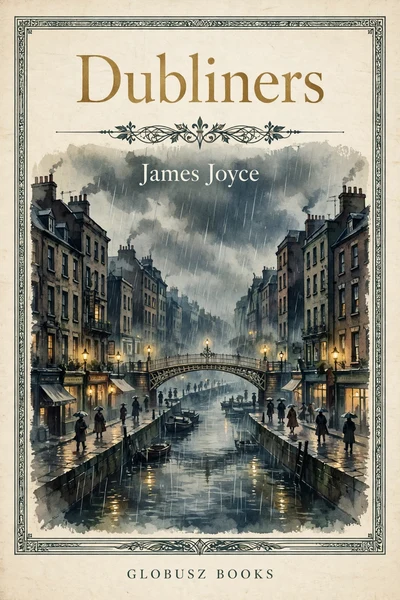
Dubliners by James Joyce — Summary & Review
James Joyce · en
Fifteen interconnected portraits of ordinary Dublin lives reveal the distance between the freedom people imagine and the lives they actually lead.
Read the summary first
The short version: Joyce reveals how habit, fear, social pressure, and incomplete understanding shape ordinary lives.
Stefan's verdict: Worth considering for Readers of literary fiction; less useful if Readers seeking a single continuous plot.
12 min review2,591 wordsOriginal book: Moderate
Globusz Books summary
What the book is about
Dubliners — Globusz Books Summary
James Joyce · First published 1914 · Literary fiction / Short stories
Introduction: A city where life struggles to move forward
In Dubliners, James Joyce presents fifteen stories about ordinary people living in Dublin at the beginning of the twentieth century. His characters are children, young adults, workers, parents, musicians, and public figures. Most are neither heroic nor exceptionally wicked. They are people attempting to find affection, independence, dignity, or a little happiness within circumstances they do not fully control.
There is no single protagonist and no conventional plot connecting the collection. Instead, Joyce creates a portrait of a city through its inhabitants. The stories move broadly from childhood through adolescence and adulthood into public life, culminating in The Dead, a story that gathers many of the collection's concerns into a meditation on love, memory, and mortality.
One of Joyce's central concerns is paralysis: the condition of recognizing that something is wrong while remaining unable, or unwilling, to change it. His characters often glimpse another possibility, but fear, habit, social expectation, or uncertainty prevents them from acting.
Yet Joyce does not simply condemn them. He shows how complicated their choices are. Family loyalty can become an obligation that suffocates. Religious belief can offer meaning while also producing guilt. Romantic dreams can inspire hope but distort reality. Social respectability can conceal cruelty.
The result is a book that asks an enduring question: How much of our lives do we genuinely choose, and how much do we inherit without examining it?
1. Paralysis: Understanding a problem does not mean escaping it
The clearest example of paralysis appears in Eveline.
Eveline is a young woman who has an opportunity to leave Dublin with Frank, a sailor who promises a different life. At home, she faces exhausting responsibilities, an intimidating father, and a future that appears increasingly narrow.
Leaving seems to offer freedom. Staying means continuing a life she already understands.
But Eveline's decision is not straightforward. Her memories include affection as well as suffering. She remembers her mother's life and the promise she made to keep the family together. Her responsibilities have become part of her identity.
At the moment of departure, Eveline cannot move. Frank calls to her, but she remains fixed in place.
Joyce does not provide a comforting explanation. Perhaps she is frightened of the unknown. Perhaps she doubts Frank. Perhaps loyalty to her family has become stronger than her desire for freedom. The story leaves room for all these possibilities.
What matters is the distance between imagining a new life and actually entering it.
A related pattern appears in The Sisters, the collection's opening story. A boy reflects on the death of Father Flynn, a priest whose life and behavior have become subjects of uneasy adult conversation. The adults speak indirectly, and the boy struggles to understand what has happened.
The atmosphere is one of uncertainty, silence, and something spiritually or psychologically obstructed.
Together, these stories establish that paralysis is not merely physical inactivity. It can be a failure of communication, a dependence on inherited expectations, or an inability to confront an uncomfortable truth.
Central insight: People can recognize the limitations of their circumstances and still find those circumstances almost impossible to leave.
2. Disillusionment: The world rarely matches our imagined version of it
In Araby, a young boy develops an intense fascination with his friend's sister. His feelings are romantic, idealized, and shaped by an imagination that transforms ordinary Dublin streets into the setting of a private adventure.
When he promises to bring her something from the Araby bazaar, the trip becomes emotionally important. He imagines it as a meaningful gesture, almost a mission.
But the practical world interferes.
His uncle returns home late, delaying the journey. When the boy finally arrives, the bazaar is closing. Its remaining stalls and conversations are disappointingly ordinary. The exotic atmosphere he imagined has disappeared.
He realizes that his expectations were largely creations of his own mind.
The story ends with a painful moment of self-recognition. The boy sees the vanity and confusion that have shaped his feelings.
This is an example of what is often called a Joycean epiphany: a sudden recognition that changes how a character understands an experience.
But an epiphany is not necessarily a solution. The boy gains insight without gaining happiness.
In An Encounter, two boys seek adventure beyond the restrictions of school. Their journey begins as an escape from routine, but an unsettling encounter with an older man exposes them to a world more disturbing than the exciting freedom they imagined.
Both stories explore the collapse of childhood expectations.
The young characters discover that independence does not automatically produce fulfillment. The world beyond familiar boundaries contains disappointment, danger, and ambiguity.
Joyce does not suggest that imagination is worthless. Without imagination, people might never desire anything beyond their immediate circumstances.
But imagination becomes dangerous when it prevents people from recognizing reality.
Central insight: Disappointment can become a form of knowledge when it reveals the difference between what we hoped to find and what was actually there.
3. Respectability, money, and power: Social life often conceals private motives
As the collection moves into adulthood, Joyce increasingly examines the influence of money, social status, and institutional authority.
In Two Gallants, Corley and Lenehan move through Dublin while Corley manipulates a young woman who works as a domestic servant. Their behavior exposes an unpleasant relationship between charm, exploitation, and financial advantage.
The men speak casually about their plans, treating another person's trust as an opportunity.
Lenehan, meanwhile, experiences moments of dissatisfaction with his own life. He imagines greater stability and comfort but continues participating in behavior that makes such a future seem increasingly remote.
Joyce shows how exploitation can coexist with self-pity.
In The Boarding House, Mrs. Mooney manages a lodging establishment and discovers that her daughter Polly has become involved with one of the boarders, Mr. Doran.
Marriage becomes the expected solution.
Yet the situation is not presented simply as a romantic relationship. Mrs. Mooney understands the social pressures surrounding sexual conduct and respectability. Mr. Doran worries about his employment, reputation, and religious obligations.
The characters maneuver within a system where personal relationships are inseparable from economic security and public judgment.
In A Mother, Mrs. Kearney arranges for her daughter Kathleen to perform in a series of concerts. When the organizers fail to honor the agreed payment arrangements, she insists on the contract.
Her demand has a legitimate basis, but her increasingly confrontational conduct damages her daughter's position.
The organizers, meanwhile, are hardly models of professionalism or fairness.
Joyce resists making the conflict a simple contest between a reasonable person and an unreasonable one. Pride, institutional weakness, social ambition, and genuine injustice become entangled.
These stories reveal the mechanisms operating beneath polite society.
Respectability may serve as a moral ideal, but it also functions as a form of social currency. People fear losing it, manipulate it, and sometimes sacrifice others to preserve it.
Central insight: Social rules are not neutral merely because they are familiar. They can protect people, constrain them, or become instruments of power.
4. Loneliness and failed connection: Being surrounded by people is not the same as being understood
Several of Joyce's adult characters live among families, colleagues, and acquaintances while remaining profoundly isolated.
In A Little Cloud, Little Chandler meets his old friend Ignatius Gallaher, who has become a successful journalist abroad. Gallaher appears worldly and confident, while Chandler feels trapped in a modest Dublin existence.
The encounter awakens Chandler's dissatisfaction.
He begins comparing his ordinary responsibilities with the literary and personal possibilities he once imagined. He wonders whether he might have become a poet and whether leaving Dublin would have transformed his life.
Returning home, he finds himself unable to reconcile these fantasies with the immediate demands of marriage and fatherhood. When his infant son cries, Chandler becomes frustrated and frightens the child.
His wife intervenes, and Chandler is left ashamed.
The story is painful because Chandler's disappointment is understandable, but his response harms someone who depends on him.
Joyce reveals how unfulfilled ambition can turn into resentment when people direct their frustrations toward those closest to them.
In Counterparts, Farrington experiences humiliation and frustration at work. His employer exercises authority over him, and Farrington responds through resentment, drinking, and attempts to recover his wounded pride.
After a disappointing evening, he returns home and beats his young son.
The violence is not excused by his suffering. Instead, Joyce exposes a destructive chain in which someone subjected to power and humiliation inflicts suffering on a more vulnerable person.
The story demonstrates how social and personal frustration can reproduce itself across relationships.
In A Painful Case, Mr. Duffy lives an orderly, emotionally restricted life. He develops a friendship with Mrs. Sinico, a married woman who offers him the possibility of genuine companionship.
When she expresses deeper affection, he withdraws.
Years later, he reads of her death and confronts the possibility that his rigid insistence on emotional distance has cost him an important human connection.
At first, his reaction is judgmental. Gradually, it gives way to loneliness and regret.
Unlike Eveline, who cannot leave an oppressive situation, Duffy protects himself so thoroughly that he cannot enter a meaningful relationship.
Both become isolated, though for different reasons.
These stories suggest that loneliness is not always imposed from outside. Sometimes it develops through pride, fear, emotional caution, or an inability to recognize another person's needs.
Central insight: Relationships require more than proximity. They demand vulnerability, responsibility, and a willingness to see beyond one's own disappointments.
5. Memory and self-awareness: We never know another person's inner life completely
The collection reaches its emotional and artistic culmination in The Dead.
Gabriel Conroy attends a Christmas-season gathering hosted by his aunts, Kate and Julia Morkan, and their niece Mary Jane. The evening includes conversation, music, dancing, dinner, and the small tensions of social life.
Gabriel is educated and socially accomplished, but he is also self-conscious. He worries about how others perceive him and struggles with conversations that challenge his assumptions.
After the gathering, he notices that his wife, Gretta, has been deeply affected by a song.
Gabriel initially interprets the moment through his own romantic feelings. He imagines a renewed intimacy between them.
But Gretta reveals that the song reminded her of Michael Furey, a young man who loved her when she was a girl in Galway. He died young, and she has never forgotten him.
Gabriel realizes that his wife possesses an emotional history he has never fully understood.
He had imagined himself at the center of their shared emotional world. Suddenly, he confronts the existence of a powerful love and sorrow that preceded him.
His reaction moves through jealousy, embarrassment, compassion, and an expanding awareness of human mortality.
The famous closing image of snow falling across Ireland unites the living and the dead within a single imaginative landscape.
The snow does not erase individual differences. Rather, it suggests a shared vulnerability that extends beyond Gabriel's immediate concerns.
His personal disappointment becomes part of a larger recognition: every human life contains memories, attachments, losses, and mysteries that remain partly inaccessible to others.
The ending also transforms the meaning of the collection.
Throughout Dubliners, people struggle to escape narrow circumstances and limited perspectives. In The Dead, Gabriel experiences a moment in which his perspective expands.
He does not receive a practical solution to his problems. Instead, he begins to understand how incomplete his previous understanding has been.
That distinction matters.
Joyce's epiphanies do not necessarily make people happier or more successful. Sometimes they reveal painful truths that cannot be undone.
But they may allow a person to see others with greater humility.
Central insight: Genuine self-awareness begins when we recognize that our understanding of other people—and of ourselves—is incomplete.
How the fifteen stories fit together
The five ideas above provide a framework for understanding the collection, but Dubliners contains more than five recurring concerns.
Joyce also examines religion, nationalism, artistic ambition, alcohol, family obligation, and the relationship between private desire and public life.
The remaining stories contribute important dimensions to this portrait.
In After the Race, Jimmy Doyle becomes caught up in the glamour of wealthy international acquaintances. His desire for prestige leaves him vulnerable to financial and social disadvantage.
In The Boarding House and A Mother, social reputation becomes inseparable from practical calculation.
In Clay, Maria's modest celebration exposes the contrast between her gentle hopes and the limitations of her circumstances. The story's seemingly ordinary details carry an undercurrent of sadness and uncertainty.
In Ivy Day in the Committee Room, political workers discuss Irish public life while their conversations reveal personal interests, disillusionment, and competing loyalties.
In Grace, a group of men attempts to address a friend's drinking through a religious retreat. Their efforts combine genuine concern with social convention and an imperfect understanding of spiritual change.
Together, the stories suggest that paralysis operates at multiple levels.
Individuals hesitate, families repeat destructive patterns, institutions preserve familiar arrangements, and public life struggles to move beyond inherited habits.
Dublin is therefore more than a setting. It becomes a social environment that influences what people imagine possible.
At the same time, Joyce does not portray the city as uniformly miserable. His characters experience humor, friendship, excitement, tenderness, and moments of generosity.
These details prevent the book from becoming a simple argument that everyone should leave Dublin or reject tradition.
The deeper concern is whether people can recognize the forces shaping their lives—and whether recognition can lead to greater understanding.
A practical five-step reading and reflection plan
Dubliners is a literary work, not a manual for personal improvement. Nevertheless, its observations offer useful opportunities for reflection.
1. Notice where habit shapes your decisions.
After reading Eveline, consider a situation in which familiarity influences your choices. Distinguish responsibilities you genuinely value from expectations you have never examined.
2. Compare expectations with reality.
Use Araby to reflect on a disappointment. What did you expect, what actually happened, and what did the difference reveal about your assumptions?
3. Examine the influence of status and reputation.
After The Boarding House or A Mother, ask whether concern about other people's opinions has ever affected a decision more than you realized.
4. Recognize how frustration affects relationships.
A Little Cloud and Counterparts invite readers to examine the difference between experiencing disappointment and directing that disappointment toward someone else.
5. Practice curiosity about other people's inner lives.
After The Dead, reflect on how much remains unknown even in familiar relationships. Consider what listening without immediately interpreting another person's experience might reveal.
These exercises are not intended to produce the correct interpretation of Joyce. They are ways to bring the book's questions into conversation with personal experience.
Final takeaway
Dubliners is a remarkable study of ordinary lives shaped by forces that are often difficult to see.
Its characters seek freedom, love, recognition, security, and meaning. Some hesitate when opportunities appear. Others confuse ambition with fulfillment, pride with dignity, or emotional distance with independence.
Joyce's achievement is to make these experiences recognizable without reducing them to simple moral lessons.
The stories remind us that understanding our circumstances does not guarantee that we can change them. They also suggest that even an uncomfortable moment of recognition may matter.
The collection's final movement, from Gabriel Conroy's personal disappointment toward an awareness of other lives and losses, offers perhaps its most lasting insight.
We live within our own memories and expectations, but so does everyone else.
Learning to recognize that complexity may be one of the first steps toward understanding ourselves more clearly.
Beyond the summary
What might this book awaken in you?
Recognizing the limits of our understanding may be the beginning of greater compassion and self-awareness.
Before you commit
Why you might read this
Fifteen interconnected portraits of ordinary Dublin lives reveal the distance between the freedom people imagine and the lives they actually lead.
Themes worth noticing
Paralysis and Change
Disillusionment
Social Expectations
Loneliness
Memory and Mortality
Key ideas, explained
Paralysis and the difficulty of change
Recognizing the limitations of one's circumstances does not necessarily make change possible.
Disillusionment and self-knowledge
The collapse of idealized expectations can reveal uncomfortable truths about ourselves.
Respectability, money, and power
Social conventions can conceal economic pressures, manipulation, and unequal power.
Loneliness and failed connection
Fear, pride, and frustration can prevent meaningful relationships and harm others.
Memory and self-awareness
Understanding others requires recognizing the limits of our knowledge of their inner lives.
How to Use This Book in Real Life
Examine familiar obligations
Consider which responsibilities you genuinely value and which expectations you have never questioned.
Compare expectations with reality
Reflect on a disappointment and what it revealed about your assumptions.
Question the influence of reputation
Consider whether concern about others' opinions has shaped an important decision.
Recognize displaced frustration
Notice when disappointment affects how you treat people close to you.
Listen with greater curiosity
Remember that even familiar people possess experiences and memories you may not fully understand.
The bottom line
Joyce reveals how habit, fear, social pressure, and incomplete understanding shape ordinary lives.
If this idea interested you
Related books, with a reason to choose each one.
A different perspective on the same shelfA Horse Walks into a BarDavid Grossman
Dovaleh Greenstein’s stand-up routine starts like any other comedy show but quickly turns into a raw, unfiltered confession. This isn’t just about jokes—it’s a painful unraveling of memory and identity on stage. Can laughter really hide the darkest truths beneath?
Read the summary & review →A useful follow-up for exploring the subject furtherA Month in the CountryJ.L. CarrThomas Birkin arrives in a quiet Yorkshire village to restore a medieval mural, but the real work is piecing together his own shattered life after the war. This is a story about healing that takes its time, unfolding in the slow rhythms of church walls and English countryside. No grand gestures—just quiet moments and the steady scrape of a brush.
Read the summary & review →Another entry point into this categoryA Room with a ViewE.M. ForsterLucy Honeychurch’s trip to Italy shakes up her buttoned-up English life, forcing her to choose between a safe, socially approved future and a messy, authentic connection. It’s a sharp look at how rigid social rules can suffocate personal freedom and desire. Can Lucy break free without losing herself?
Read the summary & review →Explore the theme
More books about starting over
Continue the journey
Read the original when you are ready.
Globusz Books helps you understand the central ideas before deciding whether the complete book deserves your time.
Read the original if: you want the evidence, stories, examples, nuance, and full argument in the author's own voice.
The summary may be enough if: you only need the central framework or want to decide whether this book suits you.
Is this worth your time if you…?
Readers of literary fiction
Found an error or outdated detail? Contact Stefan with a correction.