Human-reviewed summary and review
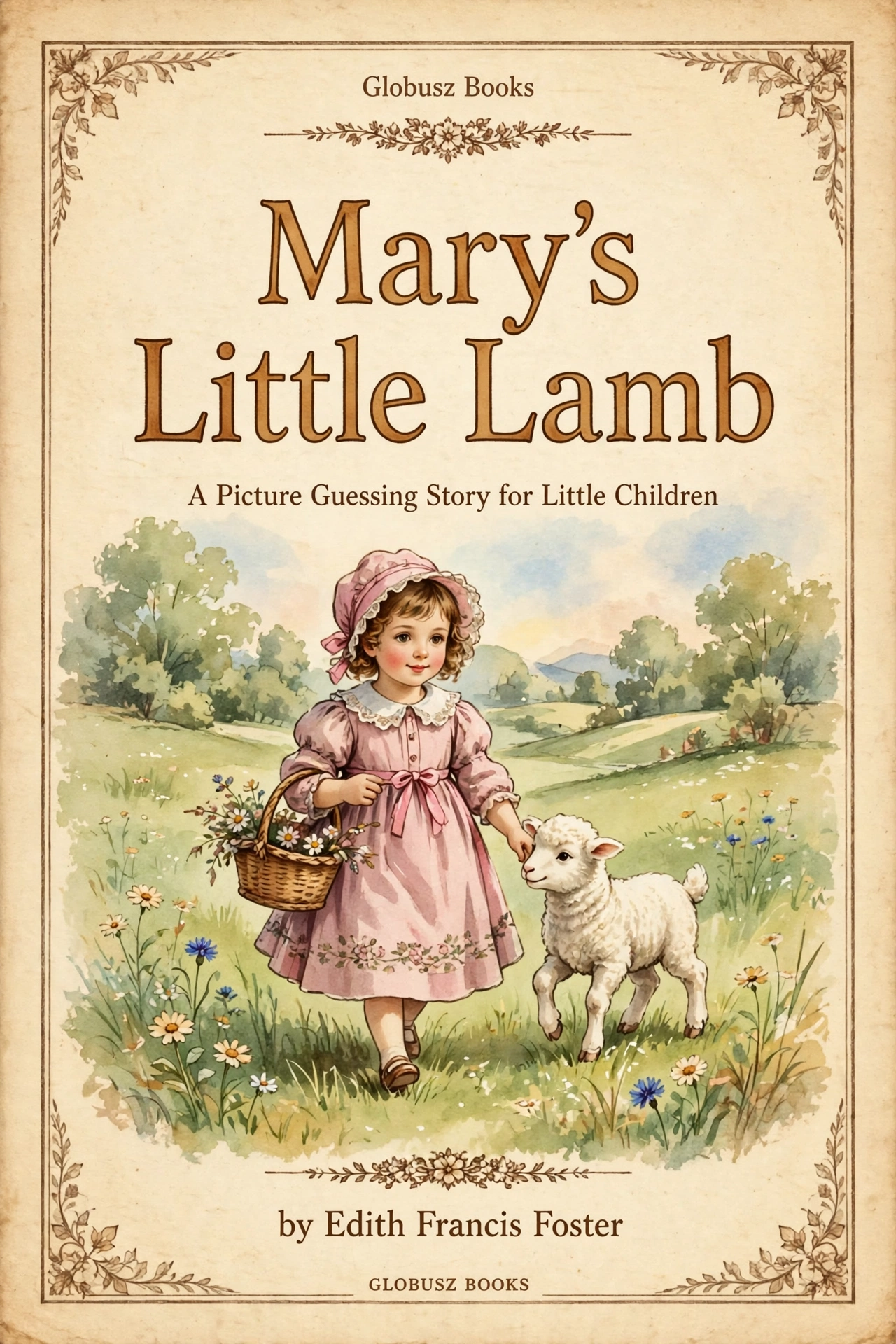
Mary's Little Lamb by Edith Francis Foster — Summary & Review
Edith Francis Foster · en
A little girl and her inseparable lamb discover the joys and challenges of farm life in twelve illustrated adventures.
Read the summary first
The short version: Mary's Little Lamb is an affectionate portrait of childhood companionship, told through the small pleasures and complications of life on a farm. Its humor comes from Mary's enthusiasm, the lamb's independent behavior and the surprising results of their adventures together.
Stefan's verdict: Worth considering for readers interested in its central subject; less useful if you need a very different level of detail or approach.
11 min review2,349 words
Globusz Books summary
What the book is about
Mary's Little Lamb
Edith Francis Foster
Globusz Books | Editorial Summary
Subtitle: A Picture Guessing Story for Little Children
Category: Children's Literature / Classics
Copyright dates: 1901 and 1903
Reference edition: Project Gutenberg #43808
Reading level: Young children with a reading companion
Spoiler sensitivity: High — the following discussion reveals the ending.
The Central Idea
Edith Francis Foster turns the familiar image of a girl followed to school by a lamb into a sequence of twelve small adventures. Mary Moffett discovers a companion who changes the rhythm of her everyday life. Feeding him, playing with him and trying to keep him out of trouble give her opportunities to learn about affection, responsibility and the difference between wanting to help and knowing how to help.
The story begins when Mary reluctantly interrupts her doll's dressmaking to fetch eggs from Clover Farm. On her way home a mysterious white creature follows her. After she trips, the little lamb approaches and nuzzles her. Mary immediately wants to keep him, but her mother insists that they first establish who owns him. Farmer Clover recognizes the animal and agrees to give him to Mary because he has no room for another lamb and she promises to care for him.
The ensuing adventures are not a single long quest. They belong to the domestic world of farm chores, school lessons, family visits, berry picking and a county fair. Mary's aunt Hannah, only three years older than Mary herself, is her frequent companion. The children's good intentions repeatedly collide with practical difficulties, and adults often help them resolve the resulting problems.
A distinctive feature is the book's picture guessing format. The title page credits Foster with five hundred pictures. The illustrations are not simply decorations: pictures stand in for words in the narrative, inviting children to recognize objects and participate in telling the story. The supplied text transcription represents many of those words in square brackets. Readers seeking the original visual experience should use the illustrated edition rather than rely on this summary or the plain-text transcription alone.
Key Idea 1: Affection Begins With Responsibility
Mary's discovery of the lamb establishes the emotional pattern of the book. She responds to his friendliness with immediate affection, but her desire to keep him is not sufficient justification for taking him home permanently. Her mother asks her to find out whether he belongs to Farmer Clover. The farmer's permission transforms a chance encounter into a commitment.
The next chapters demonstrate what that commitment entails. Mary and Hannah decide that their new companion needs a bath. They choose a wooden watering trough, put him into the warm water and attempt to wash him with soap. He struggles to escape, Mary loses her footing, and both require rescue. Hannah's mother dries them and places them near the fireplace.
Feeding the lamb requires another kind of ingenuity. Too young to graze or drink from a bucket, he is fed warm milk from an old tin teapot adapted by Mary's mother. Mary holds the pot for him three times a day. During a berry-picking expedition she remembers to bring his food, even though carrying it means taking another object on their outing.
Two passing women notice the unusual scene of the child feeding her pet. One takes a photograph, which later arrives by post as an unexpected gift. What began as an ordinary act of care becomes a treasured memory.
Why it matters
The story distinguishes the excitement of acquiring a pet from the continuing work of looking after one. Mary does not simply declare her love: she makes room for the lamb's needs in her daily routine. Modern readers should understand the feeding and washing methods as historical details, not current animal-care instructions.
Key Idea 2: Companionship Does Not Eliminate Boundaries
Mary dislikes leaving the lamb behind when she goes to school. Unknown to her, he follows her and waits outside the classroom. When the teacher asks Mary an arithmetic question about apples, her distracted answer reveals how completely she is thinking about her pet. The lamb hears her voice and calls from outside.
When the teacher opens the door, the animal rushes toward Mary. The other children laugh and the lesson is disrupted. Even after being sent outside, he continues calling whenever he hears Mary speak. Eventually the teacher tells Mary to take him home. During the rest of the school week he has to remain there.
The episode is affectionate and funny, but its resolution acknowledges that different places have different purposes. The lamb has done nothing intentionally wrong by following Mary. He simply cannot understand why his companion must spend part of her day away from him. The teacher must consider the other children as well as Mary.
A similar tension appears when Mary and Hannah arrange a pretend party on the roof of a hut. They manage to get the lamb onto the roof, but he is too frightened to jump down. Their improvised attempts to help are unsuccessful. Hannah's older brother eventually brings him down with a ladder.
Why it matters
Being close to someone does not mean sharing every activity. Respecting the needs and limitations of a companion sometimes requires changing plans. The roof episode also reminds readers that a problem which looks simple to a child may require an adult's help.
Key Idea 3: Learning Requires Patience and Humility
Mary anticipates the day when her lamb's wool will become socks and gloves. She imagines her father shearing him and her mother teaching her to spin and knit. Hannah proposes that they begin immediately. The girls trim some wool with scissors, leaving the lamb with bare patches, only to discover that they do not know how to turn the wool into yarn.
Mary's mother introduces her to the spinning wheel. At first Mary enjoys the movement and novelty of the work. Soon the thread becomes uneven, tangles and breaks. Her frustration increases, making the task even harder. She abandons the wheel and hides in the barn to cry.
Her lamb finds her and rubs his head against her hair. The sight of his ragged fleece makes her laugh. She eventually returns to apologize for her cross behavior. Her mother gives her prepared yarn and knitting needles, and Hannah teaches her to knit a sock.
This scene is a particularly clear portrait of learning as an emotional as well as a practical activity. Mary has a goal and enthusiasm, but she underestimates the number of skills necessary to achieve it. The failure is not permanent. With guidance, a simpler starting point and a willingness to return, she can still make progress.
Why it matters
The episode offers a gentle way to discuss frustration with children. Not being able to master something immediately is different from being unable to learn it. Mary benefits from accepting instruction rather than insisting that enthusiasm alone will solve the difficulty.
Key Idea 4: Playfulness Must Be Balanced With Awareness
Several adventures explore the unpredictable consequences of play. When Mary and Hannah cross a brook while gathering plants, the lamb falls from a loose bridge board and reaches a small island. Unwilling to cross the water again, he waits there while the girls fetch a boat. They retrieve him but cannot immediately steer to shore against the current. Their excursion ends when the boat reaches a fence across the brook and they climb out.
Another adventure begins when Mary decides that her recovering doll, Dollabella, needs an outing. She ties the doll onto the lamb after he repeatedly shakes it off. The unhappy animal runs away through a gap in a fence, over a wall and through bushes. Both Mary's dress and her doll's dress are torn. Farmer Clover eventually offers them a ride home, where Mary repairs the damage.
As the lamb grows stronger, he discovers that knocking things over with his head is entertaining. He overturns household objects, frightens poultry, knocks down the girls and spills Mary's father's milk. His behavior changes after he challenges Bossy, a much larger cow, and is sent tumbling into the duck pond.
The episodes portray a lively animal with preferences and habits of his own, rather than a toy that exists solely for Mary's amusement. He dislikes water, resists unwanted burdens and enjoys activities that inconvenience others.
Why it matters
Readers can distinguish between what is amusing to one participant and what is comfortable or safe for another. The book's historical handling of animals should not be copied as a training method. Its useful modern lesson is to observe boundaries and seek responsible adult assistance before play becomes hazardous.
Key Idea 5: Loyalty Is Expressed Through Ordinary Acts
The last three chapters deepen the bond between Mary and her pet. During hide-and-seek, Mary crawls into a hollow in the hay with the lamb. They fall asleep together. Hannah assumes Mary has gone indoors, while Mary's parents mistakenly believe she is staying with Hannah. The misunderstanding is only resolved the following morning when the pair emerge from the barn.
Later, Mary and the lamb lose their way while picking berries on Clover Hill. A boy who encounters them realizes that the white lamb has prevented a terrible hunting accident involving Mary. She never discovers how close she came to danger. The boy carries both of them home and becomes Mary's friend.
The concluding chapter takes place at the county fair. The boy persuades Mary to bring the lamb, who has been entered in the competition. They visit animal pens, exhibits and entertainments with Mary's family. When they return to collect their companion, he receives a blue ribbon and first prize.
The boy interprets the award as evidence that the lamb is the best in town. For Mary, he is already the best in the world. The public recognition does not create his value in her eyes. It merely celebrates a relationship that has grown through the preceding adventures.
Why it matters
The ending distinguishes competitive achievement from personal attachment. Mary's love does not depend on a judge's decision. Her companion matters because of the experiences they share, including the awkward, ordinary and difficult ones.
Critical Assessment
Foster's book offers a window into a rural childhood shaped by household work, farm animals, family networks and a local school. Everyday objects such as slates, spinning wheels, teapots and horse-drawn vehicles form part of the vocabulary children are invited to recognize. Contemporary families may enjoy comparing these objects with their modern equivalents.
Its episodic structure also suits shared reading. Individual chapters have recognizable situations, a complication and a resolution, allowing a reading companion to stop naturally and invite a child to predict what will happen next. The repeated presence of familiar characters gives the narrative continuity even when the events change.
The picture guessing technique is central to the original design. It creates opportunities for participation without requiring a child to decode every printed word independently. This is a description of the book's format, not a claim that the book has been scientifically evaluated as a literacy intervention.
Some incidents require contextual discussion. Children bathe and shear an animal without suitable supervision, use a boat in moving water and play in places that would be unsafe. The hunting incident is unusually serious for an otherwise gentle book. These passages reflect the narrative and its historical setting; they are not recommendations for present-day behavior. An adult reading companion can distinguish the characters' choices from appropriate modern safety practices.
Five Practical Lessons
1. Care for companions consistently.
Discuss how Mary remembers the lamb's meals even when she goes berry picking. Invite children to identify a safe, age-appropriate responsibility they can carry out with adult guidance.
2. Ask permission and seek help.
Remember how Mary's mother sends her back to Farmer Clover before she can keep the lamb, and how older family members help when the children encounter difficulties.
3. Begin with manageable tasks.
Use Mary's unsuccessful spinning lesson to talk about learning a new skill in stages. A small success can be more encouraging than attempting the hardest part first.
4. Notice another creature's preferences.
Ask why the lamb resists carrying Dollabella or jumping from the roof. Encourage children to notice when an animal needs space rather than treating resistance as disobedience.
5. Appreciate companionship beyond prizes.
Discuss why Mary values her lamb before the county fair. Ask children what makes a friend or beloved companion special apart from awards or accomplishments.
A Seven-Day Reflection Plan
- Day 1: Read the discovery chapter and talk about asking permission.
- Day 2: Explore the illustrated edition and guess the pictured words together.
- Day 3: Discuss the school chapter and the purpose of classroom rules.
- Day 4: Try a simple supervised craft and talk about patience when it becomes difficult.
- Day 5: Revisit the lamb's mischievous adventures and identify safer choices.
- Day 6: Discuss the difference between getting lost and playing hide-and-seek, emphasizing telling a trusted adult where you are going.
- Day 7: Read the fair chapter and celebrate a quality you appreciate in a companion.
Final Takeaway
Mary's Little Lamb is an affectionate portrait of childhood companionship, told through the small pleasures and complications of life on a farm. Its humor comes from Mary's enthusiasm, the lamb's independent behavior and the surprising results of their adventures together.
The book's strongest invitation is to read actively: recognize pictures, anticipate events, laugh at mistakes and discuss what the characters learn. For families and readers interested in historical children's literature, the original illustrated edition is the ideal companion to this editorial overview.
Editorial Metadata
Discovery hook: A little girl and her inseparable lamb discover the joys and challenges of farm life in twelve illustrated adventures.
Themes: Childhood; Animal Companionship; Responsibility; Family; Rural Life; Learning; Picture Books.
Reader fit: Young children reading with adults, families, and readers interested in historical illustrated children's literature.
Source: Project Gutenberg eBook #43808. Based on the supplied complete narrative transcription. Consult the HTML edition for the original illustrations.
Beyond the summary
What might this book awaken in you?
Care for companions, respect boundaries and learn patiently from everyday adventures.
Before you commit
Why you might read this
A little girl and her inseparable lamb discover the joys and challenges of farm life in twelve illustrated adventures.
Themes worth noticing
Childhood
Animal Companionship
Responsibility
Family
Rural Life
Learning
Picture Books
Key ideas, explained
Affection Begins With Responsibility
Mary's discovery of the lamb establishes the emotional pattern of the book. She responds to his friendliness with immediate affection, but her desire to keep him is not sufficient justification for taking him home permanently. Her mother asks her to find out whether he belongs to Farmer Clover. The farmer's permission transforms a chance encounter into a commitment.
The next chapters demonstrate what that commitment entails. Mary and Hannah decide that their new companion needs a bath. They choose a wooden watering trough, put him into the warm water and attempt to wash him with soap. He struggles to escape, Mary loses her footing, and both require rescue. Hannah's mother dries them and places them near the fireplace.
Feeding the lamb requires another kind of ingenuity. Too young to graze or drink from a bucket, he is fed warm milk from an old tin teapot adapted by Mary's mother. Mary holds the pot for him three times a day. During a berry-picking expedition she remembers to bring his food, even though carrying it means taking another object on their outing.
Two passing women notice the unusual scene of the child feeding her pet. One takes a photograph, which later arrives by post as an unexpected gift. What began as an ordinary act of care becomes a treasured memory.
Companionship Does Not Eliminate Boundaries
Mary dislikes leaving the lamb behind when she goes to school. Unknown to her, he follows her and waits outside the classroom. When the teacher asks Mary an arithmetic question about apples, her distracted answer reveals how completely she is thinking about her pet. The lamb hears her voice and calls from outside.
When the teacher opens the door, the animal rushes toward Mary. The other children laugh and the lesson is disrupted. Even after being sent outside, he continues calling whenever he hears Mary speak. Eventually the teacher tells Mary to take him home. During the rest of the school week he has to remain there.
The episode is affectionate and funny, but its resolution acknowledges that different places have different purposes. The lamb has done nothing intentionally wrong by following Mary. He simply cannot understand why his companion must spend part of her day away from him. The teacher must consider the other children as well as Mary.
A similar tension appears when Mary and Hannah arrange a pretend party on the roof of a hut. They manage to get the lamb onto the roof, but he is too frightened to jump down. Their improvised attempts to help are unsuccessful. Hannah's older brother eventually brings him down with a ladder.
Learning Requires Patience and Humility
Mary anticipates the day when her lamb's wool will become socks and gloves. She imagines her father shearing him and her mother teaching her to spin and knit. Hannah proposes that they begin immediately. The girls trim some wool with scissors, leaving the lamb with bare patches, only to discover that they do not know how to turn the wool into yarn.
Mary's mother introduces her to the spinning wheel. At first Mary enjoys the movement and novelty of the work. Soon the thread becomes uneven, tangles and breaks. Her frustration increases, making the task even harder. She abandons the wheel and hides in the barn to cry.
Her lamb finds her and rubs his head against her hair. The sight of his ragged fleece makes her laugh. She eventually returns to apologize for her cross behavior. Her mother gives her prepared yarn and knitting needles, and Hannah teaches her to knit a sock.
This scene is a particularly clear portrait of learning as an emotional as well as a practical activity. Mary has a goal and enthusiasm, but she underestimates the number of skills necessary to achieve it. The failure is not permanent. With guidance, a simpler starting point and a willingness to return, she can still make progress.
Playfulness Must Be Balanced With Awareness
Several adventures explore the unpredictable consequences of play. When Mary and Hannah cross a brook while gathering plants, the lamb falls from a loose bridge board and reaches a small island. Unwilling to cross the water again, he waits there while the girls fetch a boat. They retrieve him but cannot immediately steer to shore against the current. Their excursion ends when the boat reaches a fence across the brook and they climb out.
Another adventure begins when Mary decides that her recovering doll, Dollabella, needs an outing. She ties the doll onto the lamb after he repeatedly shakes it off. The unhappy animal runs away through a gap in a fence, over a wall and through bushes. Both Mary's dress and her doll's dress are torn. Farmer Clover eventually offers them a ride home, where Mary repairs the damage.
As the lamb grows stronger, he discovers that knocking things over with his head is entertaining. He overturns household objects, frightens poultry, knocks down the girls and spills Mary's father's milk. His behavior changes after he challenges Bossy, a much larger cow, and is sent tumbling into the duck pond.
The episodes portray a lively animal with preferences and habits of his own, rather than a toy that exists solely for Mary's amusement. He dislikes water, resists unwanted burdens and enjoys activities that inconvenience others.
Loyalty Is Expressed Through Ordinary Acts
The last three chapters deepen the bond between Mary and her pet. During hide-and-seek, Mary crawls into a hollow in the hay with the lamb. They fall asleep together. Hannah assumes Mary has gone indoors, while Mary's parents mistakenly believe she is staying with Hannah. The misunderstanding is only resolved the following morning when the pair emerge from the barn.
Later, Mary and the lamb lose their way while picking berries on Clover Hill. A boy who encounters them realizes that the white lamb has prevented a terrible hunting accident involving Mary. She never discovers how close she came to danger. The boy carries both of them home and becomes Mary's friend.
The concluding chapter takes place at the county fair. The boy persuades Mary to bring the lamb, who has been entered in the competition. They visit animal pens, exhibits and entertainments with Mary's family. When they return to collect their companion, he receives a blue ribbon and first prize.
The boy interprets the award as evidence that the lamb is the best in town. For Mary, he is already the best in the world. The public recognition does not create his value in her eyes. It merely celebrates a relationship that has grown through the preceding adventures.
How to Use This Book in Real Life
Care for companions consistently.
Discuss how Mary remembers the lamb's meals even when she goes berry picking. Invite children to identify a safe, age-appropriate responsibility they can carry out with adult guidance.
Ask permission and seek help.
Remember how Mary's mother sends her back to Farmer Clover before she can keep the lamb, and how older family members help when the children encounter difficulties.
Begin with manageable tasks.
Use Mary's unsuccessful spinning lesson to talk about learning a new skill in stages. A small success can be more encouraging than attempting the hardest part first.
Notice another creature's preferences.
Ask why the lamb resists carrying Dollabella or jumping from the roof. Encourage children to notice when an animal needs space rather than treating resistance as disobedience.
Appreciate companionship beyond prizes.
Discuss why Mary values her lamb before the county fair. Ask children what makes a friend or beloved companion special apart from awards or accomplishments.
The bottom line
Mary's Little Lamb is an affectionate portrait of childhood companionship, told through the small pleasures and complications of life on a farm. Its humor comes from Mary's enthusiasm, the lamb's independent behavior and the surprising results of their adventures together.
The book's strongest invitation is to read actively: recognize pictures, anticipate events, laugh at mistakes and discuss what the characters learn. For families and readers interested in historical children's literature, the original illustrated edition is the ideal companion to this editorial overview.
If this idea interested you
Related books, with a reason to choose each one.
A different perspective on the same shelfA Horse Walks into a BarDavid Grossman
Dovaleh Greenstein’s stand-up routine starts like any other comedy show but quickly turns into a raw, unfiltered confession. This isn’t just about jokes—it’s a painful unraveling of memory and identity on stage. Can laughter really hide the darkest truths beneath?
Read the summary & review →A useful follow-up for exploring the subject furtherA Month in the CountryJ.L. CarrThomas Birkin arrives in a quiet Yorkshire village to restore a medieval mural, but the real work is piecing together his own shattered life after the war. This is a story about healing that takes its time, unfolding in the slow rhythms of church walls and English countryside. No grand gestures—just quiet moments and the steady scrape of a brush.
Read the summary & review →Another entry point into this categoryA Room with a ViewE.M. ForsterLucy Honeychurch’s trip to Italy shakes up her buttoned-up English life, forcing her to choose between a safe, socially approved future and a messy, authentic connection. It’s a sharp look at how rigid social rules can suffocate personal freedom and desire. Can Lucy break free without losing herself?
Read the summary & review →Explore the theme
More books about learning
Continue the journey
Read the original when you are ready.
Globusz Books helps you understand the central ideas before deciding whether the complete book deserves your time.
Read the original if: you want the evidence, stories, examples, nuance, and full argument in the author's own voice.
The summary may be enough if: you only need the central framework or want to decide whether this book suits you.
Is this worth your time if you…?
A little girl and her inseparable lamb discover the joys and challenges of farm life in twelve illustrated adventures.
Found an error or outdated detail? Contact Stefan with a correction.